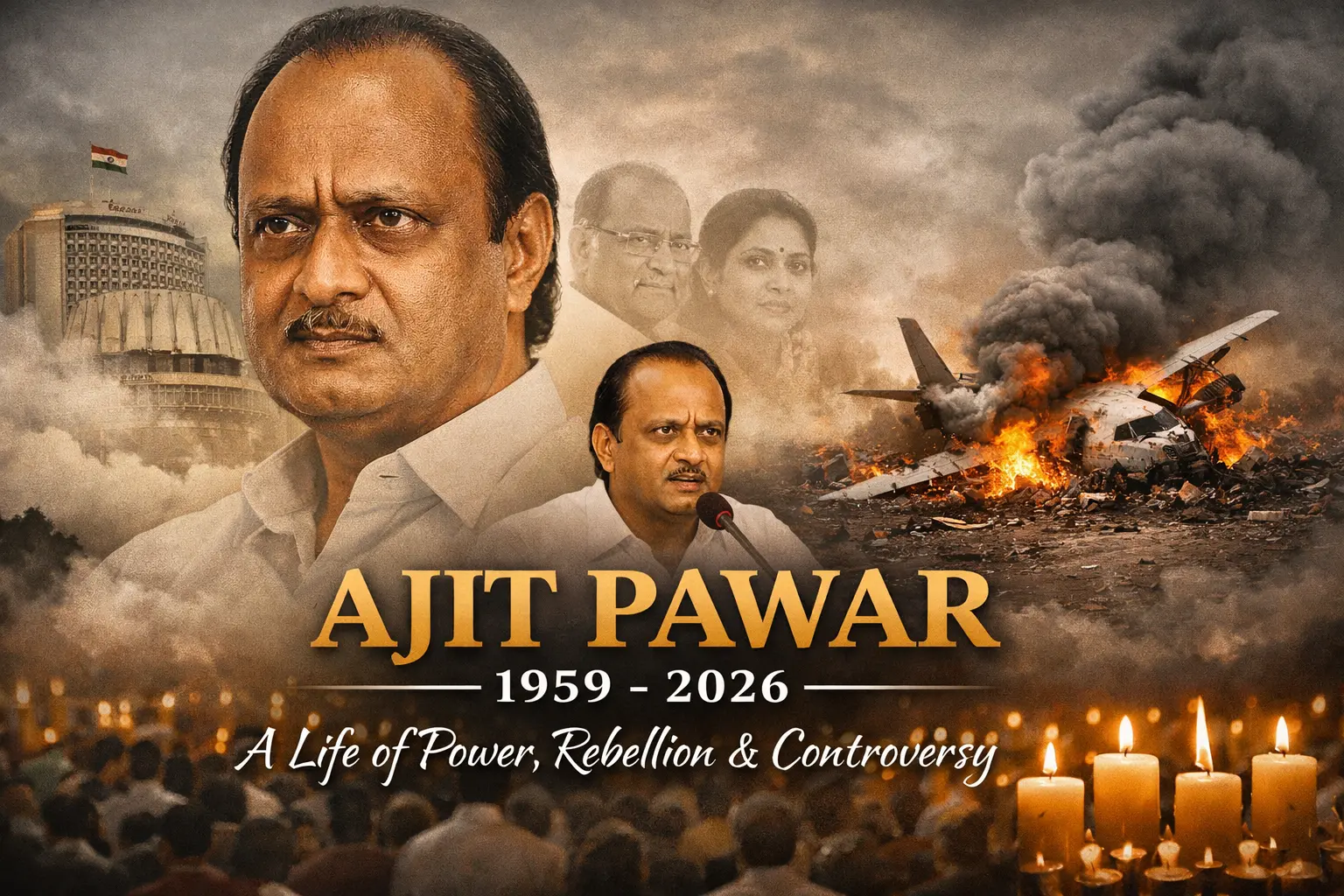
The sudden death of Ajit Pawar in a tragic plane crash on January 28, 2026, has brought an abrupt end to one of Maharashtra’s most dramatic and consequential political careers. Baramati, the constituency that shaped and sustained him for decades, mourns the loss of a leader who won eight consecutive Assembly elections and remained central to the State’s power politics till his final day. His passing has not only created an emotional vacuum in his political stronghold but has also reopened questions about the future of the Nationalist Congress Party (NCP) and the Pawar family’s political legacy.
A life shaped by legacy and ambition
Born into Maharashtra’s most influential political family, Ajit Pawar’s political identity was inseparable from that of his uncle, Sharad Pawar, the towering patriarch of the NCP. From early on, Ajit Pawar learned the mechanics of power, administration, and electoral management under his uncle’s mentorship. Yet, that very association also defined the limitations of his rise. For years, state politics watched a silent but intense tussle within the Pawar family, particularly between Ajit Pawar and Sharad Pawar’s daughter, Supriya Sule, over political inheritance and prominence.
Publicly, the family maintained that responsibilities were clearly demarcated: Ajit Pawar would handle state politics while Supriya Sule would focus on national affairs. Privately, however, the struggle for political space simmered, influencing alliances, decisions, and ultimately, the dramatic split in the NCP in 2023.
The disciplined administrator
Ajit Pawar cultivated an image of a tireless and disciplined administrator. Known to begin his day as early as 6 a.m., he often described himself as part of a “24-hour government.” His work ethic and command over files earned him respect even among political rivals. As Maharashtra’s Finance Minister, he was credited with tight fiscal management and the implementation of welfare schemes such as the Majhi Ladki Bahin Yojana, though critics accused him of diverting funds to sustain political commitments.
Despite his seniority, Ajit Pawar maintained a relatively austere personal life. He was not known for cultivating close friendships outside politics and remained intensely private. His rare moments of personal visibility—such as a viral video of him dancing at his son Jay Pawar’s wedding—were exceptions that only reinforced how little he liked public attention beyond work.
A leader of sharp words and sharper impact
Ajit Pawar’s rustic style, blunt speech, and spontaneous humour made him immensely popular among sections of the electorate, particularly the youth on social media. His remarks frequently went viral, earning him admiration for being unfiltered and relatable. At the same time, the same bluntness often landed him in controversy. An insensitive remark at a farmers’ rally during a severe drought, when dams were dry, drew widespread criticism and showcased the double-edged nature of his communication style.
Record five-time Deputy Chief Minister
Few politicians in India have navigated power transitions as frequently as Ajit Pawar. He held the post of Deputy Chief Minister of Maharashtra a record five times, across ideologically diverse coalitions. His first stint came between 2010 and 2012 with the Congress-NCP government. In November 2019, he briefly aligned with the BJP in a dramatic early-morning swearing-in that lasted barely three days—one of the shortest-lived governments in Indian political history.
That rebellion against Sharad Pawar collapsed within 80 hours, as most MLAs returned to the parent party. Ajit Pawar followed suit, rejoining his uncle and becoming Deputy CM again under the Maha Vikas Aghadi government with the Shiv Sena and Congress. The definitive break came in 2023, when the NCP split vertically and Ajit Pawar, backed by most senior leaders, joined hands with the BJP. After the 2024 elections, he assumed office for the fifth time as Deputy CM alongside BJP leader Devendra Fadnavis and Shiv Sena’s Eknath Shinde.
Though he openly harboured ambitions of becoming Chief Minister, Ajit Pawar remained pragmatic about electoral arithmetic. He acknowledged that circumstances and numbers never fully aligned in his favour, even at the peak of his influence.
Corruption allegations and clean chits
No account of Ajit Pawar’s political life is complete without addressing the controversies that shadowed him. As Water Resources Minister, he faced allegations in the multi-crore Vidarbha irrigation scam, which forced him to resign as Deputy CM in 2012. The BJP mounted aggressive protests, even parading a bullock cart symbolically carrying “evidence” of a ₹70,000-crore scam. Ironically, many of those protest leaders later became his allies. In 2019, the Anti-Corruption Bureau gave Ajit Pawar a clean chit, blunting one of the sharpest attacks against him.
He was also named in the Maharashtra State Co-operative Bank (MSCB) case, involving alleged irregularities in loans to sugar mills—an issue deeply intertwined with Maharashtra’s cooperative politics. In recent years, controversy extended to his family, with allegations against his son Parth Pawar in a Pune land deal, though no final legal conclusions were reached.
Rebellions, setbacks, and personal struggles
Ajit Pawar was widely regarded as a formidable political force in Baramati, Pune, and Pimpri-Chinchwad. While the BJP managed to erode his influence in urban pockets, Baramati remained firmly under Pawar control. Yet, within his own party and family, he often felt sidelined. His emotional speech after the 2023 split—where he publicly spoke of unfair treatment by his uncle—revealed years of bottled-up frustration.
His personal political struggles were equally evident. Efforts to establish his wife, Sunetra Pawar, in direct electoral politics ended in defeat against Supriya Sule, prompting her eventual nomination to the Rajya Sabha. His attempts to launch his son Parth Pawar as a mass leader also failed to gain sustained traction.
An unfinished chapter
Ajit Pawar’s death leaves behind unanswered questions—about the future of the NCP faction he led, the possibility of Pawar family reunification, and the political destiny of Baramati. Fierce, disciplined, controversial, and ambitious, he was a leader shaped as much by struggle as by power.
In the end, Ajit Pawar’s political life stands as a study in Maharashtra’s complex realpolitik: where loyalty and rebellion coexist, ideology bends before power, and personal ambition constantly negotiates with legacy. His story, marked by drama and resilience, will remain integral to understanding the last three decades of the State’s politics.