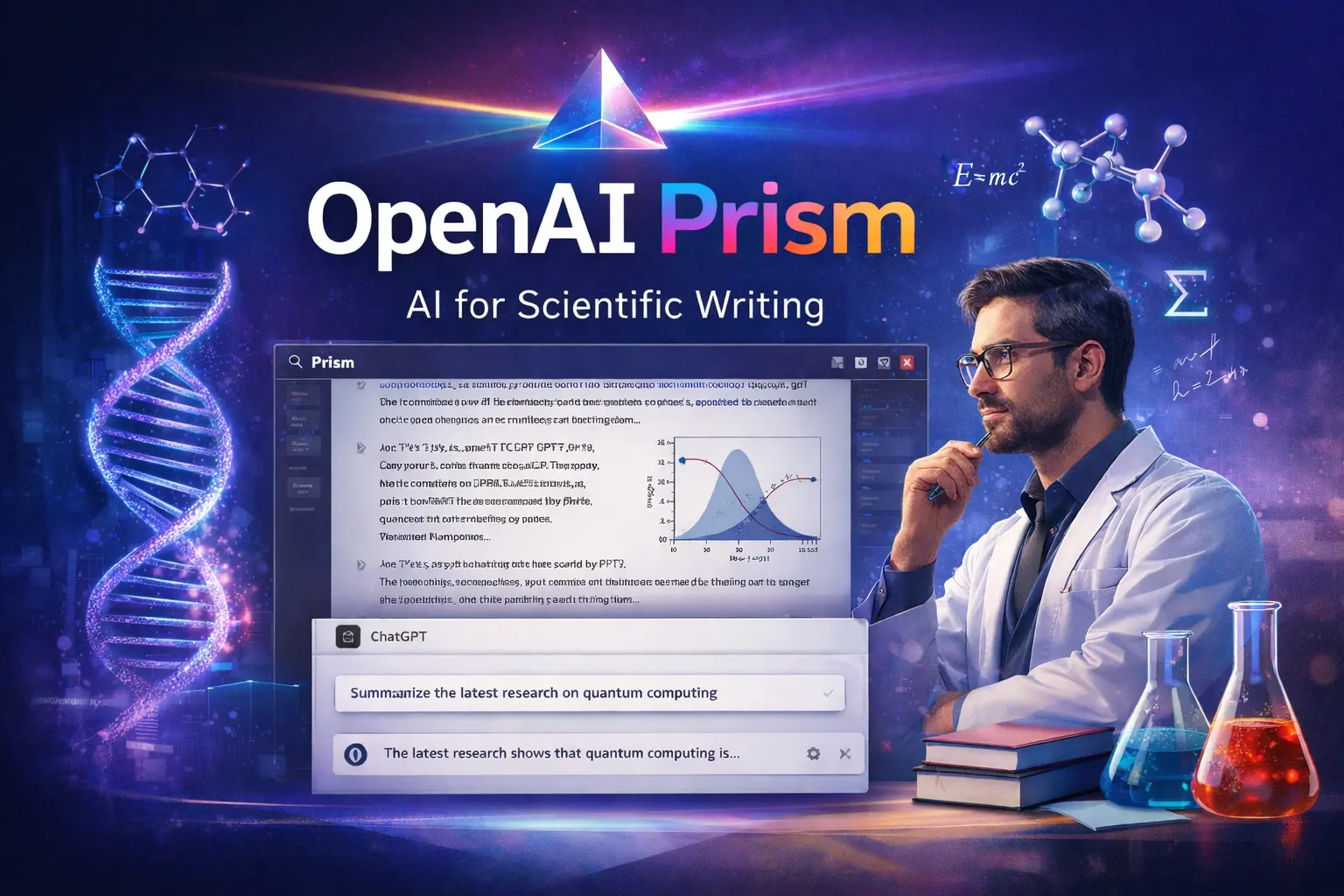
Artificial intelligence is no longer just a tool for coding, chatting, or basic automation. It is steadily embedding itself into the core workflows of researchers and scientists worldwide. OpenAI’s latest product, Prism, marks a significant step in this direction. Designed specifically for scientists, Prism is a ChatGPT-powered text editor that aims to streamline and accelerate the process of writing scientific papers. In simple terms, it brings the concept of “vibe coding” into the world of science.
AI Moves From Assistance to Workflow
Over the past few years, scientists have increasingly turned to large language models (LLMs) for help with research-related tasks. According to OpenAI, more than 1.3 million scientists submit millions of weekly queries to ChatGPT on advanced science and mathematics topics. This shift signals something important: AI is no longer an experimental curiosity for researchers. It is becoming a central part of how scientific work is done.
Prism is OpenAI’s response to this shift in behavior. Instead of requiring scientists to jump between a chatbot and their writing software, Prism places ChatGPT directly inside the document editor. The result is a more seamless and natural interaction between human researchers and AI tools.
What Exactly Is Prism?
Prism is a free, LLM-powered text editor built specifically for scientific writing. It integrates ChatGPT directly into the writing environment, particularly for documents written in LaTeX—a formatting language widely used in academic publishing. At the bottom of the editor screen, a chat interface allows scientists to interact with the AI while simultaneously viewing and editing their manuscript.
This setup mirrors what has already happened in software engineering, where AI copilots are embedded into coding environments. OpenAI believes science is now reaching a similar inflection point.
Kevin Weil, head of OpenAI for Science, has compared the current moment in science to what software development experienced a year earlier. According to him, AI’s role in science will grow rapidly, not through flashy breakthroughs, but through steady, compounding productivity gains.
What Can Scientists Do With Prism?
Prism is designed to assist scientists throughout the writing and thinking process rather than replacing them. Its capabilities include:
- Drafting and refining text: Researchers can ask the AI to help write sections, improve clarity, or polish academic language.
- Summarizing research papers: Prism can quickly digest complex articles and provide concise summaries.
- Citation management: It can help organize references and integrate them smoothly into manuscripts.
- Equation and diagram creation: Scientists can upload photos of handwritten notes or whiteboard sketches and convert them into clean equations or diagrams.
- Idea exploration: Prism can assist in discussing hypotheses, checking logical consistency, or walking through mathematical proofs.
These features make Prism a potential time-saver, particularly for early-stage drafts and routine writing tasks that often consume researchers’ energy.
Powered by GPT-5.2
At the core of Prism is GPT-5.2, OpenAI’s most advanced model for mathematical and scientific reasoning to date. This model is specifically optimized for tasks involving logic, equations, and technical language—areas where earlier AI systems struggled.
Importantly, researchers who already use GPT models have noticed improvements. Some report that hallucinated references, once a common issue, have become far less frequent. Others highlight the model’s ability to catch subtle mathematical errors or inconsistencies in text.
While GPT-5.2 is not positioned as an autonomous “AI scientist,” it is clearly engineered to act as a powerful collaborator.
Real-World Reception From Researchers
Feedback from academics suggests that tools like Prism are already making a difference. Many scientists use AI primarily for coding, but are increasingly finding value in writing and literature review tasks. Quick summarization of papers, language refinement, and error detection are among the most appreciated features.
For statisticians and mathematicians in particular, AI assistance can help identify small but critical issues in equations or explanations—problems that are easy to overlook during long writing sessions.
This growing reliance on AI underscores a key point: the value of Prism lies not in replacing scientific thinking, but in reducing friction in the research process.
Concerns: More Productivity or More “AI Slop”?
Despite the excitement, Prism also raises important questions. Science is already facing concerns about information overload and low-quality, AI-generated content. Critics worry that easier writing tools could flood journals with poorly thought-out papers polished by AI rather than grounded in rigorous research.
There is also the lingering question many researchers ask: if AI is getting so good, where is the fully automated scientist? When will an AI system make a groundbreaking discovery on its own?
OpenAI’s leadership has a measured response to these concerns. While the idea of AI-driven discoveries is appealing, they argue that the real impact of AI will come from thousands of small, incremental contributions. Faster writing, clearer explanations, better error detection, and smoother collaboration can all accelerate scientific progress—even if no single moment feels revolutionary.
Incremental Change With Massive Impact
According to Kevin Weil, the most powerful effect of AI in science will not be one dramatic breakthrough, but a cumulative acceleration of research. Projects that once took years may now take months. Ideas that might have stalled could move forward faster. Collaboration across disciplines may become easier as AI helps bridge gaps in terminology and methodology.
From this perspective, Prism is not about replacing scientists or automating discovery. It is about amplifying human capability and reducing the mundane barriers that slow research down.
A Strategic Move for OpenAI
Prism also represents a strategic move in a competitive AI landscape. With multiple companies offering chatbot-based tools, embedding AI directly into everyday software is a way to lock in long-term users. By positioning Prism as a core research tool, OpenAI is signaling that science is a priority domain for its future development.
As AI-powered office tools become standard across industries, scientific research appears to be next in line for deep integration.
Prism may not deliver an instant scientific revolution, but it represents something equally important: a shift in how science is practiced. By embedding AI directly into the writing and thinking process, OpenAI is helping scientists work faster, think more clearly, and focus more on discovery rather than documentation.
If the past is any indication, the true impact of Prism will not be measured by headlines, but by the countless research papers, ideas, and experiments that move forward just a little faster—with AI quietly working in the background.