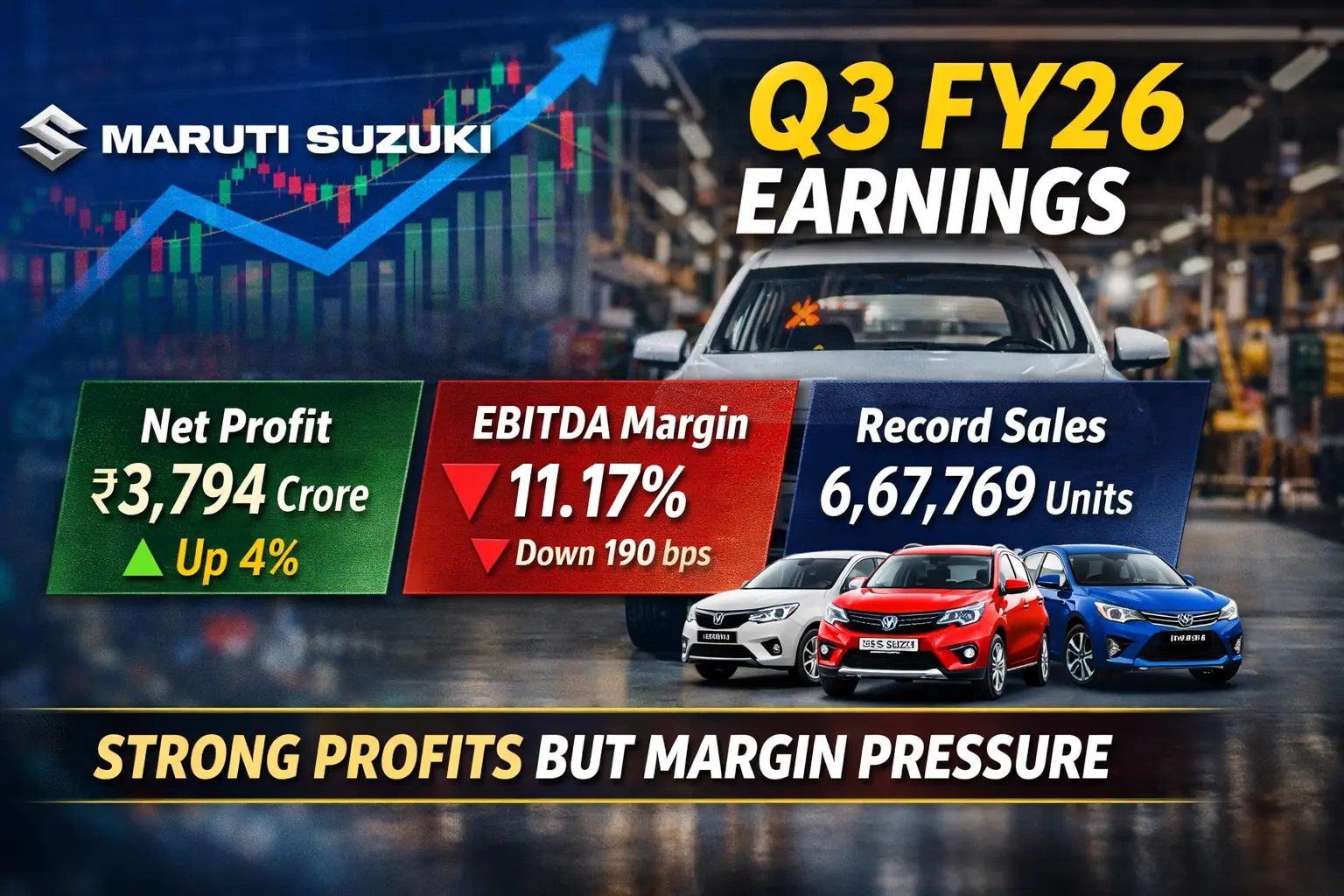
India’s largest passenger vehicle manufacturer, Maruti Suzuki India Limited, reported a mixed set of numbers for the third quarter of the current financial year (Q3FY26). While the company delivered steady growth in profit, strong revenue expansion, and record-breaking sales volumes, pressure on operating margins and a sharp market reaction kept investors cautious.
Here is a detailed, plagiarism-free analysis of Maruti Suzuki’s Q3FY26 performance, key drivers, challenges, and what lies ahead.
Strong Profit Growth Despite Headwinds
Maruti Suzuki reported a net profit of ₹3,794 crore for the October–December quarter, reflecting a nearly 4% year-on-year increase compared to ₹3,659 crore in Q3FY25. The rise in profit came despite higher costs and margin pressures, indicating the company’s ability to scale volumes efficiently.
However, profitability was partially impacted by an exceptional expense of ₹594 crore, incurred due to the implementation of four new labour codes. Excluding this one-time expense, profit growth would have been stronger, highlighting the underlying operational resilience of the company.
Revenue Surges on Robust Demand
The standout feature of Maruti Suzuki’s Q3 performance was its sharp rise in revenue. Total revenue from operations jumped 29% year-on-year to ₹49,891 crore, up from ₹38,752 crore in the same quarter last year.
This significant growth was driven by:
- Higher domestic vehicle sales
- Improved product mix
- Stable export performance
- Strong demand recovery in the Indian car market
The festive season, improving consumer sentiment, and policy-led demand recovery contributed meaningfully to higher dispatches.
EBITDA Growth but Margin Compression
Maruti Suzuki’s EBITDA (operating profit) rose 10% year-on-year to ₹5,572 crore, reflecting higher volumes and better capacity utilization. However, the company faced margin pressure, with EBITDA margin contracting by 190 basis points to 11.17%.
Reasons for Margin Contraction:
- Rising input and commodity costs
- Higher employee-related expenses
- Impact of labour code implementation
- Increased promotional and distribution expenses
While EBITDA growth remained positive, the pace lagged revenue growth, resulting in lower operating margins.
Record-Breaking Domestic and Total Sales
Maruti Suzuki achieved its highest-ever quarterly domestic sales, underlining its dominant position in the Indian passenger vehicle market.
Key Sales Highlights:
- Domestic sales: 5,64,669 units in Q3FY26
- Q3FY25 domestic sales: 4,66,993 units
- Increase: 97,676 units year-on-year
A major portion of this growth came from the small car segment, especially vehicles falling under the 18% GST bracket, which accounted for 68,328 units of the incremental volume.
The company also recorded total sales of 667,769 units, including exports of 103,100 units. This compares with 566,213 units in Q3FY25, demonstrating healthy growth across both domestic and overseas markets.
GST Reform Boosts Small Car Demand
Maruti Suzuki credited the GST reform-led recovery for the sharp rebound in the Indian car market, particularly in the entry-level and small car categories. Lower tax incidence and improved affordability encouraged first-time buyers and price-sensitive consumers to return to the market.
As a brand with a strong presence in compact and affordable vehicles, Maruti Suzuki benefited significantly from this trend, reinforcing its leadership in the mass-market segment.
Nine-Month Performance Shows Consistent Growth
For the first nine months of FY26, Maruti Suzuki delivered consistent growth across key metrics.
April–December FY26 Performance:
- Total sales: 17,46,504 units
- FY25 (same period): 16,29,631 units
- Net sales: ₹1,24,291 crore
- FY25 net sales: ₹1,06,259 crore
The steady rise in volumes and revenue over nine months indicates sustained demand momentum and effective execution of the company’s sales and production strategy.
Stock Market Reaction: Shares Slide Over 5%
Despite strong top-line growth and record sales volumes, Maruti Suzuki’s stock reacted negatively to the Q3 results. Shares fell as much as 5.3% intraday, hitting a low of ₹14,431.
Key Investor Concerns:
- Margin contraction despite revenue growth
- Rising cost pressures
- Impact of labour-related expenses
- Valuation concerns after previous rallies
The selloff suggests that while fundamentals remain strong, markets are closely tracking profitability trends and cost control measures.
Outlook: Balancing Growth and Profitability
Looking ahead, Maruti Suzuki’s outlook remains cautiously optimistic. Demand in the small and mid-sized car segments is expected to stay firm, supported by improving rural demand, stable fuel prices, and policy support.
However, key challenges include:
- Sustained pressure on margins due to costs
- Need for operational efficiency improvements
- Managing regulatory and compliance-related expenses
- Maintaining export competitiveness
If cost pressures ease and operating leverage improves, margins could stabilize in coming quarters.
Maruti Suzuki’s Q3FY26 performance reflects a company growing strongly in volumes and revenue while navigating cost and margin challenges. Record domestic sales, robust revenue growth, and steady profit expansion underline the company’s market leadership. However, margin compression and investor concerns tempered market sentiment in the short term.
Overall, Maruti Suzuki remains well-positioned to benefit from India’s passenger vehicle growth story, provided it successfully balances scale with profitability in the quarters ahead.