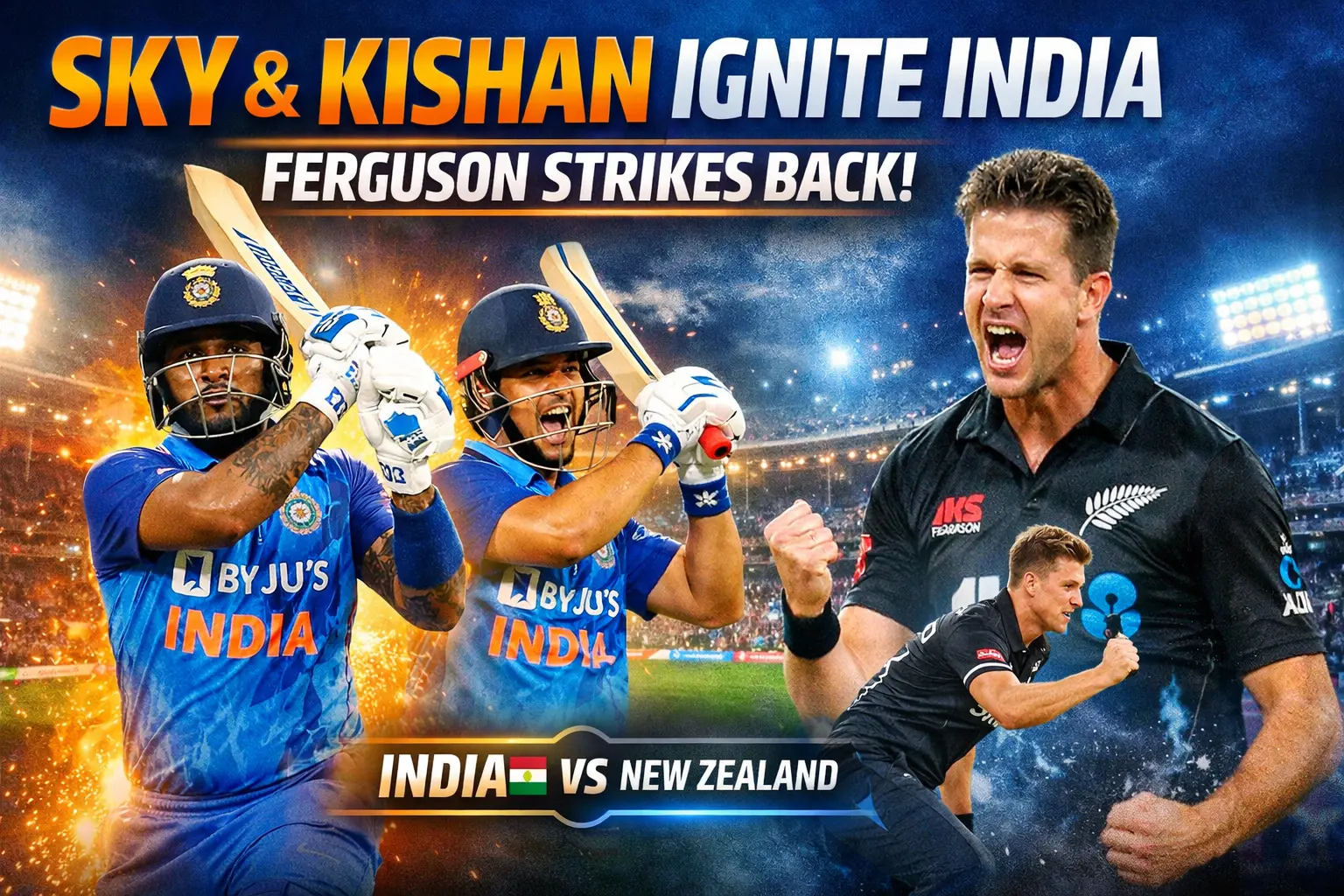
India’s final T20I before the World Cup was never going to be just another bilateral fixture. Played under lights in front of a packed house at Thiruvananthapuram, the match became a sharp, revealing rehearsal—one that showcased India’s batting depth, New Zealand’s pace threat, and a few unresolved questions heading into the global tournament.
A deliberate toss decision with World Cup implications
After winning the toss, India chose to bat against New Zealand—a decision rooted in strategy rather than conditions. With dew expected later in the evening, captain Suryakumar Yadav wanted his bowlers to experience the pressure of defending a total. With the series already sealed, India could afford to experiment with match situations that mirror World Cup knockouts.
Both sides shuffled their line-ups. India recalled Ishan Kishan, Axar Patel and Varun Chakravarthy, signalling a return to something close to their first-choice XI. New Zealand, meanwhile, brought back experienced firepower in Lockie Ferguson and Kyle Jamieson, while Finn Allen returned to international duty after a prolific Big Bash League season.
Abhishek Sharma sets the tempo
The innings began with controlled aggression from Abhishek Sharma, who once again underlined why timing can be as destructive as brute force. He punished anything fractionally off length, using subtle footwork and sharp field awareness to pick boundaries without over-hitting. A six and two fours in the opening over immediately put the New Zealand bowlers on the defensive.
Abhishek’s philosophy—focusing on timing rather than range-hitting—was evident as he raced to 30 from just 16 balls. However, his attacking intent also brought risk. Against high pace from Ferguson, he stepped out, lost his shape, and paid the price as his stumps were rattled. India were 48 for 2 after five overs, momentum checked but not broken.
Sanju Samson’s struggles continue
If Abhishek’s dismissal was about calculated risk, Sanju Samson’s wicket was about a lingering technical concern. Once again, New Zealand targeted his tendency to sit deep in the crease with a closed bat face. Ferguson drew him into an ambitious whip against away swing, and the edge carried safely to deep third.
Samson’s 6 off 6 summed up a difficult series. With the World Cup looming, the pressure is mounting. India made a late pivot to him in the squad after Shubman Gill’s lean run, but consistency at No. 2 remains a talking point.
Ferguson: pace, precision, pedigree
For New Zealand, the standout early figure was Lockie Ferguson, playing his first international since November 2024. Bowling consistently at around 145 kph, he mixed hard lengths with well-disguised slower balls. His figures—2 for 13 in two overs—were a reminder of why he boasts the best average among full-member fast bowlers with 50 or more T20I wickets.
Ferguson’s spell did more than take wickets; it disrupted rhythm. Even when batters connected, they were often hurried, mistiming strokes rather than dominating the bowler.
SKY and Kishan seize control
Just when New Zealand sensed a chokehold, the middle overs swung dramatically in India’s favour. Mitchell Santner began economically, conceding only five in his first over. What followed was a masterclass in counter-attack.
Suryakumar Yadav stepped out and chipped Santner straight down the ground for six, immediately unsettling the left-arm spinner’s length. Ishan Kishan then took over. A lofted drive over covers against a loopy delivery, followed by a lightning-quick slog-sweep from his back knee, showed both skill and confidence.
Santner’s second over disappeared for 20 runs. In a format where spinners are often used to control the middle phase, India instead turned it into a launchpad. At the halfway mark, India stood at 102 for 2—perfectly placed for a late surge.
Kishan vs pace: calculated brutality
New Zealand attempted to claw back momentum with variations. Ferguson returned with slower balls, but Kishan read them early, launching one over the off side for six and carving another for four. What stood out was not just power, but clarity of intent. Kishan committed early to his shots, trusting his bat swing and balance.
This phase illustrated why Kishan remains such a valuable asset in T20 cricket. Against both spin and pace, he demonstrated range without recklessness, keeping the scoreboard moving even when bowlers executed decent plans.
Bigger picture: selection calls and balance
Beyond the runs and wickets, this match functioned as a diagnostic test. India’s batting depth looks formidable, particularly if the top order provides brisk starts. However, the Samson question lingers, and team management must soon decide whether to persist or pivot.
For New Zealand, the return of Ferguson and Jamieson strengthens a pace attack that could be genuinely threatening on Australian surfaces. Finn Allen’s reintegration after his BBL heroics adds intrigue to their opening combination.
A rehearsal with clear takeaways
As India head into the World Cup, this innings reinforced a few truths. Aggression need not be reckless, spinners cannot relax in the middle overs, and pace—when combined with intelligence—remains the most reliable wicket-taking weapon in T20 cricket.
For fans at Thiruvananthapuram, it was entertainment. For the teams, it was information. And in tournaments decided by fine margins, information can be as valuable as form.