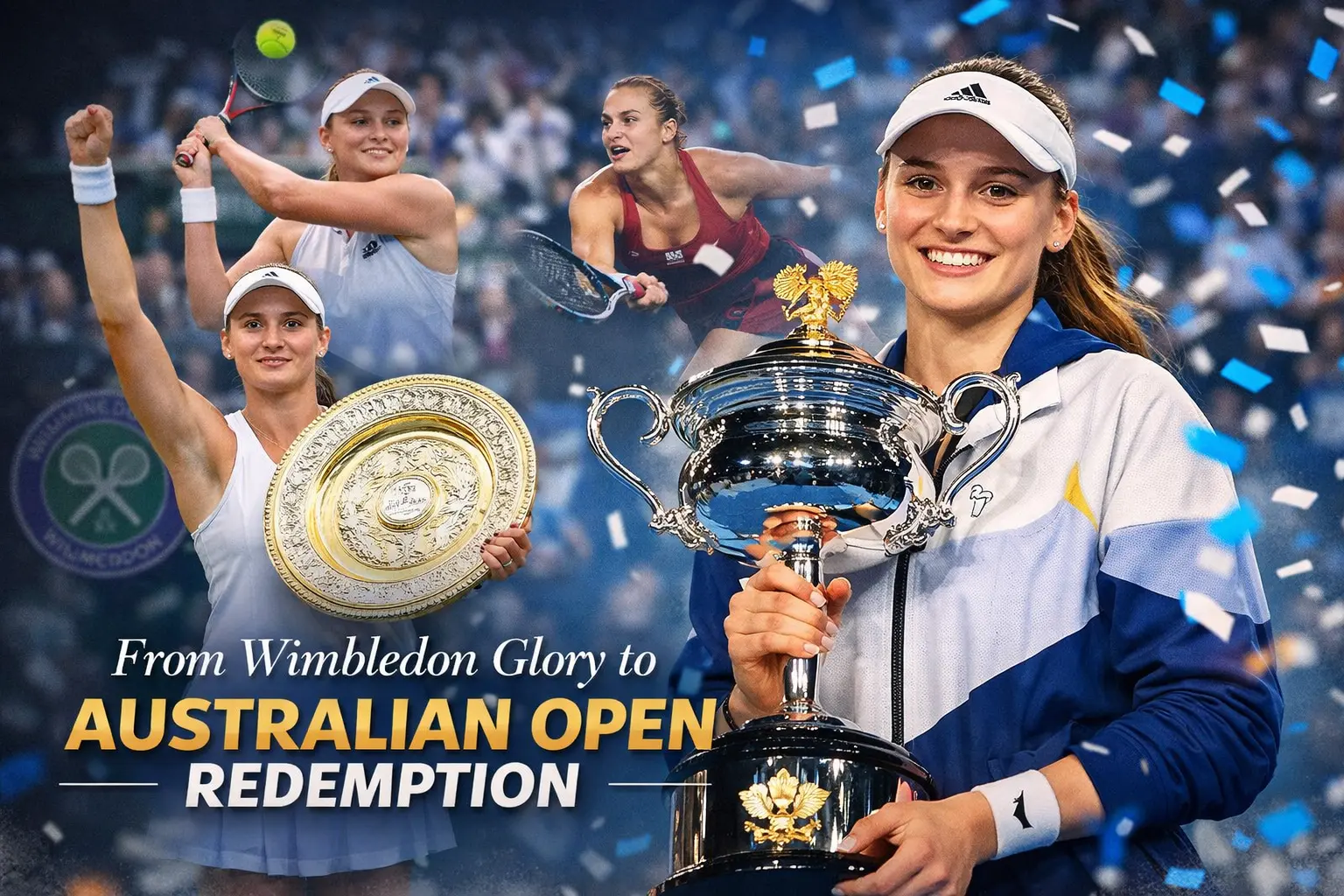
Nearly four years after her calm, understated celebration on Centre Court at Wimbledon, Elena Rybakina has completed one of the most compelling comeback arcs in modern women’s tennis. Her Australian Open triumph was not just another Grand Slam title—it was a statement of resilience, belief, and unfinished potential finally realized.
When Rybakina lifted the Wimbledon trophy in 2022, she did so with a shy smile and a modest raise of her right arm. She even joked that perhaps one day fans might see a “huge reaction” from her. That day did not arrive in Melbourne either. After sealing the Australian Open title years later, her celebration was again restrained: a clenched fist, a brief shake of the head, and a visible release of disbelief. But beneath that minimal emotion lay a monumental achievement—proof that her Wimbledon victory was not a one-off, but the foundation of an elite career.
A Slam That Took Four Years to Complete
Rybakina’s second Grand Slam title came after navigating a path far tougher than the trophy ceremony suggested. Since her Wimbledon breakthrough, the women’s game has been largely dominated by Aryna Sabalenka and Iga Swiatek, who together claimed the majority of major titles in the years that followed. For Rybakina, this era was defined by flashes of brilliance mixed with injury setbacks, form dips, and lingering doubts.
In Melbourne, however, she dismantled that hierarchy—at least for one unforgettable fortnight. Her final victory over Sabalenka in three sets was a test of nerve, power, and tactical discipline. Along the way, she also defeated Swiatek and sixth seed Jessica Pegula, making her run one of the most demanding Australian Open title paths in recent history.
Her own words revealed how fragile belief can become at the elite level. There were moments when she wondered whether she would ever return to a Grand Slam final, let alone lift another trophy. The difference this time was trust—in her team, her preparation, and her ability to rise again when confidence wavered.
Numbers That Redefine Her Status
The statistics behind Rybakina’s resurgence are striking. The Australian Open title pushed her back to world number three, matching the career-high ranking she last held in late 2024. More impressively, she has now won ten consecutive matches against top-10 opponents—a run that underscores her ability to perform against the very best.
She also became the first player since 2019 to win the Melbourne title by defeating top-10 players in every round from the quarter-finals onward. Even more remarkable is her long-term record against reigning world number ones: since official WTA rankings began in 1975, no player with at least ten such matches owns a higher winning percentage than Rybakina’s 60%.
These figures are not statistical quirks; they reflect a player whose game is uniquely suited to dismantling elite opposition.
Why Rybakina Is So Difficult to Stop
Former British player Annabel Croft summed it up perfectly when she described Rybakina as “untouchable” when fully fit and firing. Her ball-striking is among the cleanest on tour—flat, deep, and devastatingly accurate. The sound of the ball leaving her racket has become a signature in itself.
At the center of this dominance is her serve, widely regarded as the best in women’s tennis. It combines height-assisted power with pinpoint placement, giving her countless free points and immediate control of rallies. On faster courts, especially grass and hard surfaces, this weapon turns matches into uphill battles for even the most accomplished returners.
A Late Start That Defied Convention
Unlike many top professionals, Rybakina did not commit fully to tennis at an early age. As a child, she excelled in gymnastics and ice skating but was told her height would ultimately limit her prospects in those sports. Tennis, ironically, became the discipline where that same height transformed into an advantage.
Born in Moscow, she began focusing seriously on tennis only at 17. In 2018, she made the pivotal decision to represent Kazakhstan after receiving financial and developmental support from the nation’s tennis federation. That backing proved transformative. Within a year, she won her first WTA title in Bucharest and followed it with an astonishing run of four finals in her first five tournaments of 2020.
Setbacks, Silence, and Survival
Despite early momentum, consistency at Grand Slam level took time. After a quarter-final appearance at the French Open in 2021, she did not reach another major quarter-final until her Wimbledon title run in 2022. A dramatic loss to Sabalenka in the 2023 Australian Open final lingered as a reminder of how narrow the margins at the top truly are.
Her 2025 season began amid turbulence when her coach, Stefano Vukov, was temporarily banned for breaching the WTA Code of Conduct. Though later reinstated, the episode disrupted her early momentum. Instead of derailing her, it appeared to sharpen her focus.
Since the end of Wimbledon last year, no player has recorded more wins than Rybakina. With 38 victories and just one loss in her last 21 matches, she has emerged as the most consistent performer on the women’s tour.
What Comes Next?
Former Wimbledon champion Pat Cash believes the All England Club remains an obvious target. Grass amplifies everything Rybakina does well—serve, flat groundstrokes, and controlled aggression. The prospect of winning multiple Grand Slams in a single season now feels realistic rather than speculative.
Staying healthy will be crucial. So will sustaining motivation in a sport that demands constant travel and mental endurance. Yet if Melbourne proved anything, it is that Rybakina has crossed a psychological threshold. She no longer plays as a former champion chasing her past—she competes as a present force shaping the future.
A Champion Comfortable in Her Own Way
Elena Rybakina may never deliver the fist-pumping theatrics or roaring celebrations fans often associate with Grand Slam winners. But her silence speaks volumes. Four years after Wimbledon, her Australian Open victory confirms what many suspected all along: when she is confident, composed, and physically sound, she belongs at the very summit of women’s tennis—and she may only just be getting started.