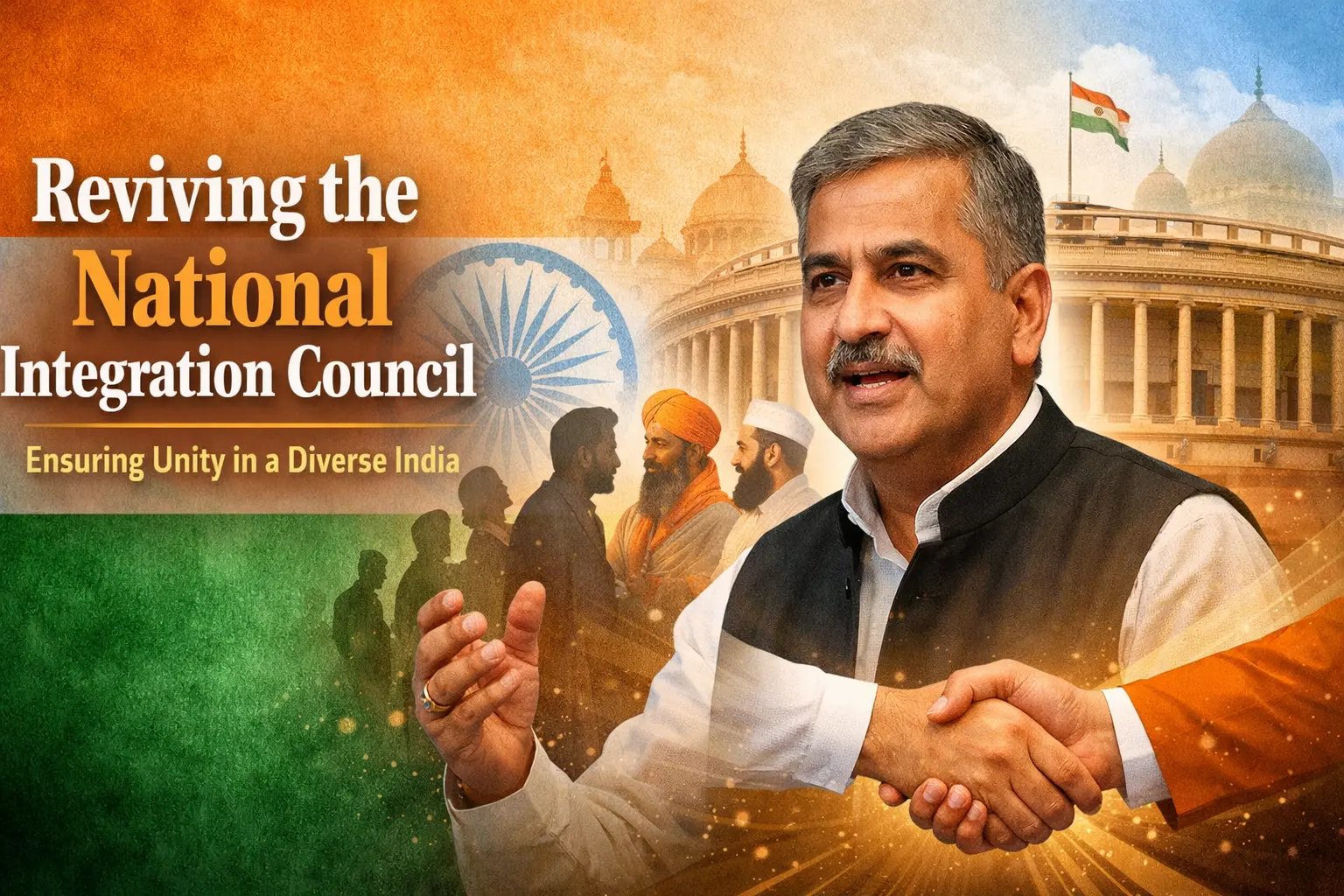
India’s democratic strength has always rested on its ability to accommodate diversity through dialogue. Yet, in recent years, concerns over social cohesion, communal harmony, and institutional silence have grown sharper. Against this backdrop, Rajya Sabha MP Javed Ali Khan has raised a pointed demand during Zero Hour in the Rajya Sabha: revive the National Integration Council (NIC), a forum that has remained dormant for over a decade.
This demand is not merely procedural; it speaks to deeper anxieties about the erosion of India’s social fabric and the diminishing space for structured dialogue between communities and political stakeholders.
What Is the National Integration Council and Why Does It Matter?
The National Integration Council was constituted in 1961 with a clear moral and political mandate: to reaffirm the principles that define India’s national life—common citizenship, secularism, religious freedom, fraternity, and social and economic justice. It was envisioned as a high-level advisory body bringing together political leaders, social thinkers, and representatives from across the ideological spectrum.
Importantly, the NIC was never meant to be a constitutional or legally binding institution. Its power lay elsewhere: in conversation, consensus-building, and conflict management through dialogue. At moments of national stress, the Council functioned as a platform where competing viewpoints could confront each other across the table rather than on the streets.
The fact that the NIC has not met since 2013 raises a critical question: can a diverse democracy afford to let such forums wither away?
Why the Demand for Revival Now?
According to Javed Ali Khan, the urgency stems from the visible strain on India’s social harmony. He argues that since 2014, the Council has been ignored altogether, even as incidents of communal polarisation and caste-based tensions have increased.
Statements attributed to political leaders, discriminatory rhetoric, and public controversies over issues like equity guidelines in higher education have intensified mistrust among communities. Khan points out that when elected representatives themselves make remarks that appear exclusionary, it sends a powerful—and damaging—signal to society at large.
For instance, controversial public comments allegedly made by Assam Chief Minister Himanta Biswa Sarma and other leaders have sparked national debate on whether political discourse is drifting away from constitutional values. In such a climate, Khan argues, the absence of an institutional forum like the NIC leaves a vacuum where dialogue should exist.
The Role the Council Can Play Today
No one, including Khan, claims that reviving the National Integration Council would be a magic solution. The Council cannot enforce decisions or override executive authority. However, its value lies in offering a roadmap—an agreed framework for engagement.
At a time when debates are often reduced to television soundbites or social media outrage, the NIC could:
- Provide a structured space for leaders across parties and ideologies to engage constructively
- Help defuse tensions by encouraging conversation rather than confrontation
- Reassert constitutional values in the national discourse
- Signal that the state takes social harmony seriously, not just rhetorically but institutionally
In democracies, dialogue is not a weakness; it is a governing tool. The NIC embodies this principle.
Lessons from the Past: What the NIC Achieved Earlier
Historically, the National Integration Council has played a quiet yet meaningful role during some of India’s most turbulent periods. During the 1990s, when tensions around the Babri Masjid-Ram Janmabhoomi issue were at their peak, the Council facilitated consultations among political and social leaders.
While it could not prevent conflict entirely, it succeeded in creating channels of communication. Participants could air grievances, critique each other’s positions, and still remain within the framework of democratic engagement. That, in itself, is a significant achievement.
The NIC’s past demonstrates that even non-binding forums can influence political behaviour by shaping norms, expectations, and shared understandings.
Zero Hour and the Silence of the Government
Javed Ali Khan’s demand was raised during Zero Hour, a parliamentary mechanism meant precisely for urgent public issues. According to him, several Opposition MPs supported the call, recognising the relevance of the NIC in the current climate.
What stood out, however, was the lack of response from the government. Khan contrasts this with his early years in Parliament, when ministers would at least acknowledge concerns raised during Zero Hour and offer assurances of consideration.
This silence, critics argue, reflects a broader trend: a shrinking space for parliamentary dialogue itself. When forums within Parliament and outside it fall silent, democratic engagement risks becoming one-sided.
Why Revival Is About More Than One Council
The debate over the National Integration Council is ultimately about the kind of democracy India aspires to be. Institutions like the NIC do not merely manage crises; they express intent. Reviving the Council would signal that the government values conversation over polarisation and inclusion over exclusion.
Conversely, allowing such bodies to remain defunct can deepen perceptions that dissenting voices and minority concerns are being sidelined. In a plural society, perception matters almost as much as policy.
Dialogue as Democratic Infrastructure
India’s Constitution envisions unity not as uniformity, but as a negotiated balance among differences. The National Integration Council was one of the instruments designed to sustain that balance. Javed Ali Khan’s demand to revive it is less about nostalgia and more about necessity.
In times of social strain, dialogue is not optional—it is infrastructure. Whether or not the government chooses to act on this demand will indicate how it views the role of conversation, consensus, and institutions in preserving India’s social fabric.
Reviving the National Integration Council may not solve every problem, but it could reopen a door that democracy cannot afford to keep closed.