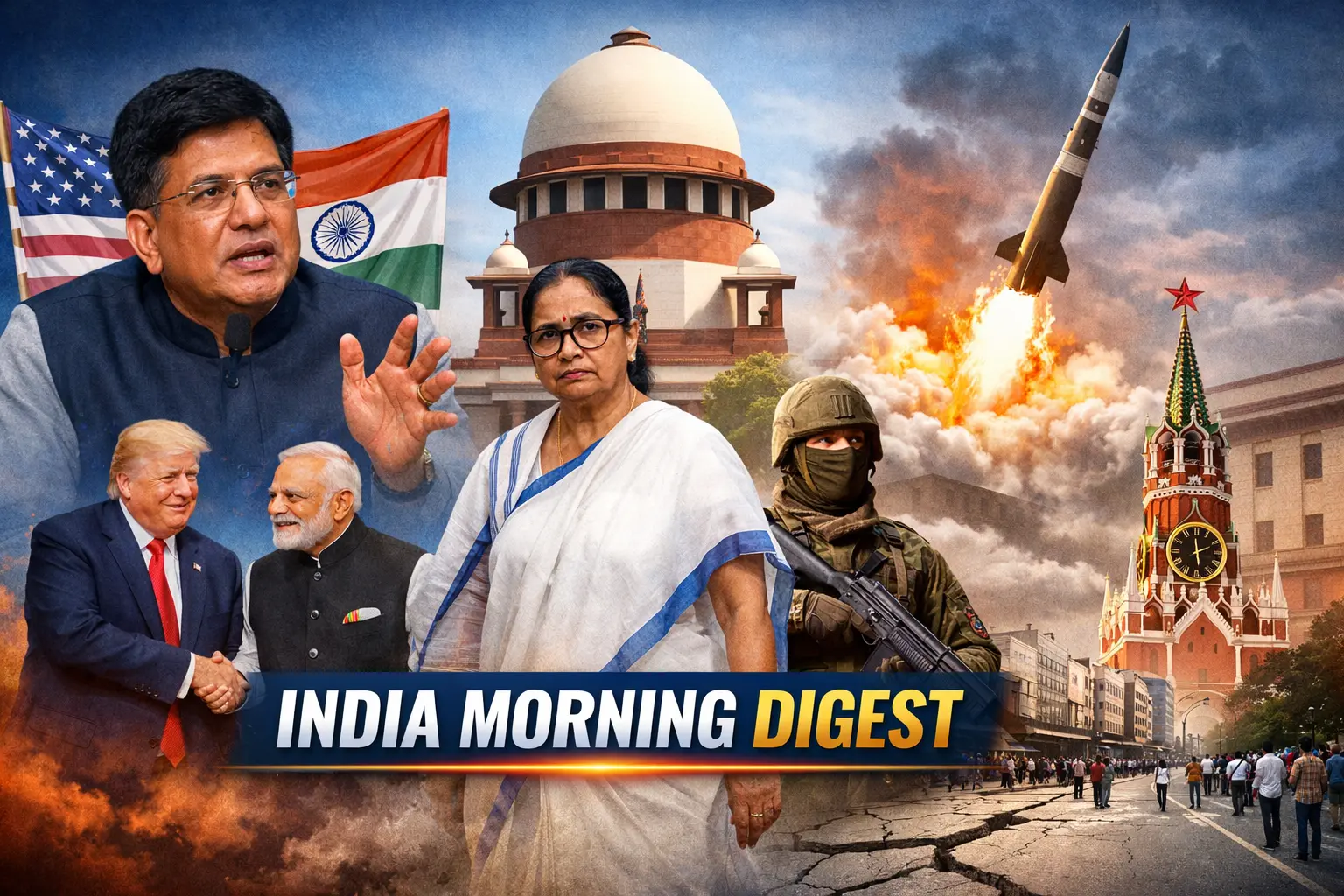
India Morning Digest: Trade Deal Politics, Supreme Court Showdowns & Strategic Breakthroughs
India woke up to a politically charged, legally intense, and strategically significant news cycle, reflecting the many pressures shaping the country’s governance, economy, and global posture. From the contours of the India–U.S. trade deal and sharp parliamentary confrontations to defence milestones and international crises, the day’s developments underline a period of heightened transition.
India–U.S. Trade Deal: Assurances, Skepticism, and Political Fire
Commerce and Industry Minister Piyush Goyal sought to reassure domestic stakeholders by stating that the newly announced India–U.S. trade deal would exclude sensitive agricultural items and dairy products. According to him, the agreement—revealed publicly after posts by U.S. President Donald Trump and Prime Minister Narendra Modi—was structured to protect Indian farmers while strengthening India’s competitive position globally.
However, the absence of detailed disclosures has fueled opposition criticism. Leader of the Opposition Rahul Gandhi accused the government of “surrendering” farmers’ interests, alleging that the Prime Minister was under external pressure. His remarks triggered sharp reactions in Parliament, intensifying an already volatile session.
Even within the ruling alliance, questions emerged. The Telugu Desam Party (TDP), an NDA ally, sought clarity on whether the U.S. had indeed rolled back the punitive 25% duty, noting that Washington’s statements spoke only of reciprocal tariff adjustments. In the Rajya Sabha, Opposition parties staged a walkout, protesting the government’s reluctance to share full details.
Parliament in Turmoil: Suspensions and Stand-offs
Tensions peaked in the Lok Sabha when repeated disruptions over Rahul Gandhi being denied an opportunity to speak led to the suspension of eight Opposition MPs—seven from the Congress and one from the CPI(M)—for the remainder of the Budget session. The protests were linked to demands for discussion on references to former Army chief Manoj Naravane in an unpublished memoir.
The episode highlighted a broader crisis of parliamentary functioning, with both sides accusing each other of undermining democratic norms.
Supreme Court Spotlight: West Bengal SIR Case
Legal attention turned to the Supreme Court as West Bengal Chief Minister Mamata Banerjee indicated she may appear in person before a Bench headed by Chief Justice Surya Kant. The hearing concerns challenges to the Special Intensive Revision (SIR) of electoral rolls in West Bengal, with petitioners alleging mass exclusion of voters and constitutional violations.
In a separate but equally sensitive matter, the Centre defended its decision to shift climate activist Sonam Wangchuk under the National Security Act, asserting before the court that due process and fair treatment had been maintained.
Political Reset in Manipur
In the conflict-scarred northeastern State of Manipur, the BJP elected Yumnam Khemchand Singh as its Legislature Party Leader, paving the way for his appointment as Chief Minister. Significantly, Nemcha Kipgen is expected to become Deputy Chief Minister—the first woman and first Kuki-Zo leader to hold the post. The move is being viewed as an attempt to restore political balance amid ethnic tensions involving Meitei, Kuki-Zo, and Naga communities.
Strategic Leap: DRDO’s SFDR Breakthrough
India marked a major defence milestone as the Defence Research and Development Organisation successfully demonstrated Solid Fuel Ducted Ramjet (SFDR) technology off the Odisha coast. With this test, India joined an elite group of nations capable of developing advanced long-range air-to-air missiles, significantly boosting the Indian Air Force’s combat edge.
Security, Society, and Natural Events
In Kashmir, authorities closed Srinagar’s historic Jama Masjid during Shab-e-Barat prayers, placing cleric Mirwaiz Umar Farooq under house arrest—prompting criticism from religious bodies.
Meanwhile, tremors from a magnitude-6 earthquake in Myanmar were felt across Kolkata and parts of eastern India, briefly alarming residents but causing no immediate reports of major damage.
On the social front, new government data revealed that 84.5% of profiled waste-pickers belong to SC, ST, and OBC communities, underscoring persistent caste inequities in informal urban labour.
International Developments: A Tense World
Beyond India, coordinated attacks by the Balochistan Liberation Army in Pakistan’s Balochistan province raised regional security concerns. In West Asia, women returning to Gaza described alleged mistreatment at Israeli checkpoints, while Iran’s President Masoud Pezeshkian signaled openness to renewed negotiations with the U.S.
Adding to global unease, the Kremlin warned of a “dangerous” phase ahead as the New START nuclear treaty between the U.S. and Russia approaches expiry.
Today’s developments capture a moment where domestic politics, judicial scrutiny, defence capability, and global uncertainty intersect. As India navigates trade negotiations, institutional challenges, and regional instability, transparency and dialogue—both at home and abroad—will be critical in shaping public trust and strategic outcomes in the months ahead.