Let’s be honest for a second. For most football fans alive today, Cristiano Ronaldo has never not existed.
Before we understood tactics. Before we knew what a low block was. Before we chose our first club or argued about formations on social media. Ronaldo was already scoring, already celebrating, already standing in front of cameras with an unmistakable aura that said, I belong here. He has been as constant as the Champions League anthem or YouTube itself. And now, suddenly, the football world is being told that the end is near.
Ronaldo has confirmed that the 2026 FIFA World Cup will likely be his final act on the global stage. By then, he will be 41. After nearly 25 years at the very top, close to 1,000 career goals, and a complete redefinition of what “longevity” means in elite sport, that announcement has hit millennials hard. But what about Gen Z? In a football ecosystem dominated by Lamine Yamal compilations, Kylian Mbappé pace edits, and Erling Haaland goal montages, where does a 40-year-old Ronaldo actually stand?
Surprisingly high.
Do Gen Z actually like Cristiano Ronaldo?
The short answer is yes—but not always in the way older generations expect.
For Gen Z, Ronaldo represents far more than a club legend or a Ballon d’Or winner. He is a global digital icon, a symbol of extreme discipline, and an aspirational brand. This generation doesn’t only support teams; it supports people, personalities, mindsets, and narratives. Footballers are not just athletes anymore—they are characters in a constantly updating online story.
Ronaldo fits that world perfectly. He isn’t just a footballer; he is a walking algorithm.
The biggest footballer on the internet
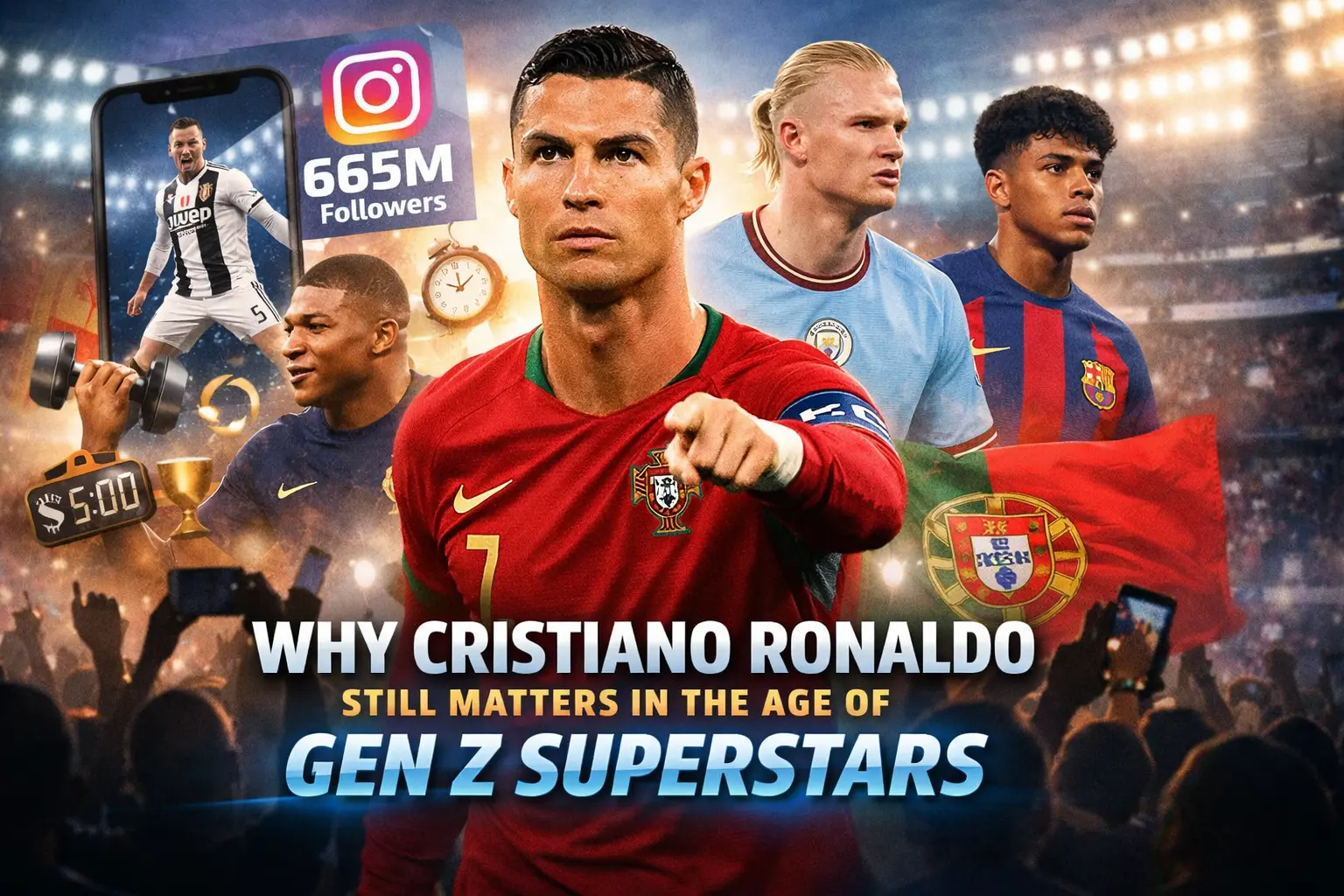
Cristiano Ronaldo is the most followed footballer on Instagram—and not just by a small margin. With over 665 million followers, he has a larger digital presence than any club, league, or national team in world football. In fact, he outpaces most global celebrities, including musicians, actors, and reality-TV icons.
For Gen Z, that matters. Online relevance is cultural relevance.
Ronaldo mastered the internet era before most athletes even understood its power. His content doesn’t rely on viral luck; it’s consistent, controlled, and brand-perfect. Training clips, recovery routines, family moments, and iconic celebrations all reinforce the same message: excellence is a lifestyle.
This is why younger fans often follow Ronaldo from club to club rather than attaching their loyalty to a single badge. It’s player-first fandom, and Ronaldo helped pioneer it.
Ronaldo as the ultimate “mentality” icon
If there is one word Gen Z consistently associates with Ronaldo, it is discipline.
We’ve all seen the clips:
- 5 a.m. gym sessions
- Ice baths and recovery routines
- No shortcuts
- No excuses
In an era full of stories about wasted talent and unfulfilled potential, Ronaldo represents the opposite. He is living proof that obsession, when paired with structure, works. Even as his raw pace and explosiveness have naturally declined with age, his mindset still feels untouchable.
And Gen Z loves mindset culture.
“Main character energy,” self-optimization, discipline arcs—these ideas dominate social platforms. Ronaldo isn’t pretending to fit into that trend; he created a real-world version of it long before it became fashionable.
For many young fans, he was the first footballer they followed actively:
- Searching his highlights on YouTube
- Copying his celebration in school playgrounds
- Arguing about him in comment sections
- Defending him online as if it were personal
That emotional investment doesn’t disappear just because time moves on.
From footballer to viral content
Somewhere along the way, Cristiano Ronaldo became more than an athlete. He became content.
The “Siuuu” celebration is no longer just a goal reaction—it’s a meme, a sound, a cultural reference. It exists independently of football now, used in gaming streams, reaction videos, and social-media edits.
Creators like IShowSpeed didn’t just amplify Ronaldo’s relevance; they reframed it for a younger audience. Through streams, memes, and chaotic fandom, Ronaldo was reintroduced to Gen Z not as a distant legend but as a living internet character.
And then there’s the Messi vs Ronaldo debate.
At this point, it’s less about football and more about identity. It’s football’s version of console wars—PlayStation vs Xbox, Android vs iPhone. Logic doesn’t end it, trophies don’t end it, and time won’t either. As long as football exists online, that debate will too.
Competing on a different level
Here’s the key point: Cristiano Ronaldo is no longer competing directly with Yamal, Mbappé, or Haaland on the pitch.
He doesn’t need to.
Those players are fighting for dominance in the present and future of football performance. Ronaldo is operating on a different plane entirely—legacy, influence, and mentality. In recent interviews ahead of 2026, he has consistently urged younger players to focus less on raw talent and more on discipline, mental resilience, and coping with pressure.
That message resonates strongly with Gen Z, a generation growing up under constant digital scrutiny and expectation. Talent is everywhere now. Mindset is what separates.
Ronaldo embodies that lesson better than anyone in football history.
Why Cristiano Ronaldo is still relevant
Ronaldo’s relevance today is not about goals per game or sprint speed. It’s about presence. He is the bridge between football’s past, present, and future. He represents what sustained excellence looks like in a world obsessed with instant success.
For Gen Z, he is:
- A global icon
- A discipline blueprint
- A viral figure
- A mentality standard
When Ronaldo finally exits the World Cup stage in 2026, football will move on—but something rare will go with him. Not just a player, but an era where obsession, ambition, and self-belief were pushed to their absolute limits.
Cristiano Ronaldo isn’t trying to outshine the next generation anymore.
He already showed them how.