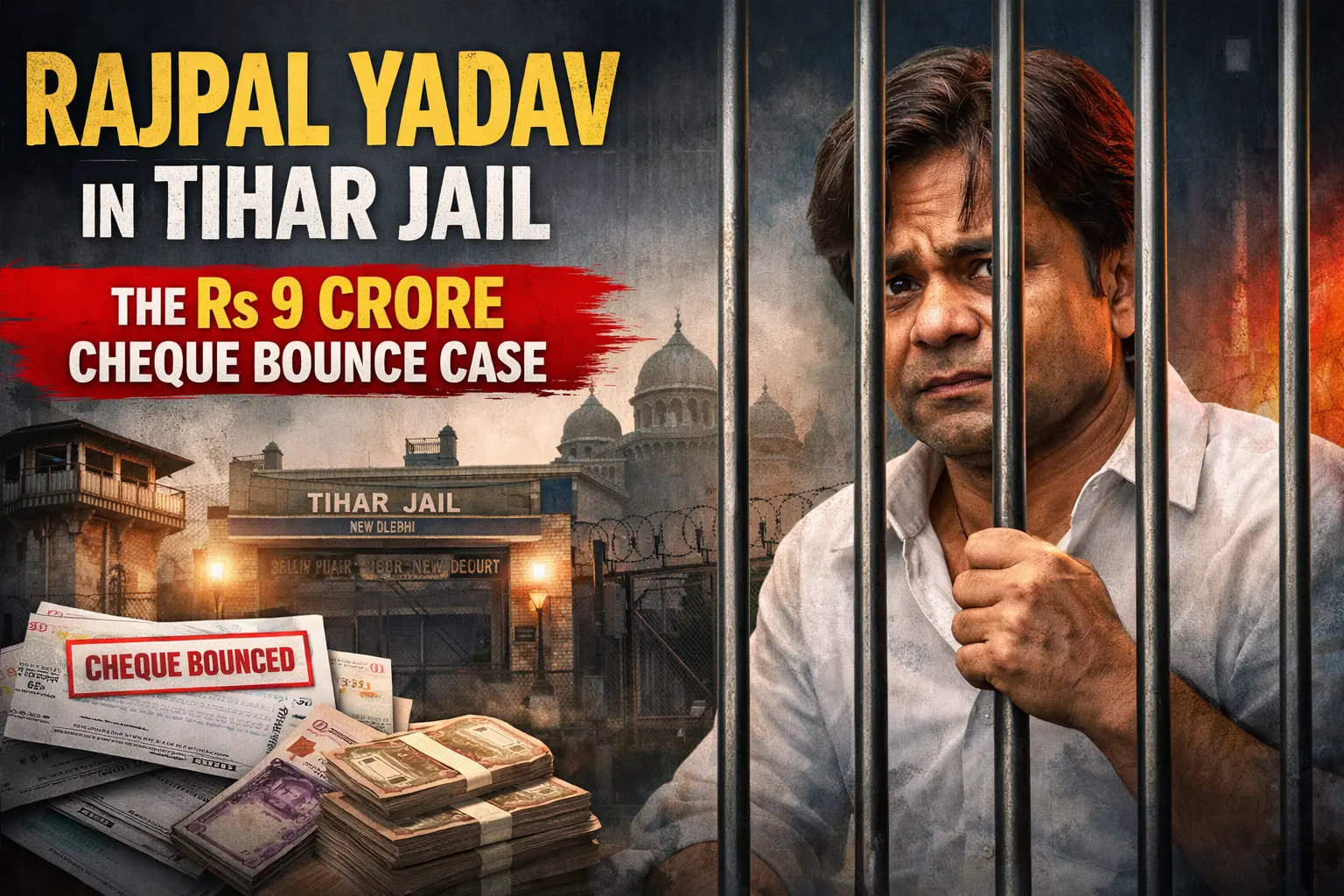
The imprisonment of popular Bollywood actor Rajpal Yadav in Delhi’s Tihar Jail has sent shockwaves across the Indian film industry. Known for his impeccable comic timing and memorable supporting roles, Rajpal Yadav’s journey from the silver screen to jail is rooted not in criminal intent, but in a prolonged financial dispute that dates back more than 15 years.
Here is a clear, plagiarism-free and detailed explanation of how a failed film project gradually escalated into a Rs 9-crore cheque-bounce case, eventually leading to his six-month imprisonment.
The Origin of the Case: A Film That Changed Everything
The legal trouble began in 2010 when Rajpal Yadav decided to turn filmmaker with his directorial debut Ata Pata Laapata. To finance the project, he borrowed approximately Rs 5 crore from M/s Murali Projects Pvt Ltd. At the time, the decision appeared commercially reasonable, given Yadav’s popularity and steady work in Hindi cinema.
Unfortunately, the film failed to perform at the box office. With poor returns and mounting expenses, the production venture collapsed financially. As a result, Rajpal Yadav struggled to repay the borrowed amount.
What initially started as a business loss soon turned into a legal nightmare.
How Rs 5 Crore Became Rs 9 Crore
As repayments were delayed, interest, penalties, and legal costs accumulated over the years. To clear his dues, Rajpal Yadav issued multiple cheques to the lender. However, several of these cheques were dishonoured due to insufficient funds.
This triggered criminal proceedings under the Negotiable Instruments Act, which treats cheque bounce cases as criminal offences when repeated defaults occur.
By the time the matter reached advanced stages of litigation, the outstanding amount had reportedly ballooned to nearly Rs 9 crore.
Conviction and Appeals: A Long Legal Battle
In April 2018, a magistrate court convicted Rajpal Yadav and his wife in multiple cheque-bounce cases, sentencing him to six months’ imprisonment. This verdict was upheld by a sessions court in 2019.
Following this, Rajpal Yadav approached the Delhi High Court, seeking relief. Over the years, the High Court granted him several opportunities to repay the dues in instalments.
While he did make partial payments and submitted repeated assurances, the court observed that he consistently failed to meet the agreed payment schedules.
Court’s Frustration Over Repeated Non-Compliance
The Delhi High Court eventually took a strict view of the actor’s conduct. The bench noted that Rajpal Yadav was required to pay around Rs 1.35 crore in each of the seven connected cases. Though some amount had been deposited with the Registrar General, a substantial sum remained unpaid.
In October 2025, demand drafts worth Rs 75 lakh were submitted, but the court recorded that close to Rs 9 crore was still outstanding.
In June 2024, the court had even temporarily suspended his conviction, hoping he would take “sincere and genuine measures” to settle the dispute amicably. However, these efforts failed to produce meaningful results.
Final Order: Surrender or Consequences
On February 2, 2026, the Delhi High Court directed Rajpal Yadav to surrender before jail authorities by February 4. The court made it clear that repeated breaches of undertakings could not be ignored indefinitely.
When Yadav failed to surrender on time, his counsel made a last-minute mercy plea, citing ongoing efforts to arrange funds. The court firmly rejected the request, stating that leniency could not be extended endlessly, especially when court directions were repeatedly violated.
Justice Swarana Kanta Sharma remarked that the judiciary could not create “special circumstances” for individuals merely because they belong to the film industry.
On February 5, 2026, Rajpal Yadav appeared in court and offered to submit a fresh demand draft of Rs 25 lakh along with a revised payment plan. The court declined to recall its order, and later that day, the actor surrendered at Tihar Jail to serve his six-month sentence.
Rajpal Yadav’s Emotional Reaction
In earlier interviews, Rajpal Yadav had expressed his helplessness over the situation. He admitted that despite working regularly, arranging such a large amount at once was beyond his means.
He also acknowledged the harsh reality of the film industry, stating that support often disappears during difficult times and that “everyone is on their own.”
Film Industry Rallies Behind Him
Following his surrender, several well-known figures from Bollywood publicly came forward to support Rajpal Yadav.
Actor Sonu Sood announced that he would offer Yadav a role in his upcoming film along with a signing amount. He described the gesture not as charity, but as dignity, urging producers and colleagues to stand together in times of crisis.
Filmmaker Anees Bazmee also expressed sympathy, noting that Rajpal Yadav never intended to wrong anyone and that many artists are not well-versed in financial paperwork. He stressed that paying such a large sum at once was extremely difficult, even for a working actor.
Actor Gurmeet Choudhary shared an emotional message on social media, calling the situation heartbreaking and reminding everyone that the industry should function like a family.
What’s Next for Rajpal Yadav?
Despite the setback, Rajpal Yadav’s professional journey is not over. He was recently seen in Baby John and Interrogation and is set to appear in Bhoot Bangla, a horror-comedy starring Akshay Kumar, scheduled for release on April 10.
Rajpal Yadav’s imprisonment is a stark reminder that prolonged financial disputes, when combined with repeated non-compliance of court orders, can lead to serious legal consequences—regardless of fame or status. What began as a failed creative risk eventually turned into a cautionary tale about financial accountability, legal discipline, and the limits of judicial leniency.
While the actor serves his sentence, the outpouring of support from the film fraternity has reopened conversations about how the industry treats its own during difficult times—and whether solidarity can help rebuild a career once the legal chapter finally closes.