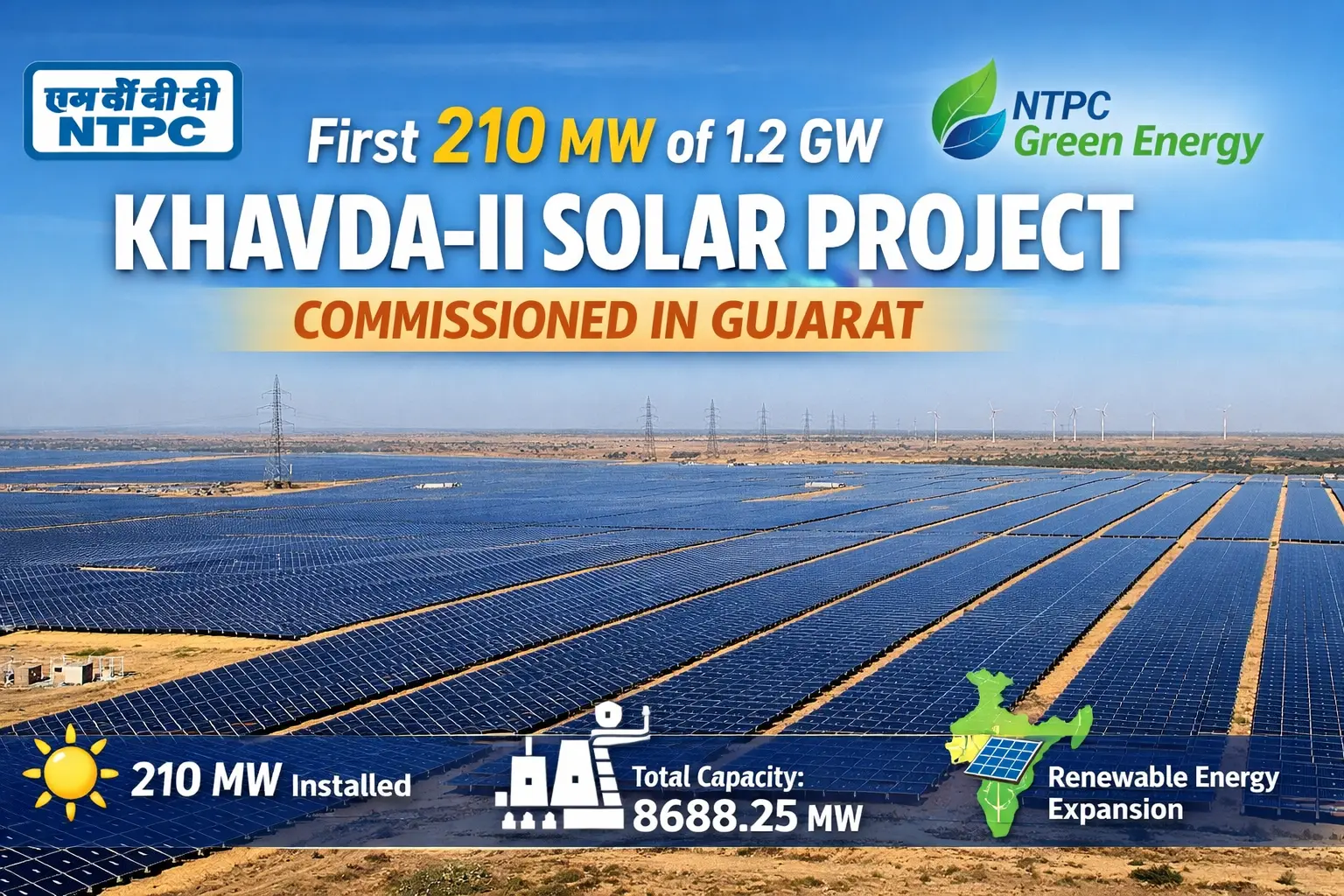
India’s renewable energy landscape has received a major boost as NTPC Renewable Energy Limited, a subsidiary of NTPC Green Energy Limited, has successfully commissioned the first phase of its ambitious 1.2 GW Khavda-II Solar PV Project in Gujarat. With the commercial operation of 210 MW in its initial phase, the project marks another significant milestone in NTPC’s clean energy expansion strategy and strengthens India’s transition toward sustainable power generation.
First Phase of Khavda-II Goes Live
According to a regulatory filing, NTPC Renewable Energy Limited has brought online 210 MW of solar capacity from the total planned 1,200 MW Khavda-II Solar PV Project. The project is located in Gujarat’s Khavda region, which has rapidly emerged as one of India’s most important renewable energy hubs due to its high solar irradiance and vast land availability.
With this commissioning, the current commercial capacity of the NTPC Green Energy Limited Group now stands at 8,478.25 MW. Once the newly commissioned 210 MW is fully reflected in installed figures, the group’s total installed capacity rises to 8,688.25 MW, reinforcing NTPC Green Energy’s position among the country’s leading renewable energy developers.
This development is not just a numerical addition; it represents a strategic step in NTPC’s long-term vision of scaling up renewable power to support India’s climate commitments and reduce dependence on fossil fuels.
Strategic Importance of the Khavda Solar Hub
The Khavda region in Gujarat has become a focal point for large-scale solar investments in India. Its arid terrain, high solar potential, and supportive state policies make it ideal for utility-scale solar projects. The Khavda-II Solar PV Project is part of a broader effort to transform the region into one of the world’s largest renewable energy clusters.
For NTPC Green Energy, Khavda-II plays a crucial role in achieving capacity expansion targets. The remaining 990 MW of the project is expected to be commissioned in phases, further increasing clean power availability and contributing significantly to grid-scale renewable supply.
NTPC Green Energy’s Rapid Project Execution
The commissioning of Khavda-II’s first phase highlights the pace at which NTPC Green Energy has been executing renewable projects across India. The group has consistently demonstrated its ability to move projects from planning to commercial operation efficiently, even at large capacities.
Earlier this month, NTPC Green Energy successfully completed final formalities for a major solar project in Rajasthan. The company operationalised 300 MW of its 500 MW Bhadla Solar PV Project located in Phalodi, Rajasthan. Out of the total planned capacity, the first 300 MW tranche has achieved full commercial operation, injecting reliable solar power into the national grid.
The Bhadla project went live on January 13, 2026, after receiving commissioning certificates from the Solar Energy Corporation of India (SECI) and the Rajasthan Renewable Energy Corporation Limited (RRECL). This achievement further underscores NTPC Green Energy’s execution capabilities across multiple states.
Growing Renewable Energy Footprint in Gujarat
NTPC Green Energy is not alone in expanding renewable capacity in Gujarat. Several other developers are also strengthening their presence in the state, drawn by its favorable policy environment and infrastructure readiness.
One notable example is SAEL Industries Ltd, which has commissioned a 1 GWp (800 MW) solar power plant at Khavda. The project represents one of the largest private-sector solar investments in the region.
SAEL Industries executed GUVNL-backed solar projects through its subsidiaries SAEL Solar P4 Private Limited and SAEL Solar P5 Private Limited, each with 400 MW (500 MWp) capacity. These projects were developed under 25-year long-term Power Purchase Agreements (PPAs) with Gujarat Urja Vikas Nigam Limited (GUVNL), ensuring long-term revenue stability and predictable cash flows.
Make in India and Advanced Solar Technology
A key highlight of the SAEL solar projects is their alignment with the Government of India’s ‘Make in India’ initiative. The projects deploy over 15 lakh TOPCon bifacial solar modules, known for their higher efficiency and ability to generate power from both sides of the panel.
More than 60% of these modules were assembled at SAEL’s solar manufacturing facilities in Punjab and Rajasthan, strengthening domestic manufacturing capabilities and reducing reliance on imports. This focus on advanced technology and local manufacturing mirrors the broader direction of India’s renewable energy sector.
Implications for India’s Energy Transition
The commissioning of the Khavda-II Solar Project’s first phase comes at a time when India is aggressively scaling up renewable capacity to meet its climate and energy security goals. Large-scale solar projects like those in Khavda and Bhadla play a critical role in:
- Reducing carbon emissions
- Enhancing energy security
- Lowering the cost of power generation
- Supporting industrial growth through reliable clean energy
For NTPC Green Energy, the addition of 210 MW strengthens its renewable portfolio and brings it closer to long-term capacity targets. For Gujarat, it reinforces the state’s status as a renewable energy powerhouse.
As the remaining phases of the 1.2 GW Khavda-II Solar PV Project are commissioned, NTPC Green Energy’s installed capacity is expected to rise sharply, further cementing its leadership in India’s renewable sector. Combined with ongoing projects in Rajasthan and other states, the group is steadily building a diversified and geographically balanced renewable energy portfolio.
With strong execution, long-term PPAs, and a focus on advanced technology, projects like Khavda-II signal a positive outlook for India’s clean energy future. The continued collaboration between public sector leaders like NTPC and private players such as SAEL Industries will be instrumental in achieving the country’s ambitious renewable energy targets.
In summary, the commissioning of the first 210 MW of the Khavda-II Solar Project is more than just another project milestone—it is a clear indicator of India’s accelerating shift toward sustainable, large-scale renewable power generation.