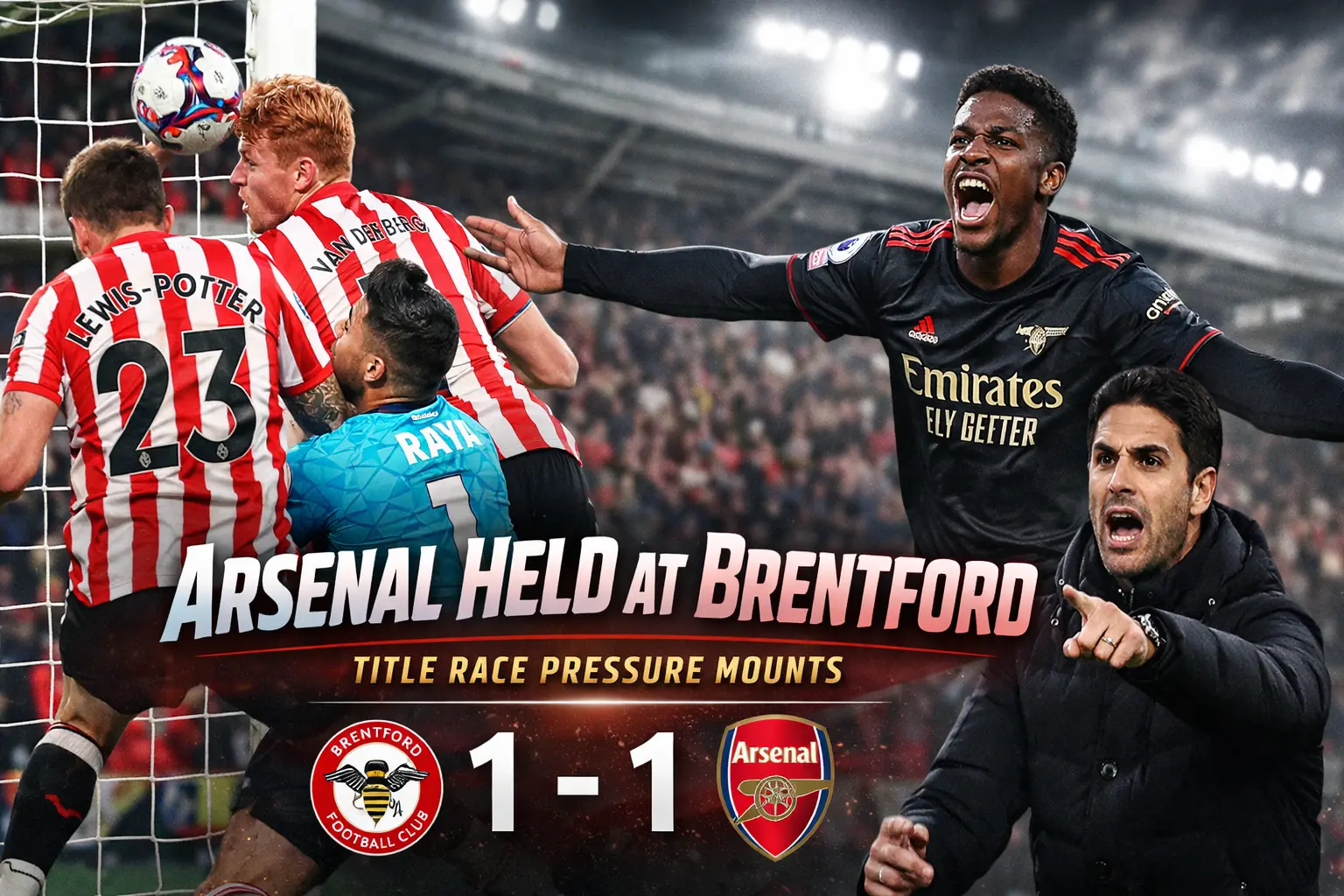

With Manchester City applying pressure through consecutive wins in recent days, the expectation was clear: Arsenal needed a statement performance. Instead, what unfolded at the Gtech Community Stadium was a fragmented display that exposed lingering concerns in Mikel Arteta’s side.
Context: City Turn Up the Heat
Before Arsenal even stepped onto the pitch, the pressure gauge had already risen. Manchester City had delivered crucial victories, tightening the margins at the top. The title race, once seemingly comfortable, now carries a sharper edge.
A draw away to seventh-placed Brentford is not a disastrous outcome in isolation. Brentford have built a reputation as one of the league’s most tactically disciplined and physically imposing teams. However, title-winning campaigns are often defined by efficiency in winnable matches — and this was one Arsenal would have targeted as three points.
The Match Narrative: A Lead That Didn’t Last
The breakthrough arrived in the 61st minute through a moment of individual quality. Noni Madueke demonstrated excellent athleticism and composure, rising to meet Piero Hincapié’s cross and guiding the ball home. It was a goal that hinted Arsenal might seize control.
Yet instead of consolidating their advantage, Arsenal retreated. The rhythm that briefly surfaced early in the second half quickly dissolved into hesitation and defensive uncertainty.
Brentford, renowned for thriving in chaotic moments, capitalized.
A long throw from Michael Kayode triggered confusion in the Arsenal box. Sepp van den Berg’s deft flick redirected the ball to the far post, where Keane Lewis-Potter finished clinically. It was a goal born not from sustained possession, but from calculated disruption — exactly the scenario Brentford seek to create.
Ironically, Arsenal’s own reputation as a set-piece powerhouse — with specialist coach Nico Jover widely credited for their structured routines — offered little protection against Brentford’s aerial threat.
Defensive Vulnerabilities and Near Escapes
The Gunners were fortunate not to leave west London empty-handed. Gabriel Magalhães walked a disciplinary tightrope after fouling Dango Ouattara while already on a yellow card. Igor Thiago came close twice, and Mikkel Damsgaard seemed destined to score before Declan Rice produced a crucial interception.
Brentford looked the more threatening side during key stretches, particularly through direct play and long throws that constantly unsettled Arsenal’s defensive shape.
At the other end, Arsenal struggled to convert possession into danger. Gabriel Martinelli, introduced as a substitute, hesitated in a promising moment, allowing Brentford goalkeeper Caoimhín Kelleher to deny him with a sharp save. It was only Arsenal’s second shot on target of the night — a statistic that underlines the lack of attacking fluency.
Midfield Experiment Falls Flat
Perhaps the most scrutinized performance came from Eberechi Eze. With Martin Ødegaard starting on the bench, Eze was tasked with orchestrating Arsenal’s creativity. Instead of asserting his own style, he appeared to drift into deeper areas, attempting to replicate Ødegaard’s influence rather than imposing his natural strengths.
Arteta’s frustration was visible from the touchline. Tactical adjustments were attempted — including urging Martín Zubimendi to advance further — but the structure never truly clicked. Eze’s substitution at halftime reflected a clear acknowledgment that the experiment had not delivered the required impact.
Arteta later explained that Brentford’s pressing demanded a different profile in advanced areas. The manager’s analysis was measured, yet the underlying issue remains: Arsenal’s creative engine lacks consistency when key figures are absent or contained.
A Broader Offensive Concern
This result cannot be viewed in isolation. Arsenal’s recent form suggests a pattern. They have won just two of their last six league matches. During that stretch, their shot conversion rate ranks outside the league’s elite, and their expected goals numbers are modest relative to a title contender.
Against low defensive blocks, Arsenal continue to struggle. Their reliance on set pieces as a primary offensive weapon has grown more apparent. While effective in many matches, it limits unpredictability in open play.
Statistical data further highlights this issue: Arsenal rank near the bottom half of the league in the percentage of goals scored from open play. For a team aspiring to outpace Manchester City, that imbalance is concerning.
The goalless draws against Liverpool and Nottingham Forest earlier in the season now feel like warning signs rather than anomalies.
Brentford’s Tactical Identity
Credit must be given to Brentford. Their approach is deliberate and well-drilled. Long throws, aggressive pressing, and second-ball dominance are not random tactics but structured components of their identity.
Arteta himself described the “chaos” Brentford create around the ball — a phase that makes defensive clarity difficult. A simple clearance can quickly turn into sustained pressure. Fouls in wide areas become dangerous opportunities. Arsenal, typically composed in controlled phases, were dragged into unfamiliar territory.
In rare fashion, Brentford appeared the more dangerous side for extended spells. That psychological dynamic alone will concern Arsenal supporters.
Declan Rice Calls for Calm
Despite the frustration, Declan Rice urged perspective. He emphasized resilience and mental composure, reminding observers that the Premier League demands consistency against high-quality opposition every week.
His comments reflect an understanding that title races are marathons rather than sprints. However, maintaining belief is easier when performances align with ambition. Arsenal’s margin for error has narrowed considerably.
Psychological Implications
Perhaps the most telling moment came not on the pitch, but from the stands. Brentford supporters chanted references to Arsenal potentially finishing second yet again — a nod to recent seasons where the Gunners have fallen just short.
The psychological battle in a title race is often as significant as the tactical one. Manchester City’s presence in the rearview mirror is familiar territory for Arsenal. Avoiding déjà vu will require sharper attacking cohesion and more decisive game management.
Acceptable Result, Lingering Questions
From a purely mathematical standpoint, Arsenal remain top of the league with a four-point cushion. A draw at Brentford is defensible in isolation. But context matters.
In a season where every dropped point reverberates, this was a fixture where a clinical Arsenal performance could have reinforced authority. Instead, vulnerabilities resurfaced — particularly in open-play creativity and defensive composure under pressure.
The title race is far from decided. Arsenal are still in control of their destiny. Yet if they are to withstand Manchester City’s relentless pursuit, incremental improvements must arrive swiftly.
As Rice suggested, calm heads and belief remain essential. But belief must now be matched with sharper execution — because in the Premier League title race, acceptable margins shrink quickly.