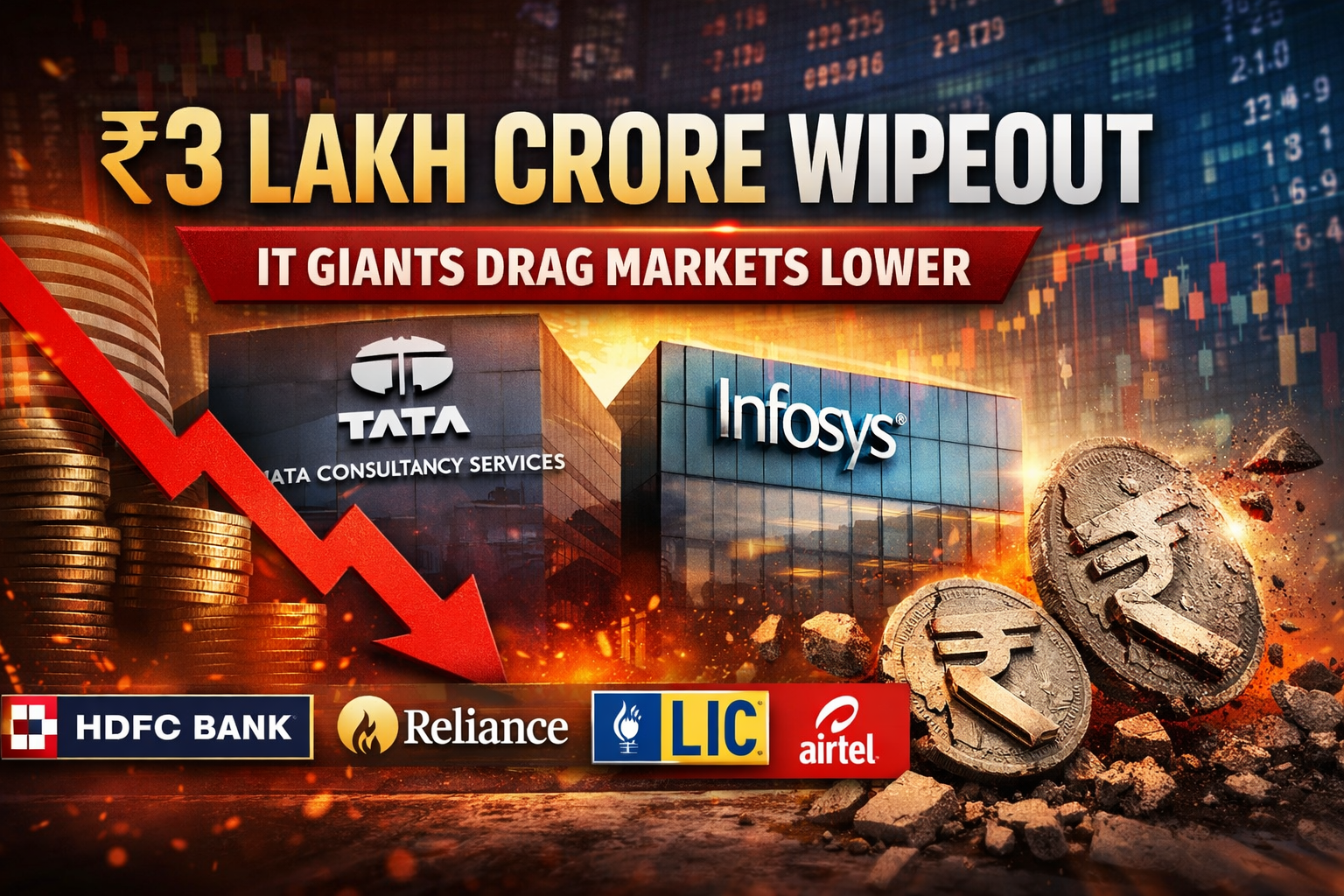
₹3 Lakh Crore Erosion: IT Heavyweights Lead Market Meltdown Amid Broad Selloff
Indian equity markets witnessed a sharp correction last week, eroding more than ₹3 lakh crore from the combined market capitalisation of six of the country’s top-10 most valued companies. The downturn was largely driven by heavy losses in information technology (IT) majors, with Tata Consultancy Services and Infosys emerging as the biggest laggards.
The broader market sentiment remained weak throughout the week, as benchmark indices declined amid global uncertainty, softer corporate earnings, and rising concerns over artificial intelligence (AI)-led disruptions in the technology sector.
Benchmark Indices Slide Sharply
The 30-share BSE Sensex dropped 953.64 points, or 1.14%, over the week. On Friday alone, the index plunged 1,048.16 points (1.25%) to close at 82,626.76, reflecting intense selling pressure.
Similarly, the NIFTY 50 ended the week 222.6 points lower, down 0.86%. On Friday, it tumbled 336.10 points (1.30%) to settle at 25,471.10.
The overall market capitalisation of firms listed on the BSE declined by ₹7,02,017.71 crore, bringing the total valuation down to ₹4,65,46,643.20 crore (approximately $5.13 trillion). This broad-based selloff reflects investor caution amid mounting macro and sector-specific headwinds.
IT Sector Bears the Brunt
The most significant damage occurred within the technology space.
TCS, India’s largest IT services firm, saw its market capitalisation shrink by ₹90,198.92 crore, taking its valuation down to ₹9,74,043.43 crore. Meanwhile, Infosys witnessed a steep erosion of ₹70,780.23 crore, reducing its market value to ₹5,55,287.72 crore.
The Nifty IT index touched a 10-month low during intraday trade before recovering slightly to close 1.4% lower. Analysts attribute the sustained pressure on IT stocks to growing concerns that rapid advancements in artificial intelligence could disrupt traditional outsourcing and labour-arbitrage models that Indian IT firms have historically relied upon.
Market participants fear that AI-driven automation may reduce dependency on large-scale manpower-based service delivery, impacting revenue visibility for major IT exporters.
Other Major Losers Among Top Firms
Apart from IT majors, several other blue-chip companies faced valuation declines:
- HDFC Bank: Market cap fell by ₹54,627.71 crore to ₹13,93,621.92 crore.
- Reliance Industries: Valuation declined by ₹41,883 crore to ₹19,21,475.79 crore.
- Life Insurance Corporation of India: Market capitalisation dropped by ₹23,971.74 crore to ₹5,46,226.80 crore.
- Bharti Airtel: Lost ₹19,244.61 crore in valuation, closing at ₹11,43,044.03 crore.
Despite the erosion, Reliance Industries retained its position as India’s most valued company, followed by HDFC Bank and Bharti Airtel.
Banking and Financial Stocks Buck the Trend
While several heavyweights struggled, select financial stocks delivered strong gains, cushioning the broader market decline.
State Bank of India (SBI) emerged as the biggest gainer among top firms. Its market valuation surged by ₹1,22,213.38 crore, taking its total market capitalisation to ₹11,06,566.44 crore.
Other notable gainers included:
- Bajaj Finance: Added ₹26,414.44 crore to reach ₹6,37,244.64 crore.
- Larsen & Toubro: Gained ₹14,483.9 crore, pushing its valuation to ₹5,74,028.93 crore.
- ICICI Bank: Market capitalisation rose by ₹5,719.95 crore to ₹10,11,978.77 crore.
The resilience in select banking and financial counters suggests continued investor confidence in domestic credit growth and relatively stable earnings outlooks in the financial services segment.
Sectoral Performance: Metals Lead the Decline
The selloff was not limited to IT stocks. Multiple sectors ended the week in the red:
- Metal stocks declined 3.21%.
- Realty and Commodities each fell 2.27%.
- Utilities dropped 2.26%.
- Energy stocks slipped 1.94%.
- Oil & Gas fell 1.86%.
- Power declined 1.85%.
- FMCG stocks lost 1.74%.
- Services sector fell 1.72%.
The weakness across sectors highlights a risk-off sentiment prevailing in the broader market.
AI Disruption Concerns Weigh on Sentiment
Market experts believe that renewed fears surrounding AI-led transformation in the technology space played a central role in dampening investor sentiment.
Analysts point out that Indian IT companies, traditionally reliant on large-scale manpower deployment and offshore service models, may face competitive challenges if global enterprises accelerate AI adoption. The concern is that AI could significantly reduce project sizes, billing volumes, and long-term outsourcing contracts.
Additionally, weaker-than-expected quarterly earnings from certain sectors added to the cautious outlook. The fading impact of earlier positive triggers—such as optimism surrounding US-India trade developments—further compounded selling pressure.
Institutional Investor Activity
According to exchange data, foreign institutional investors (FIIs) purchased equities worth ₹108.42 crore on Thursday, while domestic institutional investors (DIIs) were net buyers to the tune of ₹276.85 crore.
Although institutional buying provided some stability, it was insufficient to counter the broader selloff across sectors.
Ranking of India’s Most Valued Firms
Despite the market correction, the hierarchy of India’s most valued companies remains largely unchanged:
- Reliance Industries
- HDFC Bank
- Bharti Airtel
- State Bank of India
- ICICI Bank
- TCS
- Bajaj Finance
- Larsen & Toubro
- Infosys
- LIC
The reshuffling within the top ranks reflects the shifting investor preference toward banking and financial stocks over technology counters in the current environment.
What Lies Ahead?
Going forward, market direction will likely depend on three key factors:
- Global cues – Particularly US economic data and global tech sector trends.
- Corporate earnings trajectory – Sustained earnings growth could restore confidence.
- AI adaptation strategies – How Indian IT firms pivot toward AI-integrated service models will be closely monitored.
While the recent correction has created short-term volatility, long-term investors may view the decline as an opportunity, especially in fundamentally strong companies with robust balance sheets and diversified revenue streams.
Last week’s sharp erosion of over ₹3 lakh crore in the combined market capitalisation of leading firms underscores the fragile sentiment prevailing in Indian equities. IT heavyweights bore the brunt amid fears of AI disruption, dragging benchmark indices lower.
However, selective strength in banking and financial stocks signals that investor confidence has not entirely dissipated. As markets navigate global uncertainties and technological transitions, sectoral divergence is likely to remain a defining theme in the near term.
For investors, disciplined asset allocation and close monitoring of sectoral developments will be crucial in managing risk in this evolving landscape.