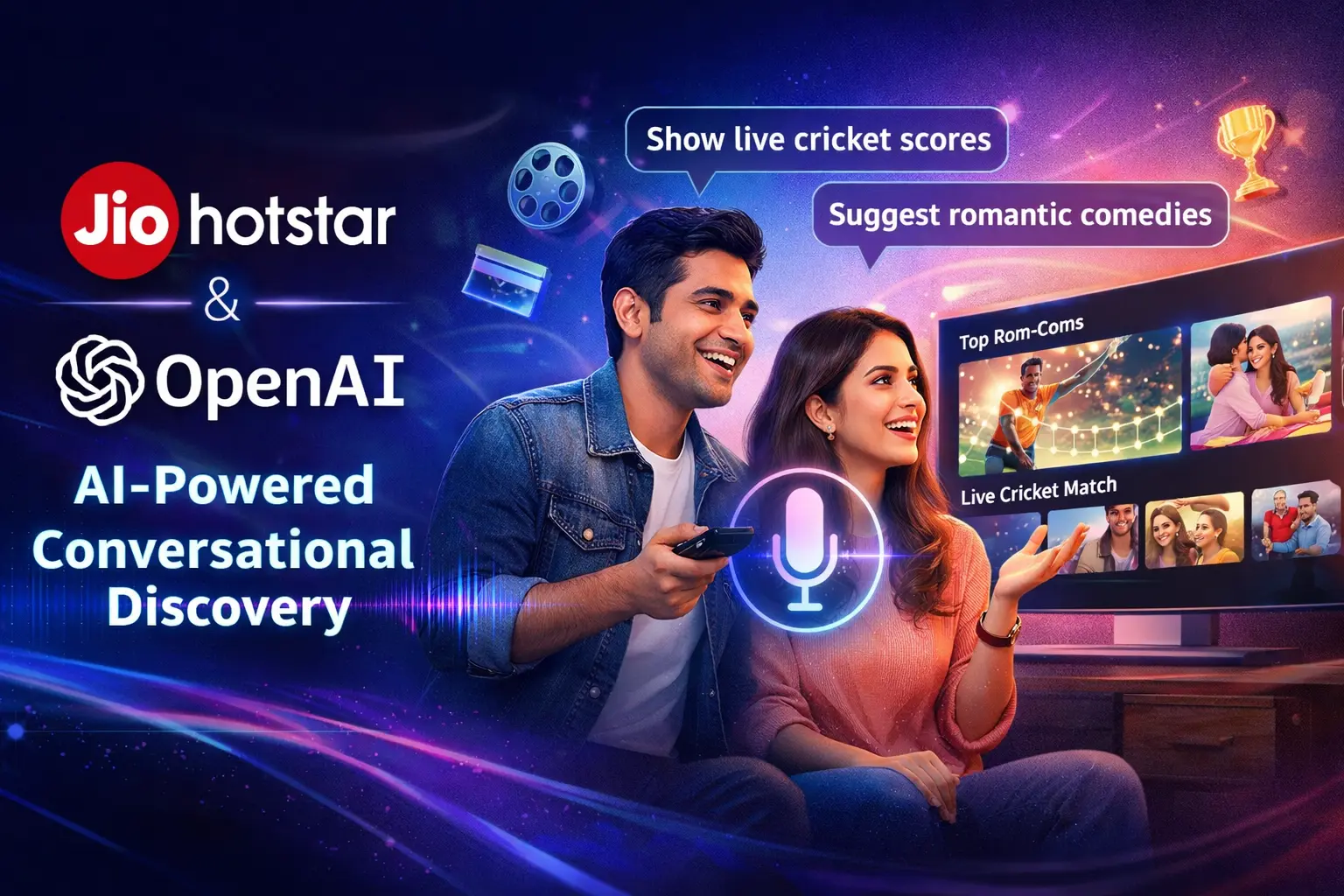
JioHotstar has announced a strategic partnership with OpenAI to introduce a ChatGPT-powered conversational discovery feature on its streaming platform. The collaboration marks a significant shift in how audiences search for and engage with digital entertainment. Moving beyond traditional keyword-based browsing, the new upgrade will allow users to discover movies, shows, and live sports content through natural voice and text conversations—across multiple languages.
This development signals a broader transformation in India’s digital entertainment ecosystem, where artificial intelligence is rapidly reshaping user experiences.
Reinventing Content Discovery
For years, streaming platforms have relied heavily on search bars, category filters, and recommendation carousels to help viewers find content. While effective to a certain extent, this system often requires users to scroll endlessly or type in specific keywords. The result is a familiar frustration known as the “What To Watch” dilemma.
The new conversational interface aims to eliminate that friction. Powered by OpenAI’s APIs, JioHotstar’s platform will now support real-time, context-aware interactions. Instead of manually browsing through titles, viewers can simply express their preferences in natural language. For example, a couple planning a movie night on Valentine’s Day could say:
“Suggest five best romantic comedies to watch on Valentine’s Day.”
Within seconds, the system would generate tailored recommendations aligned with the request.
This AI-driven upgrade is built around what the company describes as “Multilingual Cognitive Search.” Rather than matching rigid keywords, the system interprets user intent, emotional context, and situational cues to deliver highly relevant suggestions. The experience feels less like searching a database and more like conversing with a knowledgeable assistant.
How the Technology Works
At its core, the feature leverages advanced natural language processing (NLP) models through OpenAI’s API infrastructure. The integration enables both text-based and voice-based interactions. Users can type or speak their queries in multiple languages, and the system processes them conversationally.
The platform does not simply retrieve titles containing certain keywords. Instead, it understands context. For instance:
- “I want something light and funny after a stressful day.”
- “Show me a thriller similar to the last movie I watched.”
- “Find family-friendly movies for Sunday evening.”
The AI analyzes the user’s request, considers viewing history (where applicable), and generates recommendations that align with mood, occasion, and genre preferences.
This represents a move from reactive search to proactive recommendation—where the platform anticipates what viewers might enjoy rather than merely responding to typed commands.
Expansion to Live Sports
The upgrade is not limited to movies and web series. JioHotstar plans to extend conversational discovery to live sports streaming as well. Sports viewers will be able to ask for:
- Real-time scores
- Key match moments
- Player highlights
- Historical statistics
- Match summaries
Instead of navigating menus during a live game, fans could simply ask for specific information. This conversational layer transforms passive viewing into an interactive experience.
The integration of AI into live sports also opens possibilities for contextual insights during matches. For example, a viewer might ask, “How has this player performed in previous finals?” and receive instant analysis without leaving the stream.
Phased Rollout Strategy
Although the companies have not confirmed a precise launch date, reports indicate that the feature will be rolled out in phases. The implementation will begin with select experiences before expanding to both live and on-demand formats across the platform.
A phased deployment allows for optimization, user feedback integration, and performance refinement before a full-scale rollout. Given the scale of JioHotstar’s user base in India, ensuring seamless multilingual support and real-time responsiveness will be critical to success.
The Rise of Voice-Based AI in India
The timing of this partnership aligns with the growing adoption of voice-enabled technologies in India. AI assistants such as Siri and Amazon Alexa have already become household names. Their popularity has been fueled by widespread smartphone penetration, affordable internet data, and increasing smart home device usage.
Amazon reports that Alexa-enabled devices, including Echo smart speakers, have reached customers in 99 percent of India’s pin codes since their introduction. Millions of Indian users rely on voice assistants daily for tasks such as setting reminders, checking the weather, making calls, playing music, and controlling home appliances.
The key driver behind this growth has been multilingual capability. AI systems now better recognize Indian English accents and support regional languages, making technology more accessible to users beyond metropolitan centers.
A Rapidly Expanding Indian AI Ecosystem
India’s voice AI ecosystem is evolving rapidly. Several domestic companies are developing language models tailored specifically to Indian linguistic diversity. Notable players include:
- CoRover with its BharatGPT platform supporting 14+ languages
- Gnani.ai
- Haptik
- Bolna.ai
- Sarvam AI
These companies are advancing natural language understanding across customer support, sales automation, and multilingual engagement solutions. Many are specifically optimizing for Indian accents, code-mixed speech (such as Hinglish), and regional dialects.
JioHotstar’s integration with OpenAI fits squarely within this broader movement. By embedding conversational AI into mainstream entertainment, the platform is positioning itself at the forefront of AI-driven user experience in India.
Leadership Perspectives on the Partnership
Uday Shankar, vice chairman of JioStar, emphasized that the company sees AI not as a feature but as a foundational element of the platform’s evolution. According to him, the goal is to create a deeply personal entertainment experience where users can discover, engage with, and even curate content through voice interaction.
On the OpenAI side, Fidji Simo, CEO of applications, highlighted how artificial intelligence shifts entertainment from passive consumption to interactive engagement. Rather than simply watching content, viewers can now ask questions, explore context, and receive personalized recommendations in real time.
Together, these perspectives underscore a shared vision: transforming streaming platforms into intelligent, conversational environments.
Why This Matters for the Future of Streaming
The partnership reflects a broader industry trend toward AI-enhanced personalization. As streaming platforms compete for user attention, differentiation increasingly depends on experience rather than content volume alone.
Conversational discovery offers several strategic advantages:
- Reduced friction – Faster, intuitive content selection.
- Higher engagement – Interactive exploration keeps users on the platform longer.
- Personalization at scale – AI adapts to individual preferences dynamically.
- Multilingual accessibility – Broader reach across diverse audiences.
- Enhanced sports engagement – Real-time conversational insights during live events.
For Indian audiences, especially those comfortable with voice interaction in regional languages, this feature could significantly lower barriers to digital entertainment.
The Beginning of Conversational Entertainment
The collaboration between JioHotstar and OpenAI signals the beginning of a new phase in streaming evolution. Instead of navigating content libraries manually, viewers will increasingly interact with platforms conversationally—just as they would with a friend or personal assistant.
As voice-based AI adoption continues to accelerate in India, integrating conversational intelligence into mainstream entertainment seems less like an experiment and more like a natural progression.
If executed effectively, this initiative could redefine how millions of viewers discover content—transforming streaming from a search-driven activity into a seamless dialogue between user and platform.
The “What To Watch” dilemma may soon become a problem of the past.