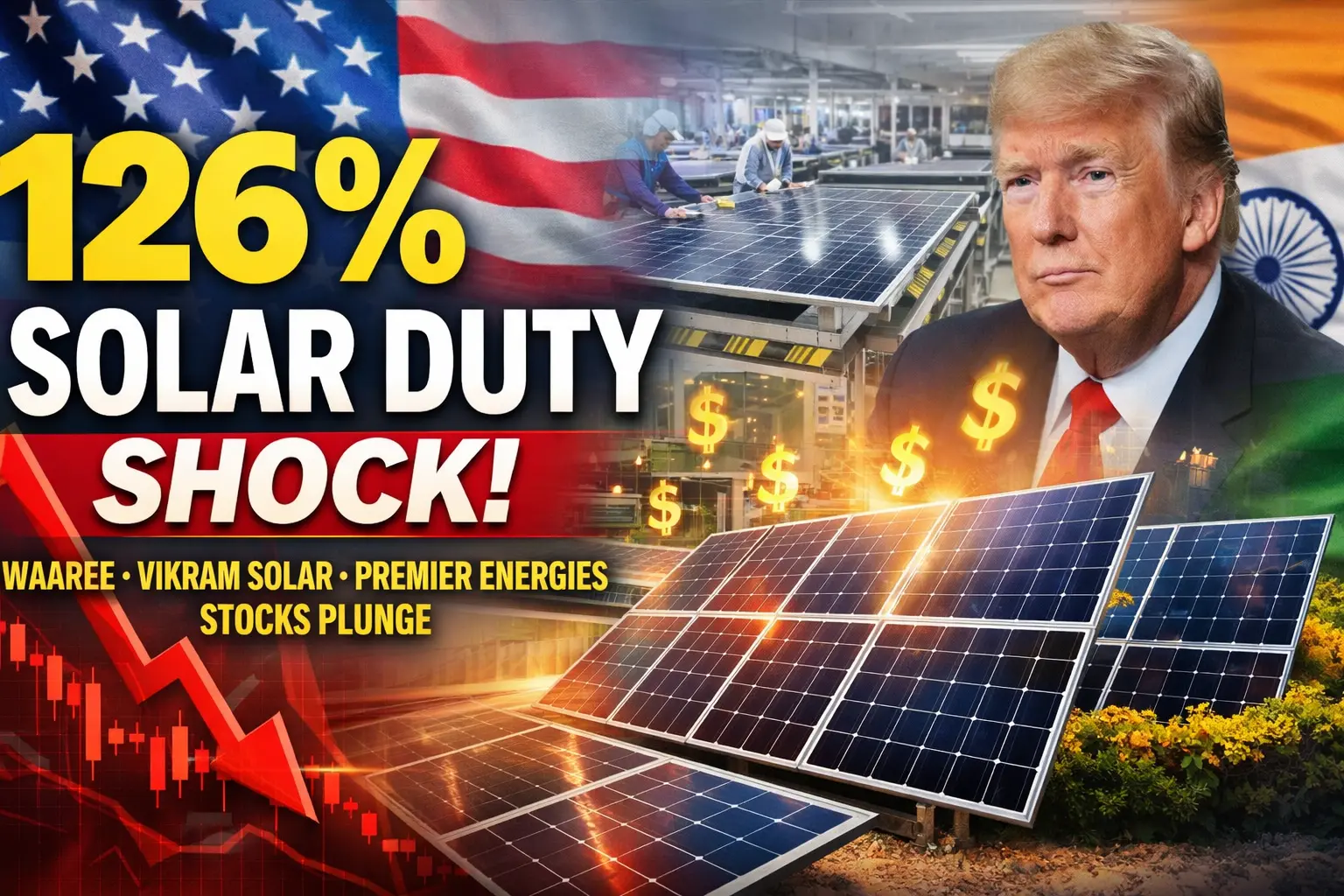
US Imposes 126% Solar Import Duty: Why Waaree, Vikram Solar & Premier Energies Stocks Fell
Indian solar energy stocks witnessed sharp volatility after the United States announced preliminary import duties of up to 126% on solar products from India. The move, introduced under the administration of former US President Donald Trump, triggered immediate investor reaction, leading to steep declines in key renewable energy stocks.
Companies such as Waaree Energies, Vikram Solar, and Premier Energies saw heavy selling pressure as markets opened, reflecting concerns over export exposure and revenue impact.
This article breaks down the reasons behind the fall, company exposure levels, and the broader implications for India’s solar manufacturing industry.
What Triggered the Market Reaction?
The US Commerce Department announced preliminary countervailing duties of 126% on solar imports from India. According to reports, the US determined that Indian manufacturers had benefited from subsidies that allowed them to price their solar modules below domestic US competitors.
In addition to India:
- Indonesia faces duties between 86% and 143%
- Laos faces duties of around 81%
These measures are separate from broader global tariffs previously introduced, which were later struck down by the US Supreme Court. However, fresh 10% tariffs were subsequently introduced, with potential increases to 15%.
The new duties directly target solar imports and are aimed at protecting US-based solar manufacturers from what authorities describe as unfair competition.
Stock Market Impact: Who Fell and Why?
1️⃣ Waaree Energies
Shares of Waaree Energies plunged as much as 14% in early trade, making it one of the biggest losers in the sector.
Why the sharp fall?
- Nearly 29% export exposure
- Significant presence in the US market
- Large module manufacturing capacity
Waaree is primarily engaged in manufacturing solar photovoltaic (PV) modules and solar cells. It also operates in power generation and EPC (Engineering, Procurement & Construction) contracts.
The company’s product portfolio includes:
- HJT modules
- N-type modules
- Mono PERC modules
- Flexible solar modules
- Battery Energy Storage Systems (BESS)
- Electrolyser stacks for green hydrogen
With manufacturing plants in Gujarat (Tumb, Nandigram, Chikhli, Surat), Waaree has positioned itself as a global supplier. However, this global exposure has now become a short-term risk factor.
2️⃣ Vikram Solar
Vikram Solar shares dropped over 7.5% during early trading hours.
The company derives around 16% of its revenue from exports, making it moderately exposed to US policy changes.
Vikram Solar is one of India’s largest module manufacturers in terms of operational capacity (as of March 31, 2025). It operates as an integrated solar solutions provider, offering:
- PV module manufacturing
- EPC services
- Operations & Maintenance (O&M) services
While its export exposure is lower than Waaree’s, the stock reacted negatively due to uncertainty in overseas demand.
3️⃣ Premier Energies
Premier Energies fell nearly 10% initially but later showed signs of recovery.
Interestingly, the company reportedly has negligible or no export exposure to the US market. This suggests that the decline was largely driven by:
- Negative sector sentiment
- Panic selling
- Spillover impact from peer companies
Premier Energies is an integrated solar cell and module manufacturer. Apart from manufacturing, it is involved in:
- Solar power generation
- EPC execution
- Independent power production
- O&M services
Its EPC division has executed over 266 MW of ground-mounted projects and nearly 23 MW of rooftop solar projects.
Why Is the US Taking This Step?
The US government argues that foreign subsidies allowed exporters from India, Indonesia, and Laos to undercut domestic solar manufacturers. By imposing high duties, the US aims to:
- Protect domestic manufacturing
- Encourage local production
- Reduce dependence on imports
However, this move creates a dilemma.
Short-Term Benefits:
- Boost for US-based solar manufacturers
- Higher domestic capacity utilization
Potential Risks:
- Increased solar project costs in the US
- Higher prices for consumers
- Slower renewable energy adoption
According to BloombergNEF, India, Indonesia, and Laos accounted for 57% of US solar module imports in the first half of 2025. Developers had shifted sourcing to these countries after earlier tariffs hit Southeast Asian suppliers.
US imports from India were valued at $792.6 million in 2024 — more than nine times higher than 2022 levels. This rapid growth likely drew regulatory scrutiny.
Broader Implications for Indian Solar Industry
1️⃣ Export Uncertainty
Companies with high export exposure may face:
- Order cancellations
- Reduced margins
- Pricing pressure
2️⃣ Domestic Opportunity
On the positive side, India’s domestic solar demand remains strong due to:
- Renewable energy targets
- Government incentives
- Green hydrogen mission
Companies may redirect capacity toward domestic projects if exports slow.
3️⃣ Global Trade Tensions
Although a bilateral trade agreement was recently finalized between the US and India to ease economic tensions, sector-specific duties like these highlight that trade relations remain complex.
Is This a Long-Term Threat?
The impact depends on several factors:
- Whether duties become permanent
- Scope for negotiations between India and the US
- Companies’ ability to diversify export markets
- Expansion of US manufacturing by Indian firms
Some Indian manufacturers may explore setting up production facilities within the US to bypass tariff barriers — a strategy already adopted by several global players.
Investor Takeaway
The sharp fall in Waaree Energies and Vikram Solar reflects genuine export-related risk. However, Premier Energies’ decline appears more sentiment-driven than fundamentally justified.
For investors, key evaluation metrics include:
- Export revenue proportion
- Order book strength
- Domestic project pipeline
- Balance sheet stability
- Global expansion strategy
Short-term volatility is likely, but long-term growth prospects for solar energy remain structurally strong due to global decarbonization goals.
The US decision to impose 126% preliminary duties on Indian solar imports has sent shockwaves through the Indian renewable energy sector. While the policy aims to strengthen domestic US manufacturing, it has introduced uncertainty for Indian exporters.
Waaree Energies and Vikram Solar are directly exposed due to meaningful export revenues, while Premier Energies’ fall appears largely sentiment-driven.
Despite near-term challenges, the long-term outlook for India’s solar manufacturing ecosystem remains positive, supported by strong domestic demand and global clean energy transition trends.
Investors should closely monitor policy developments, company disclosures, and trade negotiations before making investment decisions in the solar energy segment.