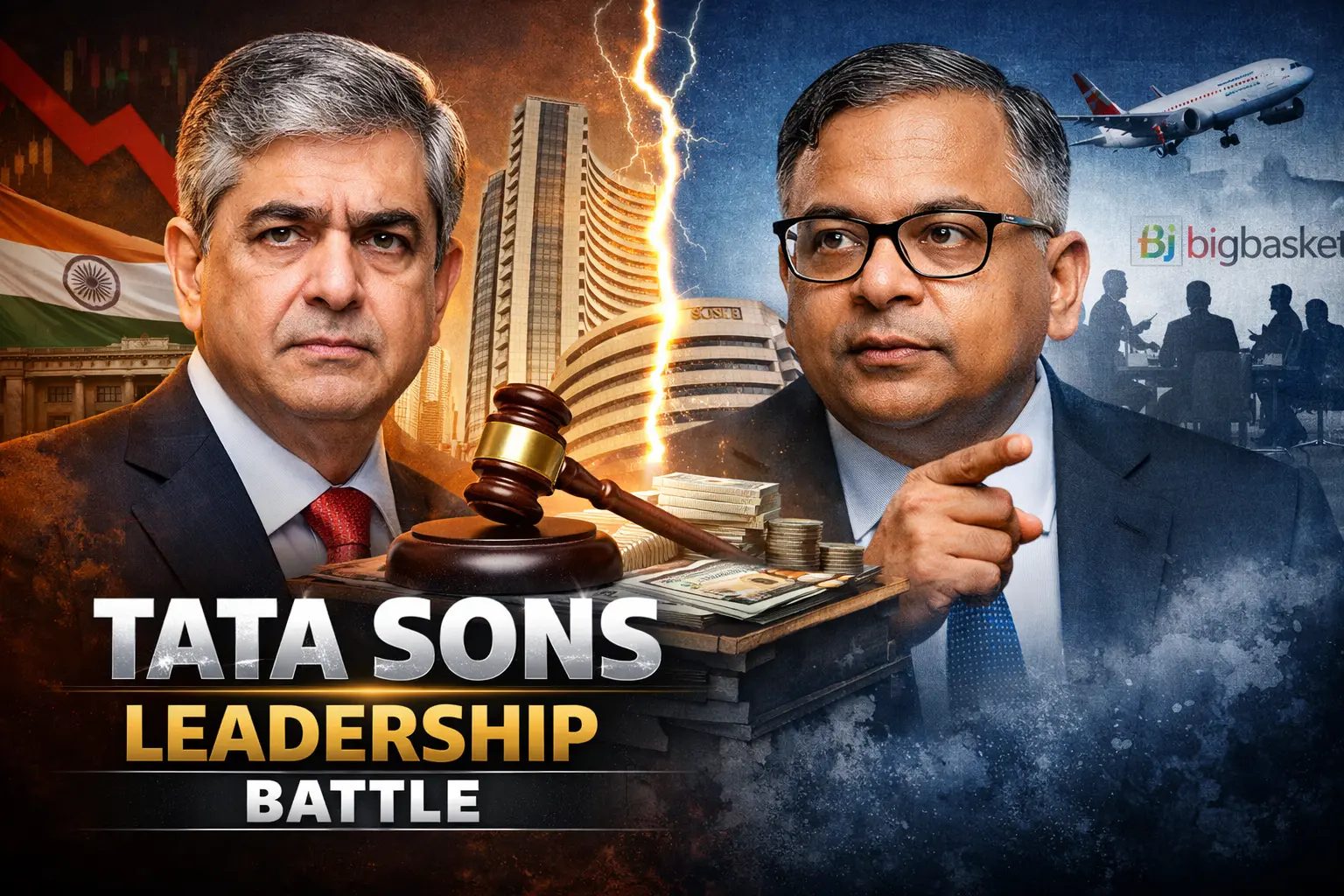
Tata Sons Leadership Crossroads: Legacy, Power and the Future of India Inc.
Boardroom struggles within India’s largest conglomerates rarely stay confined to conference rooms. When it involves the leadership of Tata Sons, the holding company of the $300+ billion Tata Group, the implications ripple across corporate India and the broader economy.
At the center of the present speculation is the future of Chairman N. Chandrasekaran, whose current term concludes in 2027. His potential reappointment has become more than a routine governance matter — it reflects deeper tensions over legacy, authority, risk appetite, and the philosophical direction of the Tata empire.
The Power Equation: Trusts and Control
To understand the current dynamics, one must first understand the structure. Tata Trusts are the majority shareholders of Tata Sons. Control of the trusts effectively translates into influence over the group’s apex decision-making.
Following the passing of Ratan Tata, leadership transitioned to Noel Tata, who inherited not just a legacy but also a complex governance ecosystem. Noel, long perceived as understated within the group hierarchy, has increasingly asserted his authority.
Earlier internal disagreements between trustees and loyalists reportedly resulted in a consolidation of control under Noel’s leadership. With that consolidation complete, attention has now shifted to Tata Sons itself — and more specifically, to Chandrasekaran’s future.
The Reappointment Question
Chandrasekaran, who was personally chosen by Ratan Tata in 2017 after the high-profile exit of Cyrus Mistry, has earned considerable respect within corporate circles. His tenure has been marked by operational consolidation, debt reduction across group companies, and ambitious strategic bets such as the Air India revival.
However, a procedural challenge looms. Tata Sons’ internal retirement policies restrict leadership continuation beyond 65. Chandrasekaran turns 63 this June. A five-year term starting in 2027 would extend beyond that threshold, requiring a special board resolution for exemption.
What initially seemed like a smooth renewal — especially since Chandrasekaran tacitly supported Noel during the trusts’ internal struggles — has now become a delicate negotiation.
Reported Conditions and Strategic Concerns
According to various media discussions, Noel Tata has reportedly emphasized four broad principles regarding leadership continuity:
- Tata Sons should not pursue a public listing.
- The holding company must remain debt-free.
- Cash reserves should be preserved rather than deployed aggressively in high-risk capital expenditure.
- Losses from recent acquisitions should be contained or reversed.
Each of these points is not merely financial — they are deeply connected to the group’s history.
1. The Listing Debate
The question of listing Tata Sons has periodically surfaced over decades. During Ratan Tata’s tenure, regulatory triggers could have forced a listing, particularly under central banking norms governing large systemically important NBFCs. Through debt reduction and restructuring, the group avoided that path.
A public listing would introduce institutional investors, retail shareholders, and global governance scrutiny. While this may enhance transparency, it would also dilute the concentrated influence of Tata Trusts. For Noel, avoiding listing preserves structural continuity and decision-making autonomy.
2. Debt-Free Discipline
Maintaining a debt-free status has symbolic and strategic importance. It reduces regulatory vulnerability and protects operational independence. The Tata Group historically used dividends from profitable companies — such as Tata Consultancy Services — to strengthen Tata Sons’ balance sheet, which in turn funds philanthropic initiatives through the trusts.
Financial conservatism, therefore, is not merely prudence; it supports the group’s philanthropic DNA.
3. Capital Allocation and Risk Appetite
The third concern revolves around capital discipline. Large conglomerates often face tension between expansion and preservation. Aggressive capex in sunrise sectors can generate long-term value but may depress short-term profitability.
Noel’s emphasis appears to favor stability over aggressive expansion. This contrasts with Chandrasekaran’s willingness to back transformative moves, including aviation, digital commerce, and electronics manufacturing.
4. Acquisition Losses and Legacy Comparisons
Perhaps the most sensitive issue relates to losses from past acquisitions. During Ratan Tata’s era, European acquisitions in steel and automotive drew criticism for their financial strain. Cyrus Mistry publicly questioned these decisions during his tenure, which eventually led to a dramatic fallout.
Today, acquisitions such as Air India and BigBasket are under scrutiny. While these investments are strategic — aviation revival and digital retail integration — they carry heavy upfront losses.
The irony is notable: earlier, a professional executive challenged family-led decisions; now, a family successor is scrutinizing a professional leader’s capital allocation.
Boardroom Alignments
Reports suggest that most Tata Sons board members support Chandrasekaran’s continuation. Their reasoning includes:
- Listing decisions will ultimately depend on regulatory requirements.
- Cash reserve levels are influenced by dividend flows from operating companies.
- Losses are natural in greenfield or turnaround projects.
- Provisions have already been made against expected losses.
However, the trusts’ board nominees reportedly possess veto authority in specific resolutions, especially those requiring special approvals. This introduces a layer of governance complexity uncommon in widely held corporations.
Leadership Style and Institutional Culture
Chandrasekaran has maintained a public stance emphasizing unity between Tata Sons and Tata Trusts. He has deferred contentious votes and avoided escalation. This contrasts sharply with the earlier public battle between Ratan Tata and Cyrus Mistry, which unsettled markets and damaged reputational capital.
Institutionally, the Tata Group prides itself on ethical governance and long-term stewardship. Public disputes erode that carefully curated image. Hence, even amid tensions, there appears to be a conscious effort to prevent open confrontation.
Broader Impact on India Inc.
This leadership question extends beyond personalities. The Tata Group spans sectors from steel and automobiles to IT, retail, aviation, and renewables. Its strategic direction influences supply chains, employment, capital markets, and investor confidence across India.
A shift toward financial conservatism may stabilize balance sheets but slow expansion. Conversely, aggressive growth strategies could accelerate India’s global competitiveness but increase short-term volatility.
India’s economic transformation requires both risk-taking and discipline. The balance between these two philosophies lies at the heart of the current deliberation.
Legacy Versus Evolution
Ratan Tata built an image of bold global expansion while preserving ethical stature. Noel Tata appears inclined toward structural control and capital caution. Chandrasekaran represents professionalized, performance-driven corporate leadership.
The question is not merely whether Chandrasekaran is reappointed. It is whether the group prioritizes continuity of professional management or reassertion of tighter trust-led oversight.
The Road Ahead
As 2027 approaches, Tata Sons stands at a strategic inflection point. A special resolution may be required. Veto powers may come into play. Negotiations may redefine governance norms within one of India’s most respected institutions.
What remains clear is that stability within Tata Sons is crucial for investor confidence and economic continuity. Unlike past confrontations, the current stakeholders appear cautious about triggering a public showdown.
The outcome will determine not just who occupies the chairman’s office — but how India’s most iconic conglomerate balances legacy, authority, and ambition in a rapidly evolving global economy.