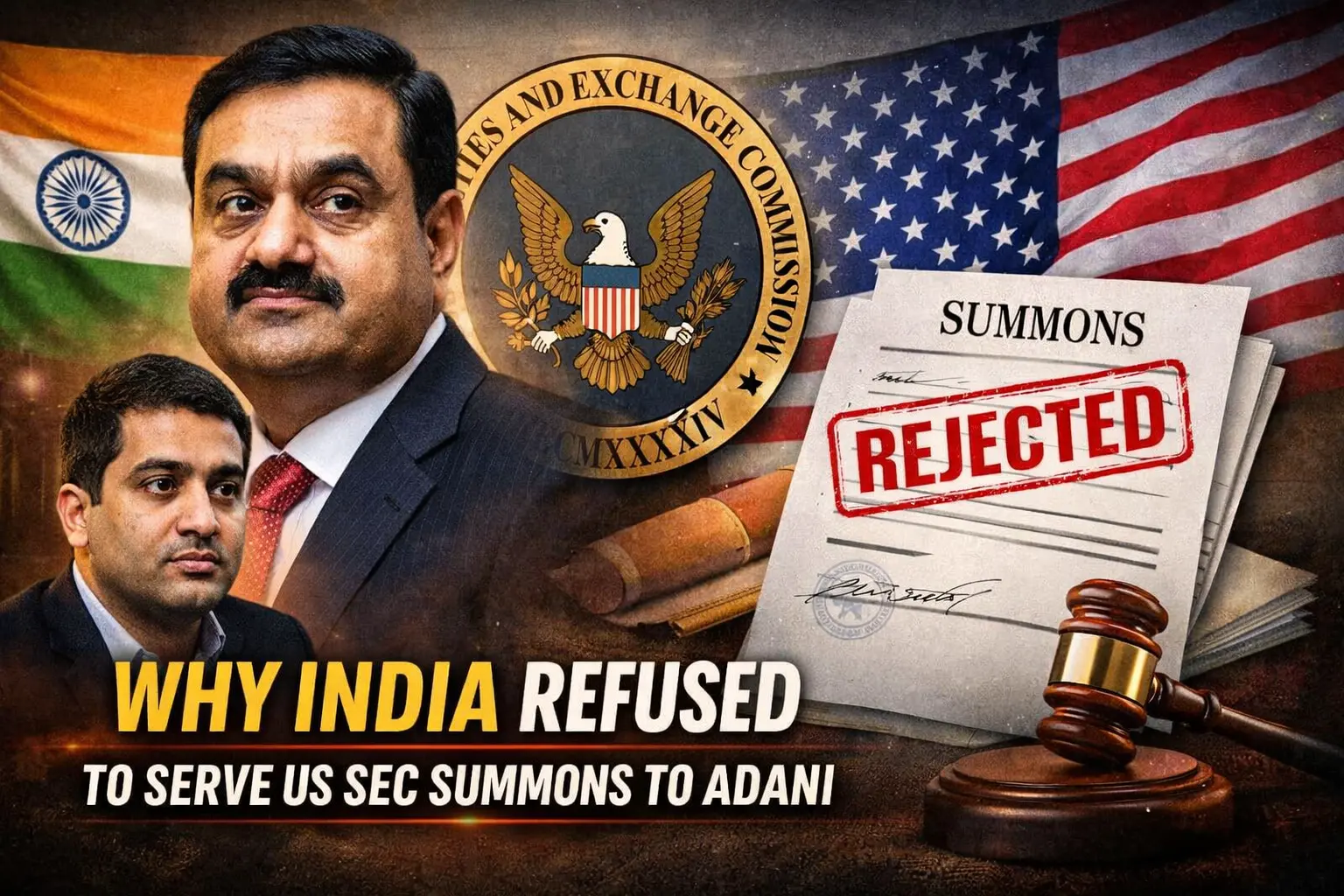
No Ink Signature, No Seal: Why India Refused to Deliver US SEC Summons to Adani
Court filings in the United States have revealed an unusual diplomatic and legal standoff between India’s Ministry of Law and Justice and the US Securities and Exchange Commission (SEC). At the centre of the dispute is the ministry’s refusal—on two separate occasions—to formally serve legal summons issued by the SEC on Adani Group chairman Gautam Adani and his nephew Sagar Adani.
The reasons cited may appear technical on the surface—missing ink signatures, absence of official seals, and objections to the nature of the documents themselves—but the implications are far-reaching. The episode has now prompted the SEC to seek permission from a New York federal court to bypass traditional international procedures and serve the summons electronically via email.
Two refusals, months apart
According to documents filed before the US District Court for the Eastern District of New York, India’s law ministry declined to execute the SEC’s request in May 2025 and again in December 2025. Both requests were made under the Hague Convention on the Service Abroad of Judicial and Extrajudicial Documents in Civil or Commercial Matters, a multilateral treaty designed to ensure reliable cross-border service of legal papers.
In February 2025, the SEC had formally approached the ministry seeking assistance in serving summons related to a civil enforcement action against the Adanis. However, the Indian authorities returned the documents, stating they could not verify their authenticity.
The ministry pointed out that the SEC’s forwarding letter did not carry an ink signature or an official seal, and that the standard “Model Form” prescribed under the Hague Convention also lacked the seal of the requesting authority. Without these elements, the ministry said, it was unable to confirm the legitimacy of the request.
In its response, the ministry stated that the absence of these formal markers meant the documents could not be processed further and were therefore being returned for “necessary action.”
SEC pushes back
Later that month, the SEC resubmitted the documents, disputing India’s interpretation of the Hague Convention. The US regulator argued that the convention does not require documents to bear seals or stamps of the issuing court and cited the 4th Edition of the *Practical Handbook on the Operation of the Service Convention*.
According to the handbook, the SEC noted, the practice adopted by some states of refusing service unless documents carry official seals or stamps is considered “erroneous.” From the SEC’s perspective, India’s objections went beyond what the convention mandates.
Despite this clarification, the matter did not end there.
December rejection and a new objection
In December 2025, India’s law ministry again declined to serve the summons, this time raising a different legal objection—one rooted in US law itself.
In a letter to the SEC, the ministry cited Rule 5(b) of the SEC’s Informal and Other Procedures (17 C.F.R. § 202.5(b)). After reviewing the documents, the ministry concluded that the summons did not fall within the categories of enforcement actions outlined under the rule and therefore could not be acted upon.
Rule 5(b) lists the types of actions the SEC may initiate after an investigation, including administrative proceedings, civil injunctive actions, or referrals to the US Department of Justice for criminal prosecution. The ministry appeared to argue that issuing a “summons” was not, in itself, an enforcement tool authorised under this framework.
On this basis, the documents were returned once again.
SEC turns to the US court
Faced with repeated refusals and significant delays, the SEC approached the New York federal court seeking permission to serve the summons through alternative means—specifically, by email.
In its submission, the SEC stated that given the Indian government’s position and the time already elapsed since it first attempted service under the Hague Convention, it no longer expected the process to be completed through traditional channels.
The regulator also rejected India’s interpretation of its authority, telling the court that the Hague Convention governs procedures for service of documents, not the underlying power of an agency like the SEC to bring enforcement actions.
“The Ministry appeared to suggest that the SEC lacks authority to invoke the Hague Convention or seek service of the summonses,” the SEC told the court, adding that such an objection has no basis under international law.
Background of the SEC case
The summons are linked to a civil complaint filed by the SEC in November 2024. In that complaint, the regulator alleged that Gautam Adani and Sagar Adani violated antifraud provisions of US federal securities laws by making false or misleading representations in connection with a September 2021 debt offering by Adani Green Energy Ltd.
The case gained further attention after the Adani Group withdrew a $600 million bond offering following criminal indictments by the US Department of Justice against Gautam Adani and six related entities on bribery charges. While the DOJ case is criminal in nature, the SEC’s action is a separate civil proceeding focused on alleged securities law violations.
Market reaction and company response
The developments have had a visible impact on the markets. As reported by *The Indian Express*, shares of Adani Group companies fell sharply following news of the court filings, with losses ranging from 3.3% to 14.6% in a single trading session. In cumulative terms, the group’s market capitalisation reportedly declined by around ₹1 lakh crore during the day.
In response to queries from stock exchanges, Adani Green Energy clarified that it is not a party to the SEC proceedings and that no charges have been brought against the company itself. The firm reiterated that the SEC case is civil in nature and stressed that the defendants have not been charged with violations of the US Foreign Corrupt Practices Act.
The Adani Group has consistently rejected the SEC’s allegations, describing them as baseless and stating that it will pursue all available legal remedies.
A rare glimpse into legal diplomacy
Beyond the immediate legal battle, the episode offers a rare glimpse into how international legal cooperation can be complicated by procedural differences and divergent interpretations of law. What the SEC viewed as a routine request under a global convention was treated by Indian authorities as a technically flawed and legally questionable exercise.
Whether the US court ultimately allows service of summons by email—and how that decision may influence future cross-border enforcement actions—remains to be seen. What is clear, however, is that a dispute over signatures, seals, and statutory interpretation has now become a key chapter in one of the most closely watched corporate legal sagas involving India and the United States.