Crypto Trading Volume Surges to $5.95 Trillion as Volatility Revives Digital Asset Markets
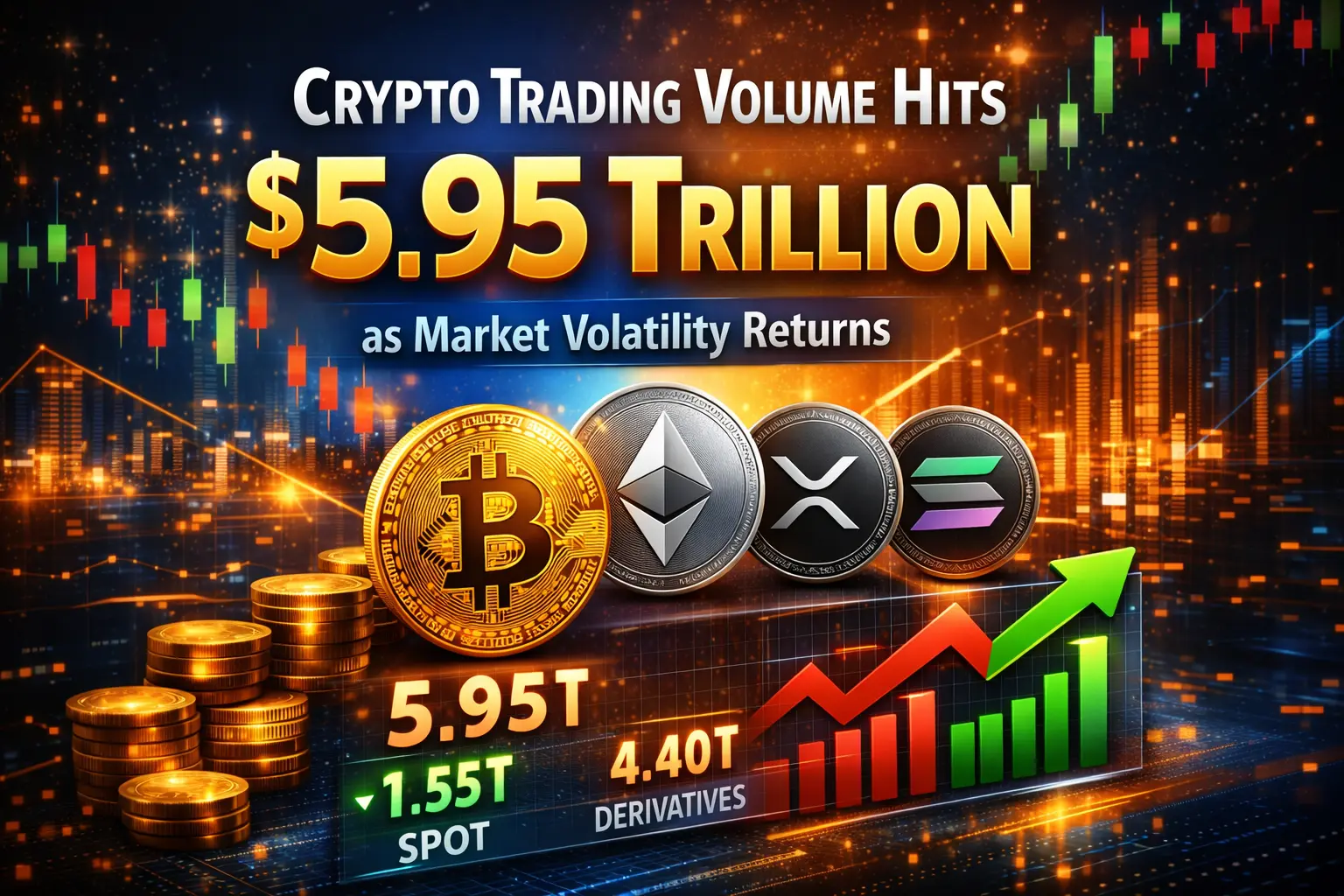
After a relatively quiet close to 2025, the cryptocurrency market began 2026 with renewed intensity. January witnessed a strong rebound in trading activity across centralized and decentralized exchanges, driven largely by heightened price volatility in major digital assets. According to CoinDesk Data’s latest Exchange Review, combined spot and derivatives trading volumes on centralized exchanges climbed 2.43% month-over-month to reach an impressive $5.95 trillion.
This marked the first monthly increase in trading volume in three months, signaling a revival of momentum across global crypto markets.
Volatility Sparks Trading Revival
The resurgence in activity coincided with sharp price swings in leading cryptocurrencies. Bitcoin briefly approached the $98,000 level early in January before retreating and closing the month more than 10% lower. Such rapid price movements typically stimulate higher trading participation, as traders seek to capitalize on both upward and downward momentum.
Market volatility is often a double-edged sword. While it introduces risk, it also creates liquidity opportunities, arbitrage setups, and derivatives positioning strategies. January’s volatility appears to have reignited speculative and hedging activity after a subdued December.
Spot Trading Volumes Rebound
Spot trading volumes on centralized exchanges rose 5.83% to $1.55 trillion in January, reflecting renewed investor engagement.
Binance retained its position as the dominant player in the spot market, recording $407 billion in trading volume — a 10.8% increase from December. This growth pushed Binance’s market share to 26.2%, reinforcing its leadership in the global exchange ecosystem.
Other exchanges also recorded notable gains:
- MEXC reached $93.6 billion in spot volume.
- Gate followed with $74.4 billion, both platforms registering double-digit monthly growth.
However, not all exchanges benefited from the rebound. Bybit and HTX experienced declines in spot activity, with volumes dropping 16.4% and 19.1%, respectively.
Interestingly, top-tier exchanges accounted for 71.3% of total spot trading in January, up from 69.8% in December. Despite a slight aggregate decline among these major platforms, their overall market dominance strengthened. Lower-tier exchanges recorded a modest 0.62% drop in spot volume, totaling $445 billion.
This shift suggests consolidation within the exchange landscape, as traders increasingly prefer liquidity depth and perceived security offered by leading platforms.
Most Traded Cryptocurrencies
Bitcoin and Ethereum continued to dominate spot trading activity across centralized exchanges.
- Bitcoin recorded $557 billion in spot trading volume.
- Ethereum followed with $306 billion.
Together, the two largest cryptocurrencies accounted for a significant share of total market turnover.
One of January’s notable developments was XRP overtaking Solana as the third most traded asset on centralized exchanges. XRP registered $74.2 billion in spot volume, narrowly surpassing Solana’s $72.9 billion.
This shift highlights evolving trader preferences and potential capital rotation among large-cap altcoins.
Derivatives Market Expands, but Market Share Slips
While spot volumes experienced stronger growth, derivatives trading on centralized exchanges also increased — albeit more modestly. Derivatives volumes rose 1.28% to reach $4.40 trillion.
Despite the increase in absolute volume, the derivatives market share edged down slightly to 74% from 74.8% in December. This subtle shift suggests that spot trading regained some ground relative to leveraged trading products during January’s volatility spike.
Binance once again led the derivatives market, processing $1.51 trillion in trading volume. It was followed by:
- OKX with $697 billion
- Bybit with $505 billion
These platforms continue to dominate perpetual futures and leveraged trading segments, which remain critical drivers of overall crypto liquidity.
Open Interest and Institutional Participation
Open interest — the total value of outstanding derivatives contracts — reached $116 billion in January. Institutional exchanges accounted for 16.7% of this total, indicating that while institutional involvement remains significant, retail-focused platforms still command the majority share.
Retail-dominated exchanges led open interest distribution:
- Binance: 24.2%
- Bybit: 10.6%
- Gate: 10.1%
This structure underscores the continued influence of retail traders in derivatives markets, particularly in perpetual futures products.
Although institutional participation has grown steadily over recent years, January’s data suggests that retail traders remain highly active during volatile market conditions.
Decentralized Exchanges Gain Spot Market Share
Decentralized exchanges (DEXs) also experienced growth in January, particularly in spot trading.
DEX spot volumes rose 8.69% to $339 billion, increasing their share of the overall spot market to 17.9%. This reflects a gradual but persistent shift toward on-chain trading platforms.
Rising DEX activity may be attributed to several factors:
- Increased DeFi engagement
- Greater demand for self-custody solutions
- Expansion of cross-chain liquidity
- Continued innovation in automated market maker (AMM) models
The growth in DEX spot volumes suggests that decentralized infrastructure continues to mature and capture incremental market share from centralized venues.
DEX Futures Volume Declines
In contrast to spot growth, decentralized futures trading volumes declined 0.86% to $1.00 trillion. This marked the third consecutive monthly drop and the first decrease in futures market share in eight months.
The divergence between spot and futures performance on decentralized platforms may indicate reduced appetite for leveraged on-chain trading or migration back to centralized exchanges for derivatives exposure.
Centralized platforms still offer deeper liquidity and more advanced risk management tools, which remain attractive to high-frequency and professional derivatives traders.
Market Structure Trends to Watch
January’s trading data reveals several key structural themes:
- Volatility drives liquidity. Sharp price movements reignited trading momentum after months of subdued activity.
- Centralized exchanges maintain dominance. Despite DEX growth, centralized platforms continue to command the majority of spot and derivatives volumes.
- Retail influence remains strong. Retail-heavy exchanges hold substantial derivatives open interest.
- Bitcoin and Ethereum remain core liquidity anchors.
- XRP’s rise signals shifting altcoin dynamics.
As 2026 progresses, sustained volatility could further support elevated trading volumes. However, macroeconomic factors, regulatory developments, and ETF flows may also shape liquidity patterns in the coming months.
January marked a decisive return of trading momentum to the cryptocurrency market. Combined centralized exchange volumes reached $5.95 trillion, breaking a three-month downtrend and highlighting renewed market engagement.
Spot markets outperformed derivatives in growth terms, while decentralized exchanges expanded their presence in the spot segment. Meanwhile, Bitcoin and Ethereum retained dominance, and XRP emerged as a standout performer among altcoins.
The data underscores a fundamental principle of digital asset markets: volatility fuels participation. If price swings persist, trading volumes could remain elevated throughout the first quarter of 2026, reinforcing crypto’s position as one of the most dynamic financial markets globally.