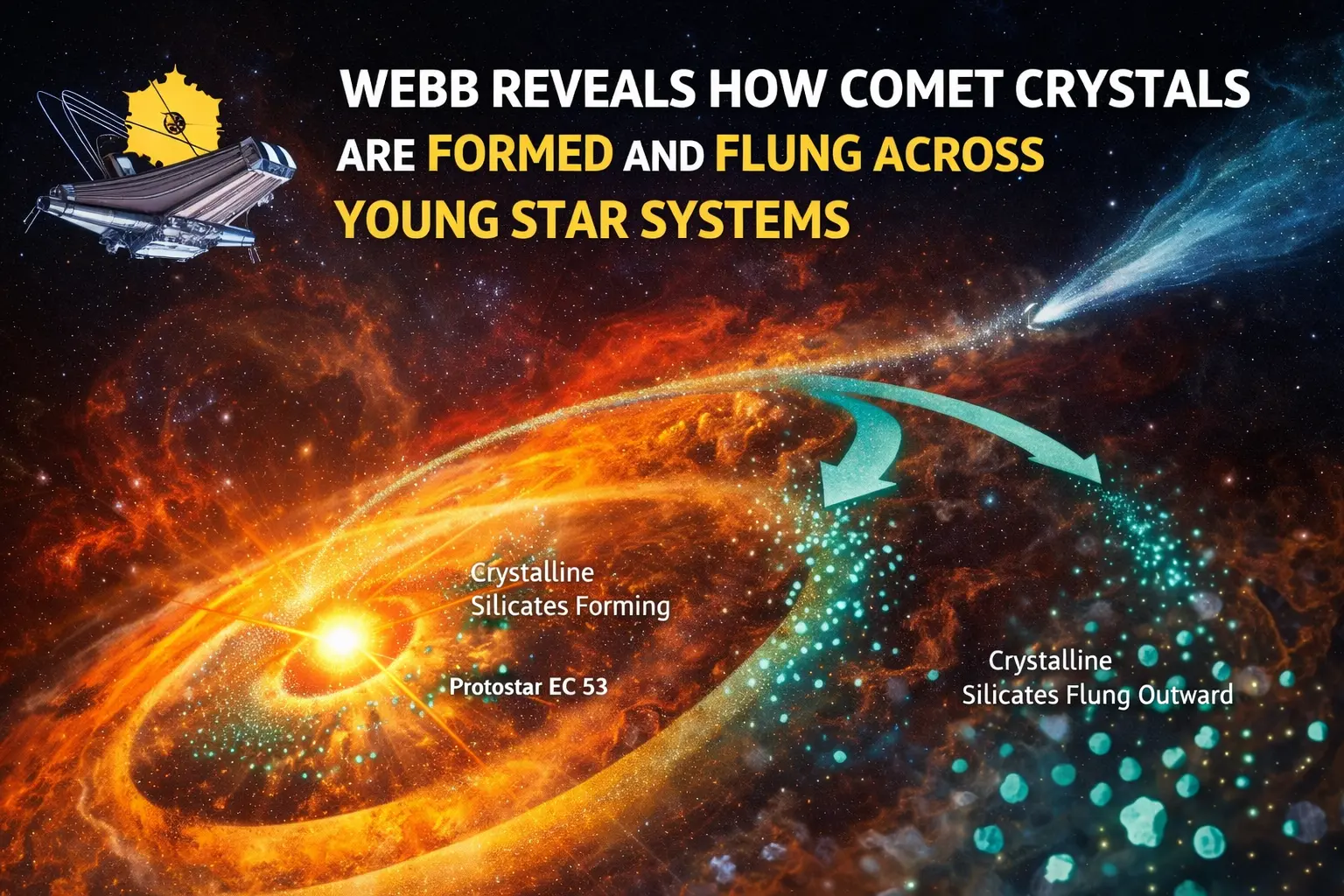
For decades, astronomers have been puzzled by a fundamental contradiction hidden inside comets. These icy objects, often described as “dirty snowballs,” spend most of their existence in the freezing outer reaches of planetary systems. In our own solar system, comets originate in regions like the Kuiper Belt and the distant Oort Cloud, where temperatures are so low that heat-driven processes seem impossible. Yet, when scientists examined comet samples and observations, they repeatedly found crystalline silicates—minerals that require extremely high temperatures to form.
How could minerals forged in intense heat end up embedded in bodies that live in deep cosmic cold? Thanks to new observations from NASA’s James Webb Space Telescope, astronomers finally have a clear and compelling answer.
A Long-Standing Cosmic Mystery
Crystalline silicates, such as forsterite and enstatite, are not exotic materials. They are common on Earth and form under high-temperature conditions, typically above 1,000 degrees Celsius. For years, their presence in comets challenged existing models of planetary system formation. The prevailing theories struggled to explain how these minerals could travel from hot, inner regions near a star to the frigid outskirts where comets take shape.
Earlier studies had detected crystalline silicates in comets and in protoplanetary disks around young stars, but the mechanism behind their formation and transport remained unclear. Observations lacked the resolution and sensitivity required to pinpoint where these minerals formed and how they migrated outward.
Webb’s Breakthrough Observation
The James Webb Space Telescope has now delivered the first conclusive evidence linking high-temperature mineral formation to large-scale transport within a young stellar system. Using Webb’s powerful mid-infrared capabilities, researchers observed a very young, actively forming star system and traced both the origin and movement of crystalline silicates.
The data show that these crystals are forged in the hottest, innermost region of the disk of gas and dust surrounding a newborn star. This area is comparable, in scale, to the region between the Sun and Earth in our own solar system. Crucially, Webb also detected strong disk winds and outflows capable of lifting these newly formed crystals and carrying them to the outer edges of the disk—precisely where comets are expected to form.
This discovery provides the missing physical link that scientists have sought for decades.
The Role of Powerful Stellar Outflows
At the heart of this process is a phenomenon that Webb has now observed in remarkable detail: layered stellar outflows. These winds originate from the inner regions of the protoplanetary disk, where temperatures are high enough to crystallize silicate dust. During periods of increased activity, the star ejects material in narrow, high-velocity jets and broader, slower-moving outflows.
According to the research team, these outflows act like a cosmic conveyor belt. Newly formed crystalline silicates are lifted from the hot disk surface and transported outward, riding along these winds until they reach the cold, distant regions of the disk. There, they can become incorporated into comets and other icy bodies.
The lead author of the study, Jeong-Eun Lee of Seoul National University, described the process as a kind of “cosmic highway,” efficiently moving materials across vast distances within the young system.
Observing a Predictable Young Star
What makes this discovery even more compelling is the predictable behavior of the young star observed. Unlike many protostars that experience irregular or centuries-long outbursts, this system follows a consistent cycle. Approximately every 18 months, it enters a dramatic burst phase lasting about 100 days.
During these outbursts, the star rapidly consumes nearby gas and dust while simultaneously ejecting part of that material through jets and winds. Webb’s observations captured both the quiet phases and the active outbursts, allowing scientists to map exactly when and where crystalline silicates appear—and how they move during these events.
This level of temporal and spatial detail has never been achieved before.
Identifying Earth-Like Minerals in Space
Using Webb’s Mid-Infrared Instrument (MIRI), the team collected highly detailed spectra that allowed them to identify specific minerals and determine their molecular structures. Among the detected materials were forsterite and enstatite, two silicates that are also common on Earth.
Doug Johnstone, a co-author from the National Research Council of Canada, emphasized the significance of this finding. Silicates are the primary building blocks of rocky planets, including Earth itself. Seeing these familiar minerals forming and moving within a young stellar system offers a powerful glimpse into the processes that may have shaped our own planetary neighborhood billions of years ago.
Why This Matters for Our Solar System
The implications of this research extend far beyond a single star system. For decades, scientists have known that comets in our solar system contain crystalline silicates, but they could only speculate about how those minerals arrived in such cold environments.
Webb’s observations now provide a robust, testable explanation:
- Crystalline silicates form close to a young star, where temperatures are extremely high.
- Stellar outflows and disk winds transport these minerals outward.
- The crystals become embedded in icy bodies forming at the edges of the disk.
This mechanism likely operated in the early solar system, helping to shape the composition of comets that still orbit the Sun today.
A New Era of Planet Formation Studies
Beyond solving a long-standing mystery, this research highlights the transformative power of the James Webb Space Telescope. According to Joel Green of the Space Telescope Science Institute, Webb does more than simply detect materials—it shows where everything is and how it moves.
By mapping the journey of particles smaller than grains of sand across an entire planetary system, Webb is enabling scientists to directly test theories of planet and comet formation that were once purely theoretical.
The findings were published in the journal Nature, underscoring their significance to the broader scientific community.
The James Webb Space Telescope has delivered a landmark discovery that reshapes our understanding of how planetary systems evolve. By revealing where crystalline silicates form and how they are transported across young star systems, Webb has finally explained how heat-born minerals can end up frozen inside comets.
This breakthrough not only solves a decades-old puzzle but also strengthens the connection between distant star systems and our own cosmic origins. As Webb continues to observe the universe with unprecedented clarity, it is likely that even more fundamental mysteries about planet formation, comets, and the building blocks of life will soon come into focus.