Software at a Turning Point: Innovation vs Investor Anxiety
The global software industry is living through what many executives describe as its most transformative phase in decades. Artificial intelligence is no longer a future promise—it is actively reshaping how businesses build products, manage data, and automate work. Yet, paradoxically, as innovation accelerates, software stocks are tumbling.
Nowhere is this contradiction more visible than at Box. Its co-founder and CEO Aaron Levie recently said that in the company’s 20-year history, this is “the most exciting moment” he has ever seen. Wall Street, however, is unconvinced. Box shares are down about 17% in 2026, following their steepest monthly decline since 2023.
This tension—between technological optimism and investor fear—is defining the current moment for cloud software companies.
Why Software Stocks Are Under Pressure in 2026
The selloff is not limited to Box. The broader sector has been hit hard as investors worry that AI agents could eventually replace traditional software applications altogether.
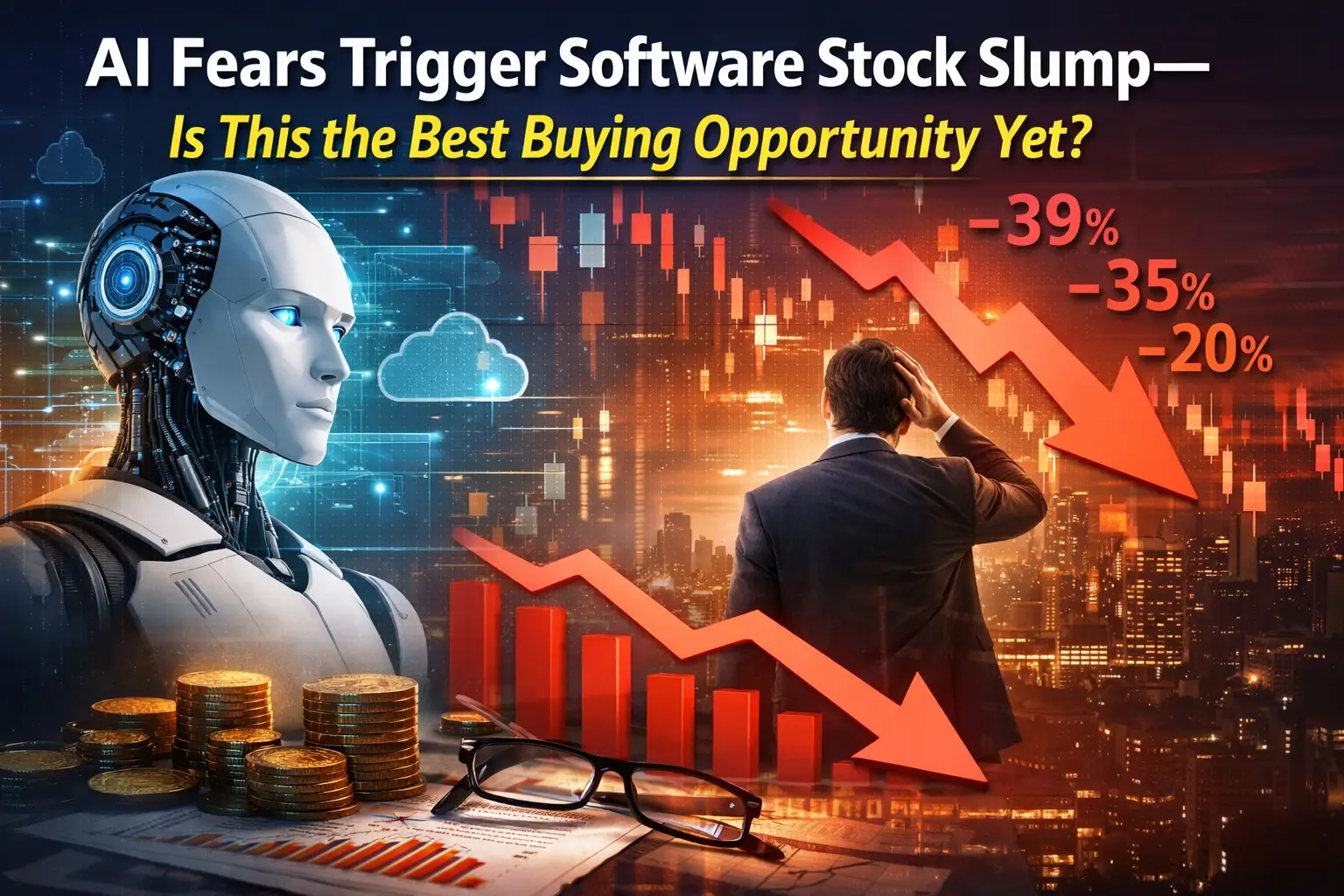
The WisdomTree Cloud Computing Fund has fallen roughly 20% so far this year, including a sharp drop in recent weeks. Several high-profile software names have performed even worse:
- HubSpot: down nearly 40% in 2026 after a brutal 2025
- **Figma year
- Atlassian: down about 35%
- Shopify: down close to 30%
The common thread is fear. Investors are increasingly questioning whether traditional SaaS vendors can survive in a world where AI can generate apps, websites, legal documents, and marketing content in minutes using simple text prompts.
Generative AI Changes the Rules of the Game
The generative AI boom began in earnest with OpenAI’s ChatGPT, and since then, AI capabilities have rapidly expanded into the enterprise. Today, AI tools can automate tasks that once required multiple specialized software products.
Levie describes a growing “cognitive dissonance” inside the software industry. On one hand, companies see AI dramatically enhancing their offerings. On the other, markets fear that the same technology could render many software platforms obsolete.
According to Levie, this fear misunderstands how enterprises actually operate. Most businesses, he argues, would rather pay specialized vendors to manage back-office systems, content, or customer data than attempt to build and maintain AI-powered systems themselves—along with the legal, security, and compliance risks that come with them.
Enterprise Software Leaders Push Back
Other software leaders echo this view. Marc Benioff, CEO of Salesforce, has argued that deeply embedded enterprise platforms are difficult to replace. Salesforce’s AI-driven Agentforce product, which automates sales and customer service workflows, is already one of the fastest-growing offerings in the company’s history.
Similarly, Bill McDermott of ServiceNow says his company serves as the “semantic layer” that allows AI to work securely and effectively across large organizations.
Even so, reassurance from executives has done little to calm markets. Salesforce and ServiceNow stocks have both lost roughly a quarter of their value this year.
Anthropic’s Role in Accelerating the Selloff
A major catalyst behind the recent panic has been Anthropic, the creator of the Claude AI model. The company recently unveiled new legal, finance, and marketing capabilities for its Claude Cowork productivity tool—and released its plugins as open source.
This move sent shockwaves through the software industry. By making advanced AI tools customizable and widely accessible, Anthropic intensified fears that enterprises might bypass traditional SaaS vendors altogether.
Claude now competes directly with OpenAI’s GPT models and Google’s Gemini, with a strong focus on large corporate customers deploying AI at scale.
Anthropic’s momentum is reflected in its valuation. The company recently signed a term sheet for a $10 billion funding round valuing it at $350 billion, while OpenAI is reportedly exploring valuations north of $800 billion. Meanwhile, Google parent Alphabet has seen its stock surge over the past year, reinforcing the narrative that AI infrastructure and model builders are the real winners.
Are Software Companies Really Being Replaced?
Despite market fears, many analysts and investors on the ground see little evidence that enterprises are abandoning their existing software stacks.
Analysts tracking HubSpot recently noted that partners are not reporting near-term reductions in software seats or widespread replacement by AI tools. Instead, AI is being layered on top of existing platforms.
Similarly, analysts covering Monday.com argue that the company is benefiting from long-term digital and AI collaboration trends. They view the stock’s sharp decline as an attractive entry point rather than a warning sign.
The Buy-the-Dip Argument Gains Momentum
Some of the most experienced investors in cloud software are openly embracing the volatility. Bessemer Venture Partners partner Byron Deeter recently described the current moment as one where “chaos creates opportunity.”
Deeter, an early investor in Box, believes that while AI will undoubtedly reshape software, it will not eliminate the need for trusted platforms that manage data, workflows, and compliance at scale.
Adapt or Fall Behind
Even the most optimistic executives agree on one point: complacency is not an option. AI is forcing every software company to move faster, innovate more aggressively, and deliver greater value to customers.
For IT buyers, this competition is ultimately beneficial. Vendors are racing to integrate AI responsibly, securely, and in ways that actually reduce costs and complexity rather than adding new risks.
Final Thoughts: Fear or Opportunity?
The software sector’s slump in 2026 reflects fear of disruption, not necessarily evidence of decline. While AI agents are undeniably powerful, they are more likely to transform software than replace it outright—at least in the foreseeable future.
For long-term investors, the current selloff may prove to be less a signal of extinction and more a rare opportunity. As history has shown, industries undergoing profound technological change often reward those who can separate short-term panic from long-term fundamentals.
The “most exciting moment” in software may also be its most misunderstood.