Anthropic’s AI Plugins and the Day the SaaS Narrative Cracked
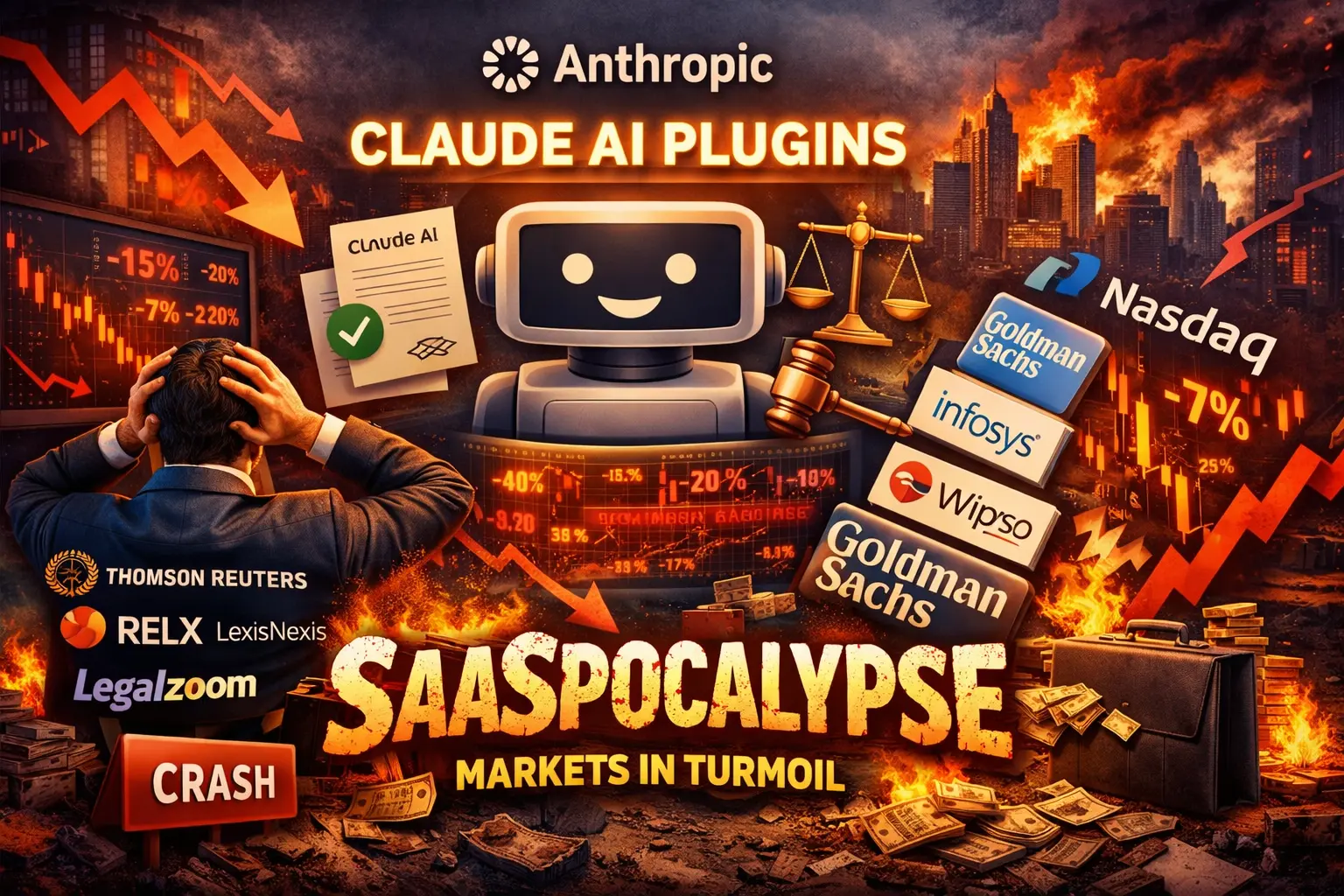
A single product announcement rarely erases hundreds of billions of dollars in market value. Yet that is exactly what happened when Anthropic released a set of open-source plugins for its Claude Cowork tool. What followed was a violent market reaction now being described by analysts as a “SaaSpocalypse”—a sharp reassessment of the long-held belief that artificial intelligence merely supports software companies rather than competes with them.
In one trading session, roughly $285 billion was wiped off software, legal tech, and financial services stocks. The catalyst was not a new foundation model or a breakthrough algorithm. It was a folder of workflows.
What Anthropic Actually Launched
Claude Cowork is Anthropic’s agentic AI assistant designed for non-technical professionals. Unlike developer-centric tools, Cowork can read and organise files, draft documents, manage folders, and execute multi-step tasks with explicit user consent. Think of it as an office-ready AI colleague rather than a coding assistant.
The real shock came when Anthropic released 11 open-source starter plugins for Cowork. These plugins allow organisations to configure Claude for specific roles—defining workflows, connecting internal tools and data, and automating routine processes across domains such as sales, marketing, finance, data analysis, customer support, product management, and scientific research.
One plugin stood out: legal workflows.
This legal plugin automates tasks like contract review, NDA triage, compliance checks, and legal brief preparation. Anthropic was careful to include disclaimers stating that outputs must be reviewed by licensed attorneys and that the tool does not provide legal advice. Markets, however, paid little attention to those caveats.
Why Legal Tech Stocks Panicked First
Legal information giants were hit hardest. Thomson Reuters fell more than 15%, while RELX, owner of LexisNexis, dropped about 14%. LegalZoom lost nearly 20% in a single session.
The fear was not that Claude suddenly became a perfect legal mind. By Anthropic’s own admission, the plugin is largely a structured set of prompts and configurations. There is no proprietary legal reasoning engine, no bespoke model trained exclusively on case law.
What spooked investors was something deeper: Anthropic moved up the value chain—from selling intelligence to selling outcomes.
From API Provider to Workflow Owner
Until recently, AI model developers were seen as neutral infrastructure providers. Software companies could safely build products on top of large language models without worrying that the model creator would compete directly with them. That assumption is now under strain.
When Claude existed primarily as an API, firms like Thomson Reuters could integrate AI into their products while maintaining ownership of the workflow and customer relationship. The moment Anthropic published ready-made vertical solutions—especially for high-margin sectors like law—it signaled a strategic shift.
Analysts argue that the real competitive threat is not better AI reasoning, but workflow ownership. Whoever controls the workflow controls pricing power, distribution, and user dependency.
The Broader Market Fallout
The selloff quickly spread beyond legal tech. A Goldman Sachs basket tracking U.S. software stocks recorded its worst single-day decline since April’s tariff-driven rout. The Nasdaq fell 1.4%.
Enterprise software leaders were dragged down with it. DocuSign lost double digits, while Salesforce, Adobe, and ServiceNow all fell around 7%.
The impact even crossed borders. Indian IT majors were not spared, with Infosys ADRs sliding over 5% and Wipro down nearly 5%.
This was not a sector-specific correction. It was a narrative reset.
Why a ‘Folder of Prompts’ Was Enough
At first glance, the reaction seems excessive. How could a set of open-source plugins—essentially curated prompts—trigger such destruction?
The answer lies in speed and intent.
Enterprise software companies typically take quarters, sometimes years, to design, test, and ship workflow automation features. Anthropic launched Cowork on January 12 and shipped industry-specific plugins less than three weeks later. That pace signals a fundamentally different operating model—one where AI vendors can iterate faster than traditional SaaS firms can respond.
As Jefferies analysts put it, the market has flipped its core assumption. The old story was AI helps SaaS companies grow. The new story is AI vendors are the SaaS companies.
Pressure on Startups and Incumbents Alike
Anthropic’s move also complicates the outlook for legal-tech startups. Companies like Harvey AI and Legora have spent years building AI-assisted legal tools and command multibillion-dollar valuations.
The problem? Many of these startups rely on third-party foundation models—including Claude itself. When the model creator begins offering overlapping functionality, the startup risks being squeezed between incumbents and its own infrastructure provider.
Anthropic’s vertical integration—owning both the model and the workflow—gives it a structural advantage that few competitors can easily match.
Anthropic’s Growth Explains the Fear
Investors are reacting not just to the product, but to Anthropic’s momentum. Claude Code reportedly reached $1 billion in annualised recurring revenue within months of launch. The company is said to be raising $20 billion at a valuation near $350 billion, a dramatic jump from earlier 2025 levels.
Meanwhile, enterprise adoption is accelerating. Analysts estimate that enterprises now account for around 80% of Anthropic’s business, suggesting that Claude is gaining ground against rivals like OpenAI in corporate deployments.
This combination—rapid iteration, enterprise focus, and vertical ambition—is what makes markets uneasy.
What This Means for the Future of Software
The “SaaSpocalypse” does not mean traditional software companies are obsolete overnight. Domain expertise, regulatory trust, and deep customer relationships still matter. But the buffer that once protected SaaS firms—the assumption that AI vendors would stay upstream—has clearly eroded.
For software executives, the lesson is stark: differentiation cannot rely solely on workflow automation anymore. If a general-purpose AI can replicate 70% of your product’s value with configuration and prompts, your moat is thinner than you thought.
Anthropic did not unveil a revolutionary new model. It simply demonstrated what Claude could already do—and published the instructions. That alone was enough to shake global markets.
In the age of agentic AI, sometimes all it takes to disrupt an industry is not invention, but execution—and the confidence to hit “publish.”