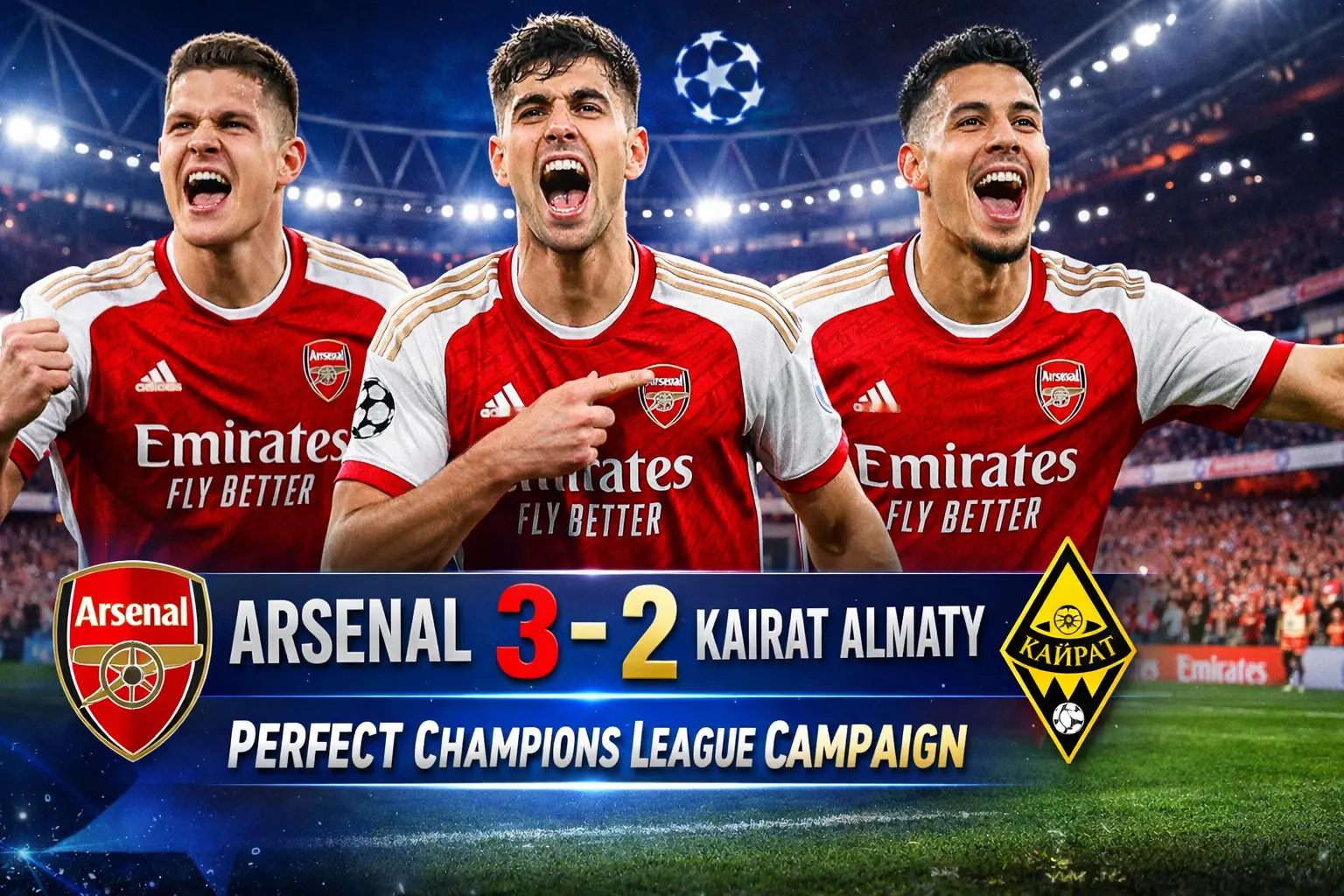
Arsenal wrapped up a flawless UEFA Champions League league-phase campaign with an entertaining 3-2 victory over Kairat Almaty at the Emirates Stadium, combining rotation, youth, and returning star quality in a performance that underlined their growing European maturity. Goals from Viktor Gyokeres, Kai Havertz, and Gabriel Martinelli ensured the Gunners finished the phase with a 100 per cent record, comfortably securing top spot in the table.
With qualification already within touching distance, Arsenal manager Mikel Arteta opted for wholesale changes, naming an entirely fresh starting XI. The headline return was Kai Havertz, making his first competitive start in 358 days after a long injury layoff. The German’s influence was immediate—and decisive.
Lightning start and early drama
Arsenal could not have scripted a better opening. Inside just two minutes, Havertz dropped into a clever pocket of space and threaded a precise forward pass for Viktor Gyokeres, who rifled his finish past the Kairat goalkeeper to give the hosts an early lead. The Emirates barely had time to settle before the Gunners were in front.
However, the advantage was short-lived. Straight from the restart, a long ball exposed Arsenal’s high line. Kairat forward Jorginho was tugged back by Riccardo Calafiori, himself returning from injury. After a VAR review, referee Urs Schnyder pointed to the spot, and Jorginho calmly converted past Kepa Arrizabalaga to restore parity.
The setback did little to disrupt Arsenal’s rhythm. Arteta’s rotated side continued to dominate possession, pressing aggressively and moving the ball sharply between the lines.
Havertz marks his return in style
Arsenal’s control was rewarded midway through the first half, and fittingly it was Havertz who provided the moment of quality. Picking up the ball on the left edge of the box, he cut inside onto his stronger foot and unleashed a ferocious strike high into the net. After nearly a year without a start, it was a goal that spoke of confidence, technique, and belief.
The German was at the heart of everything Arsenal did well in attack. His movement disrupted Kairat’s defensive shape, while his physical presence created space for Gyokeres to operate centrally. The Swedish striker could easily have doubled his tally before the break, missing two gilt-edged chances, including a close-range effort from under the crossbar.
Three before half-time
Arsenal’s pressure eventually told again. Havertz, continuing his standout display, drifted into space inside the area and delivered a low cross. Gyokeres’ initial prod was met on the goal line by Gabriel Martinelli, who ensured the ball crossed before being cleared.
VAR conducted a lengthy check for potential offsides involving both Havertz and Martinelli, but the goal stood. At 3-1, Arsenal were firmly in control and cruising toward another European win.
Recognising Havertz’s workload after such a long absence, Arteta withdrew both him and Calafiori at half-time, managing minutes with bigger domestic challenges ahead.
Comfortable second half and academy joy
The second half lacked the intensity of the first, but Arsenal never looked in danger of surrendering their advantage. Captain Martin Odegaard came close on two occasions, seeing a pair of headers well saved as the Gunners probed for a fourth.
One of the night’s most heartwarming moments arrived when 17-year-olds Brando Bailey-Joseph and Ife Brahima were introduced from the bench, marking their senior Arsenal debuts and highlighting the club’s commitment to youth development.
Gabriel Jesus thought he had added a late fourth, only for the semi-automated offside system to rule out the effort almost instantly. Kairat did manage a late consolation through Ricardinho, but it did little to dampen the celebratory mood inside the stadium.
Arteta’s verdict on Havertz
Post-match, Arteta was full of praise for Havertz’s contribution, highlighting both his tactical intelligence and technical quality.
The Arsenal boss emphasised the plan to limit the German to 45 minutes, while also hinting that selection decisions for upcoming fixtures—particularly against Leeds—would now be more complex. Arteta underlined Havertz’s versatility, his understanding of the Premier League, and his ability to cope with pressure as reasons why he could play a key role in the second half of the season.
Tactical implications: Is Odegaard under pressure?
Havertz’s performance has reignited debate around Arsenal’s attacking midfield hierarchy. With Odegaard substituted early in recent league games and Eberechi Eze also pushing for involvement, competition is intensifying.
From an analytical standpoint, Havertz offers something different. His physicality and off-ball movement complement Gyokeres’ style, as evidenced by their combined touches in the opposition box during the first half. While Odegaard remains Arteta’s trusted creative leader, Havertz’s display demonstrated that Arsenal now possess genuine tactical flexibility in advanced areas.
What’s next for Arsenal?
By completing the league phase with a perfect record, Arsenal have positioned themselves as one of the tournament’s most consistent sides. In the last 16, they will face one of Borussia Dortmund, Olympiakos, Atalanta, or Bayer Leverkusen.
With momentum building, key players returning, and young talents emerging, Arsenal’s Champions League campaign is gathering serious belief. The victory over Kairat Almaty may have come against bottom opposition, but it showcased squad depth, tactical evolution, and a returning star who could yet shape the season’s defining moments.
For Arteta and Arsenal, this was more than just another win—it was a statement of readiness for the knockout stages ahead.