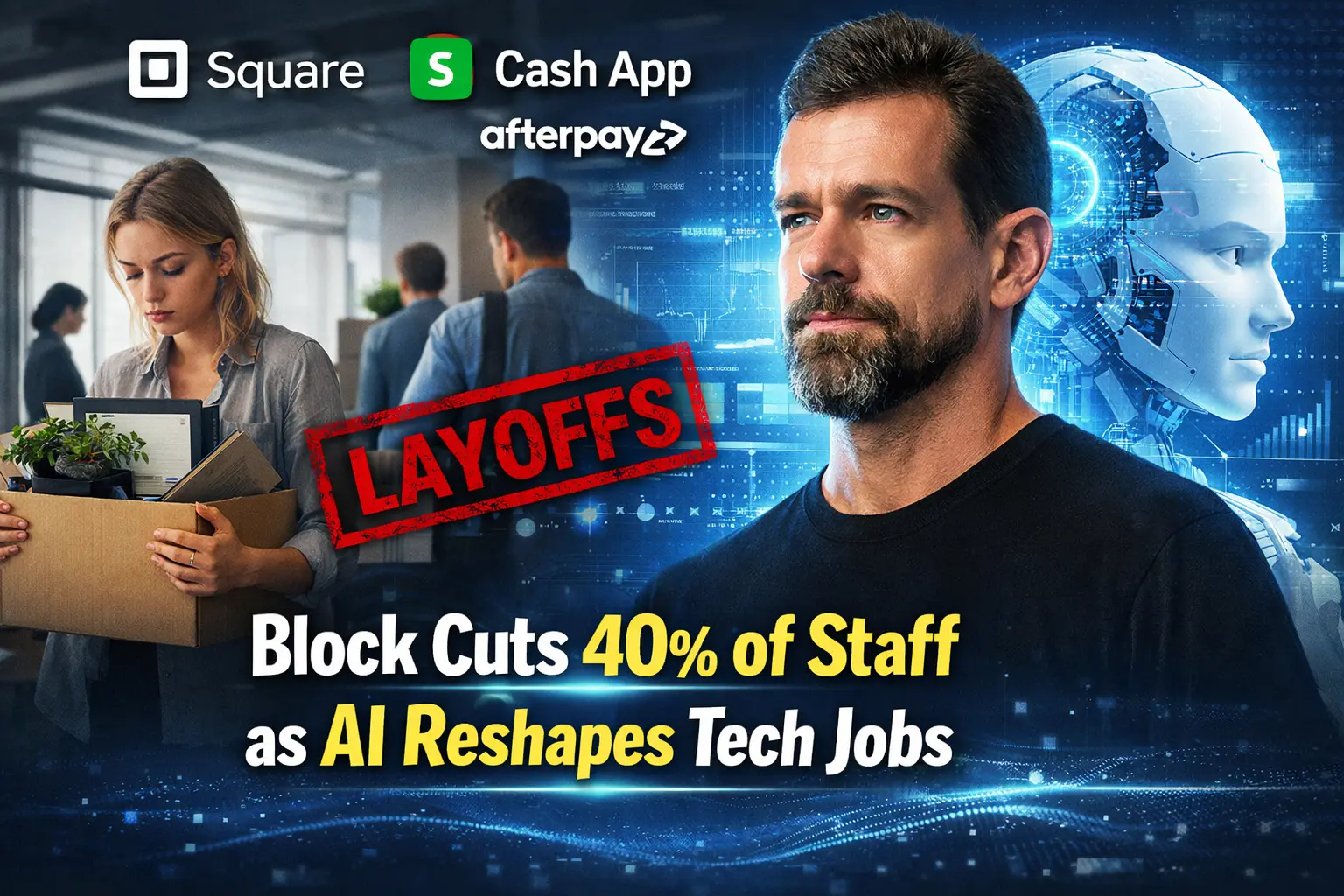
Block Lays Off 40% of Workforce as AI Redefines the Future of Work
The rapid advancement of artificial intelligence is no longer a distant concept—it is actively transforming corporate structures, workforce strategies, and long-term business models. In a bold and controversial move, Block, Inc., the financial technology company behind Square, Cash App, and Afterpay, has announced a massive workforce reduction of approximately 40%.
The decision will eliminate more than 4,000 roles, shrinking the company’s headcount to just under 6,000 employees. According to co-founder and CEO Jack Dorsey, the primary driver behind these layoffs is not financial instability—but artificial intelligence.
AI as a Structural Catalyst, Not a Cost-Cutting Excuse
In a letter to shareholders, Dorsey emphasized that the company’s business fundamentals remain strong. Gross profit continues to grow, and the company is not facing operational distress. Instead, the restructuring reflects a strategic shift toward AI-powered productivity.
Dorsey stated that a “significantly smaller team” equipped with advanced intelligence tools can accomplish more work—and do it better. He further argued that AI capabilities are compounding at an accelerating pace, making traditional workforce models inefficient.
Block’s Chief Financial Officer, Amrita Ahuja, echoed this position in the company’s financial guidance. She noted that the firm sees an opportunity to operate with smaller, highly skilled teams leveraging AI to automate large volumes of operational tasks.
In essence, the layoffs are being positioned as a forward-looking recalibration rather than a defensive reaction.
A Broader Tech Industry Trend
Block is not alone. The technology sector has experienced substantial workforce reductions over the past year, many of which have been at least partially attributed to artificial intelligence integration.
Major corporations including Amazon, Meta, Microsoft, and Verizon have announced sweeping job cuts. While each company cites multiple factors—economic normalization, efficiency improvements, and restructuring—AI-driven automation has emerged as a central theme.
During the pandemic, many tech firms rapidly expanded to meet soaring demand for digital services. Remote work, e-commerce, digital payments, and online communication tools saw unprecedented growth. Block itself grew from roughly 3,800 employees in 2019 to over 10,000 before the recent layoffs.
Now, leaders across the industry are recalibrating to pre-pandemic staffing levels while integrating AI systems to enhance operational efficiency.
“Most Companies Are Late,” Says Dorsey
Dorsey believes his company is ahead of a broader corporate shift. In public remarks, he suggested that most companies will reach a similar conclusion within the next year and implement comparable structural changes.
His philosophy is clear: it is better to act decisively and transparently rather than reduce staff gradually over an extended period. By making immediate adjustments, Block aims to operate leaner and faster in an AI-driven economy.
This proactive stance contrasts with reactive downsizing strategies seen in previous economic downturns.
AI’s Expanding Capabilities in Enterprise Work
The workforce implications of AI are intensifying as major AI firms roll out enterprise-grade tools capable of performing complex professional tasks.
Companies like Anthropic and OpenAI continue to release models that handle tasks in human resources, design, financial analysis, and wealth management. Anthropic recently upgraded its Claude system to perform more effectively in white-collar office environments.
These tools are not limited to repetitive manual processes; they increasingly assist in decision-making, documentation, analysis, and workflow automation. As AI systems improve weekly, businesses are reconsidering how many employees are necessary to achieve the same—or greater—output.
Software sector volatility earlier this month reflected investor sensitivity to these AI advancements. When Anthropic launched updates to its enterprise tools, several software stocks declined sharply, signaling market awareness of potential disruption.
Investor Reaction: Efficiency Over Expansion
Wall Street responded positively to Block’s announcement. The company’s shares surged as much as 24% following the news.
Investors appear to favor leaner operating models, particularly when paired with strong profitability metrics. The shift suggests that markets are rewarding companies that aggressively pursue automation-driven efficiency.
This marks a departure from the growth-at-all-costs mentality that defined the pandemic-era tech boom. Today’s investment climate emphasizes profitability, productivity, and technological leverage.
Employee Support Measures
Although the layoffs are significant, Block has outlined a compensation package for affected workers. The severance includes:
- A minimum of 20 weeks of pay (with longer periods based on tenure)
- Equity vesting through the end of May
- Six months of healthcare coverage
- Retention of corporate devices
- An additional $5,000 support payment
These benefits aim to cushion the transition for displaced employees while reinforcing the company’s assertion that the decision is strategic rather than financial distress-driven.
The Long-Term Labor Market Question
The central issue raised by Block’s restructuring is broader than one company’s headcount—it concerns the evolving structure of the labor market.
If AI enables smaller teams to produce higher output, workforce demand in certain sectors may permanently decline. However, historical technological revolutions suggest that while some roles disappear, new ones emerge.
The challenge lies in the transition period.
Professionals in administrative, operational, and analytical roles may face increased pressure to upskill in AI literacy, automation management, and advanced technical capabilities. Organizations will likely prioritize hybrid skill sets—human creativity combined with AI proficiency.
Lean Operations as the New Corporate Norm
Dorsey’s move reflects a growing executive consensus: operate lean, move fast, and integrate AI deeply into workflows.
Similarly, Amazon leadership recently emphasized reducing organizational layers to accelerate decision-making, describing AI as the most transformative technology since the internet itself.
If this perspective gains universal traction, corporate structures could shift from labor-intensive hierarchies to compact, high-skill teams augmented by AI systems.
Block’s 40% workforce reduction is one of the most direct acknowledgments yet of AI’s structural impact on corporate employment. Unlike traditional layoffs driven by declining revenue, this move represents a strategic pivot toward automation-enabled productivity.
With investors applauding and industry leaders signaling similar intentions, the tech sector may be entering a new phase—one defined not by expansion, but by intelligent optimization.
Whether this shift results in widespread job displacement or a redefinition of work itself remains uncertain. What is clear, however, is that artificial intelligence is no longer a supplementary tool. It is rapidly becoming the operational backbone of modern enterprises.
And according to Jack Dorsey, this is only the beginning.