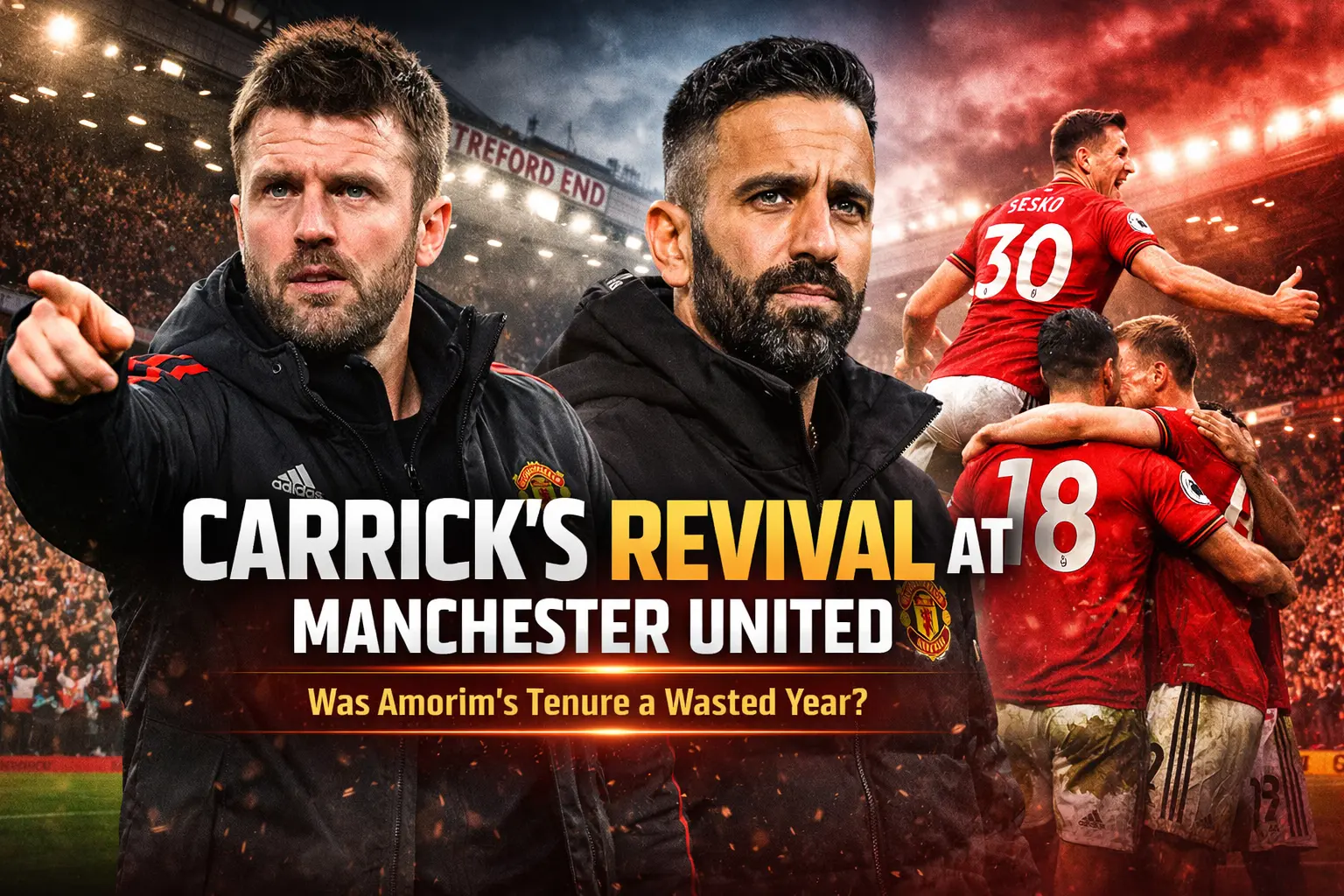
Few football clubs live as intensely in their past as Manchester United. Late winners, emotional nights under the lights, and the roar of the Stretford End are woven into the club’s identity. When United snatched another dramatic stoppage-time victory, this time under Michael Carrick, the reaction felt familiar—almost nostalgic.
But nostalgia quickly turned into an uncomfortable question: is Carrick proving that Ruben Amorim’s year in charge was effectively wasted?
The Return of a Familiar Feeling
Carrick’s words after the latest dramatic win captured the mood perfectly. He spoke of emotion, connection, and that unique surge of elation when United score late at Old Trafford. These are not just romantic ideals; they are moments that define how supporters measure success.
Ironically, Ruben Amorim also delivered moments like these during his tenure. Thrilling wins, dramatic European nights, and flashes of promise suggested something might be building. Yet, consistency—the currency of elite management—never followed.
What Carrick has done in a short space of time is restore belief that those moments can be part of a broader, functional system rather than isolated highs.
Results That Rewrite the Narrative
The numbers are stark. In just a handful of league matches, Carrick has achieved something Amorim struggled with throughout his 14-month spell: momentum. Consecutive league wins, a rapid climb up the table, and a return to Champions League contention have shifted the narrative almost overnight.
By contrast, Amorim’s Premier League record told a story of hesitation. Wins rarely came in clusters, and progress up the table often stalled just as optimism began to grow. His points-per-game return ranked among the lowest for United managers in the post-Sir Alex Ferguson era—a damning statistic at a club where patience is always conditional.
Carrick’s immediate impact has forced supporters and pundits alike to re-evaluate whether United simply endured a lost year by backing a project that never truly aligned with the club’s needs.
Tactical Simplicity vs Tactical Stubbornness
One of the most visible changes under Carrick has been structural. The move away from a back three to a more traditional four-man defence has not solved every issue, but it has restored balance.
Under Amorim, the system often felt imposed rather than evolved. Players were asked to adapt to roles that dulled their strengths, leading to confusion and caution. Carrick, by contrast, has prioritised clarity—players know where they stand and what is expected.
This shift has been particularly beneficial for young midfielders such as Kobbie Mainoo, whose return to prominence symbolises Carrick’s approach. Freed from tactical congestion and positional battles, Mainoo has looked composed, intelligent, and influential—qualities that had been largely absent during Amorim’s final months.
Man Management and Identity
Beyond tactics, Carrick has re-established something less tangible but equally important: trust. His calm authority and deep understanding of the club resonate with players and fans alike.
Amorim, despite his impressive reputation and articulate press conferences, often appeared disconnected from the emotional rhythms of the club. His messaging rarely translated into performances, and dressing-room confidence seemed fragile as results dipped.
Carrick’s presence on the touchline, much like his playing days, exudes steadiness. It is not revolutionary, but at Manchester United, stability itself can be transformative.
Europe Back on the Horizon
Perhaps the most damaging aspect of Amorim’s reign was the missed opportunity in Europe. Failure to secure Champions League football not only hurt the club financially but also undermined its pull in the transfer market.
Carrick has reversed that trajectory almost immediately. United now sit in a strong position for European qualification, with Champions League football once again a realistic target. In modern football economics, this shift alone justifies the managerial change.
It also sharpens the criticism of the club’s hierarchy. Had decisive action been taken earlier, could United have avoided drifting through a season defined by hesitation?
Was the Year Truly Wasted?
To label Amorim’s tenure entirely wasted would be unfair. He inherited a fractured squad and attempted to implement a long-term vision. Some players improved, and certain performances hinted at a future that never materialised.
Yet football at elite clubs is ruthless. When a successor achieves rapid improvement with largely the same squad, uncomfortable conclusions are inevitable. Carrick has not transformed United overnight—but he has made them coherent, competitive, and confident.
That contrast is why the debate now centres not on if Amorim should have gone, but why he was appointed in the first place.
What Happens Next?
The question of whether Carrick should be given the job permanently remains open. Short-term success does not guarantee long-term excellence. But what he has undeniably done is remind everyone what Manchester United can look like when clarity, belief, and identity align.
For supporters, the joy is immediate. For the club’s decision-makers, the lesson is sobering. Footballing philosophy matters, but fit matters more.
If Carrick’s early success continues, history may judge Amorim’s tenure not as a failed experiment—but as a costly detour on the road back to Manchester United’s true self.