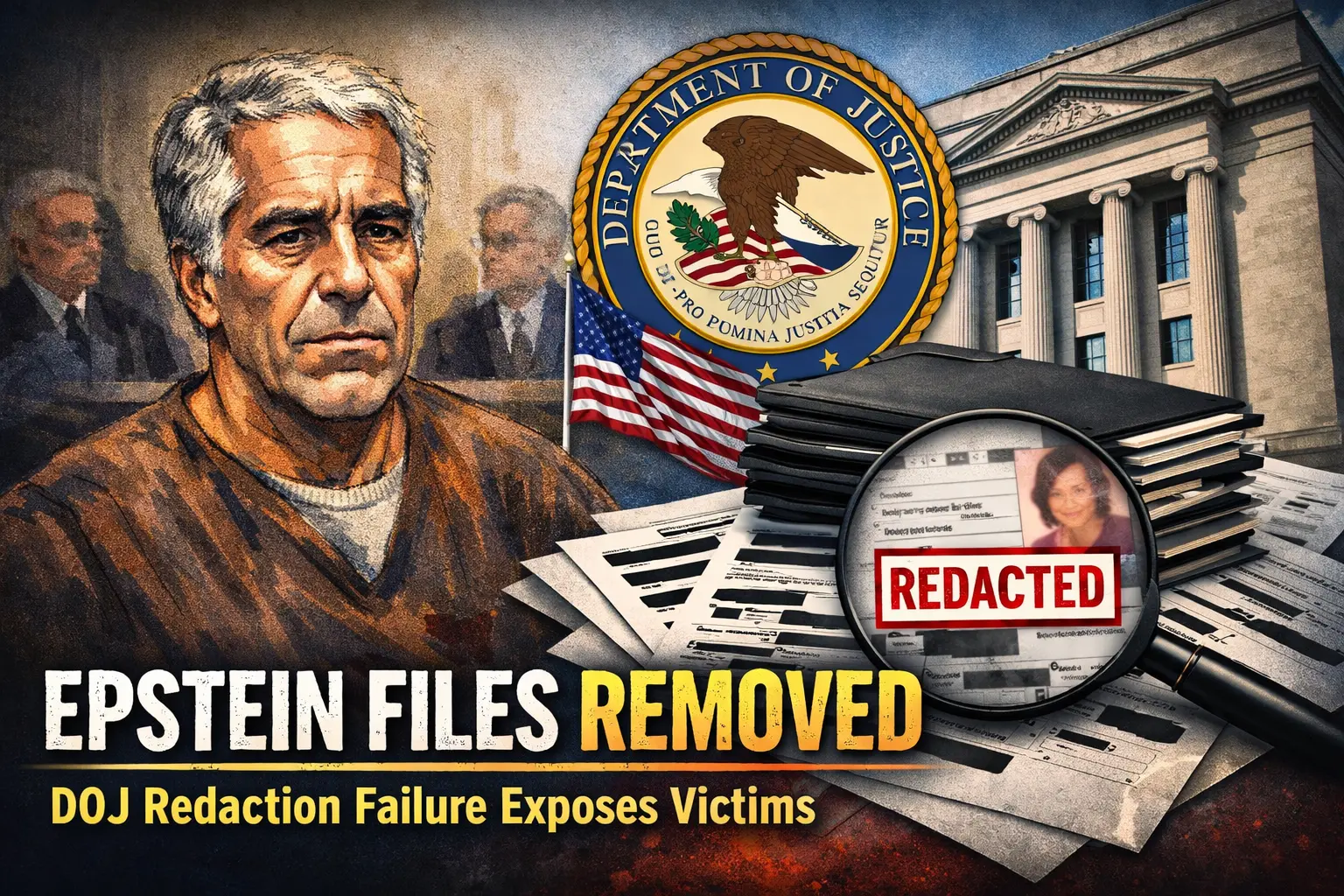
Thousands of Epstein Documents Taken Down After Victim Identities Exposed
The latest release of documents connected to disgraced financier Jeffrey Epstein has ignited widespread outrage, after serious redaction failures led to the exposure of victims’ identities. In a dramatic reversal, the US Department of Justice (DOJ) removed thousands of files from its website following urgent complaints from survivors and their legal representatives.
What was intended to be a landmark transparency exercise has instead become a deeply controversial episode, with victims describing the disclosure as retraumatizing, dangerous, and unprecedented in its scope.
What Happened in the Latest Document Release
On Friday, the DOJ published approximately three million additional documents linked to the federal investigation into Epstein. The release was part of a congressionally mandated disclosure requiring the government to make public all Epstein-related material while ensuring that victims’ identities were fully protected.
However, shortly after publication, lawyers representing survivors discovered severe flaws in the redaction process. According to court filings, thousands of pages contained unredacted or poorly redacted personal information, including:
- Full names of survivors
- Email addresses and banking details
- Nude photographs where faces and identifying features were visible
Nearly 100 survivors were reportedly affected, many of whom had never been publicly identified before.
Victims Call the Disclosure “Outrageous”
In a joint statement, Epstein survivors condemned the DOJ’s actions, saying the release had “turned upside down” their lives. They stressed that transparency must never come at the cost of victim safety and dignity.
One survivor described the release as “life-threatening,” while another said she received death threats after her private financial information became public. The emotional toll has been immense, with survivors stating they felt exposed, scrutinized, and retraumatized by the very system meant to protect them.
Speaking to the BBC, survivor Annie Farmer said it was difficult to focus on any new revelations from the files because of the damage caused by the exposure. Another survivor, Lisa Phillips, accused the DOJ of violating commitments on disclosure, deadlines, and confidentiality.
Emergency Legal Action Against the DOJ
On Friday, victim advocates Brittany Henderson and Brad Edwards filed an emergency request in federal court in New York, urging a judge to order the immediate removal of the website hosting the files.
They described the situation as “the single most egregious violation of victim privacy in one day in United States history.” Their filing argued that the DOJ’s failure to properly redact sensitive information constituted an unfolding emergency requiring immediate judicial intervention.
Several survivors personally submitted comments to the court, underscoring the real-world risks created by the disclosures.
DOJ Admits Errors, Removes Files
In a letter to the federal judge on Monday, the DOJ acknowledged the errors and confirmed that all documents flagged by victims or their lawyers had been taken down for further redaction. The department attributed the failures to “technical or human error” and said it was continuing to review new requests.
The DOJ also stated that a “substantial number” of documents had been independently identified and removed as a precaution. According to the department, only 0.1% of released pages were found to contain unredacted identifying information—but for victims, even a single exposed page can have devastating consequences.
A DOJ spokesperson told CBS that the department takes victim protection “very seriously” and is working around the clock to fix the issue.
Redaction Failures Raise Systemic Concerns
The incident has reignited broader concerns about how large-scale document disclosures are handled, especially in cases involving sexual violence and trafficking. Proper redaction is not a technical afterthought—it is a legal and ethical obligation.
Veteran women’s rights attorney Gloria Allred criticized the release, noting that in some files, names were crossed out so poorly that they remained readable. In others, photographs of survivors who had never spoken publicly were included without adequate safeguards.
For advocates, this underscores a troubling pattern: institutional failures that prioritize speed or optics over survivor safety.
The Political and Legal Backdrop
The document release was mandated after both chambers of Congress approved legislation compelling the DOJ to publish all Epstein-related material. The law required strict redaction of any details that could identify victims.
The latest batch of files was released six weeks after the DOJ missed its original deadline, a delay that occurred under bipartisan pressure and a law signed by Donald Trump.
Since last year, the DOJ has released millions of Epstein-related records, including:
- Over three million pages of documents
- Around 180,000 images
- Approximately 2,000 videos
The scale of the disclosure makes precision and care even more critical—yet critics argue the DOJ was unprepared for the magnitude of the task.
Epstein’s Death and Unfinished Accountability
Epstein died in a federal jail in New York on 10 August 2019 while awaiting trial on sex-trafficking charges. His death left many victims without the courtroom accountability they sought, making public disclosures one of the few remaining avenues for truth.
However, survivors have repeatedly emphasized that truth-seeking must not come at the cost of their safety. Transparency that harms victims, they argue, is not justice.
A Breach of Trust That Will Have Lasting Impact
For Epstein’s survivors, the DOJ’s redaction failure represents more than a technical mistake—it is a breach of trust. Many had cooperated with investigators believing their identities would remain protected. The exposure has reopened old wounds and created new fears.
As legal proceedings continue and further reviews are conducted, the episode stands as a stark warning. When institutions fail to safeguard the most vulnerable, the damage can eclipse the very purpose of disclosure.
Whether meaningful reforms follow remains to be seen. For now, survivors say they will continue to fight—not just for accountability in the Epstein case, but for a system that truly places victim protection at its core.