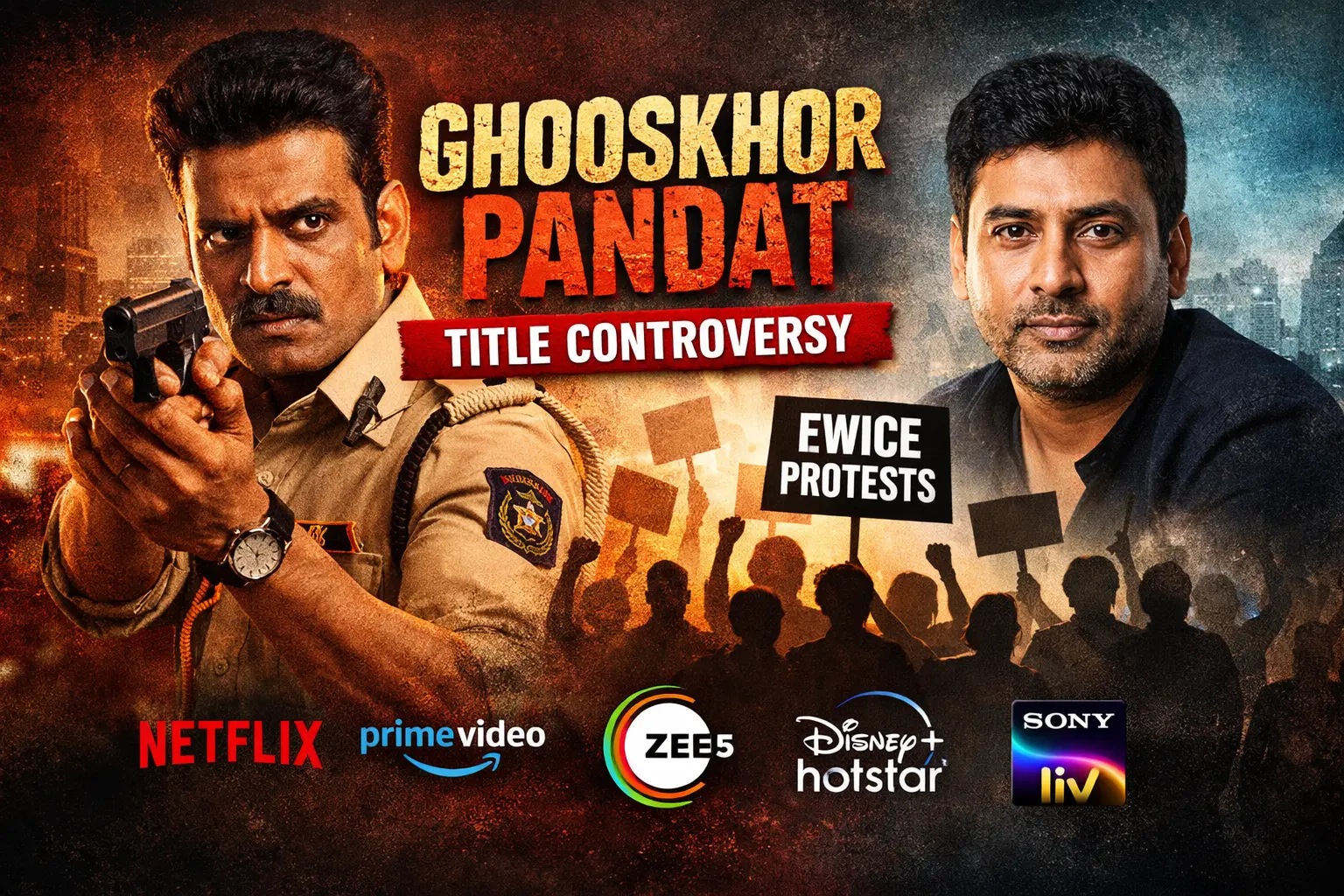
FWICE’s Objection to ‘Ghooskhor Pandat’: A Controversy That Reignites the Debate on Sensitivity in Indian Cinema
Indian cinema has once again found itself at the centre of a heated social and cultural debate. The upcoming crime thriller Ghooskhor Pandat, starring Manoj Bajpayee, has drawn strong objections from the Federation of Western India Cine Employees (FWICE) over its title, which the body has termed derogatory, offensive, and potentially disruptive to social harmony.
The film, produced by noted filmmaker Neeraj Pandey under his banner Friday Filmworks and directed by Ritesh Shah, was announced earlier this week. What was expected to be a routine project announcement quickly escalated into controversy, drawing reactions from political leaders, social media users, and industry bodies.
Why the Title Sparked Objections
The term “Ghooskhor Pandat” roughly translates to “bribe-taking Pandit.” FWICE has argued that the title appears to single out a specific community and associate it with corruption, thereby reinforcing harmful stereotypes. According to the union, such representation goes beyond creative liberty and enters the realm of social insensitivity.
In a strongly worded letter addressed to major OTT platforms including Netflix, Amazon Prime Video, Disney+ Hotstar, ZEE5, and SonyLIV, FWICE stated that the title targets “a particular community and its traditional means of livelihood in a derogatory and offensive manner.”
The union, which represents 36 affiliated associations of workers, technicians, and artists across the Indian entertainment industry, emphasised that cinema reaches millions and carries a responsibility to avoid content that may provoke division.
Concerns Over Social Harmony
FWICE’s objection is rooted in a broader concern about maintaining social unity in a diverse country like India. In its letter, the body warned that provocative titles can hurt sentiments, provoke misunderstandings, and disturb communal harmony.
The union reiterated its belief that society should not be divided on the basis of caste, creed, religion, or profession. It appealed to all producer bodies to ensure that film titles are chosen responsibly and do not create unrest or alienation among communities.
Copies of the letter were also sent to industry associations such as the Producers Guild of India, Indian Motion Picture Producers Association, and Indian Film and Television Producers Council, urging them to take note of the issue.
Threat of Industry Action
One of the most significant aspects of FWICE’s response was its warning of further action if the issue is not resolved promptly. The union stated that it could advise its members and affiliated associations to distance themselves from projects associated with the producer if the title is not withdrawn.
Such a move could have serious implications, as FWICE’s membership spans a wide cross-section of the industry, from technicians to artists. Historically, objections from major unions have often forced producers to reconsider creative decisions, especially when public sentiment aligns with the union’s stance.
About the Film and Its Narrative
Despite the controversy, Ghooskhor Pandat is positioned as a gritty crime thriller. Manoj Bajpayee plays Ajay Dikshit, also known as Pandat, a corrupt police officer operating in Delhi. The story reportedly follows a single night in the officer’s life, where his plans for personal gain spiral out of control as he becomes entangled in a global conspiracy.
The film is said to explore themes of corruption, power, and moral decay—subjects that Indian cinema has tackled many times before. However, critics argue that while addressing corruption is valid, the way characters are named and framed carries symbolic weight and must be handled carefully.
Neeraj Pandey’s Response
Amid growing backlash, Neeraj Pandey took to social media to acknowledge that the film’s title had hurt a section of the audience. In his statement, he said that all promotional materials related to the film would be taken down temporarily.
While Pandey did not announce an immediate change of title, his acknowledgment was seen as a step toward dialogue. Observers believe that discussions between the production house, OTT platforms, and industry bodies are likely to follow in the coming days.
The Larger Debate: Creative Freedom vs Responsibility
The controversy surrounding Ghooskhor Pandat highlights a recurring tension in Indian cinema—where should the line be drawn between creative freedom and social responsibility?
Filmmakers often argue that art should reflect reality, even if it is uncomfortable. Unions and social groups, on the other hand, stress that cinema’s massive influence demands sensitivity, especially in a society shaped by deep-rooted social identities.
In recent years, several films and web series have faced objections over titles, dialogues, or portrayals perceived as offensive. Many of these disputes have resulted in title changes, disclaimers, or edits, underscoring the evolving expectations placed on content creators.
What Lies Ahead
As of now, the future of the title Ghooskhor Pandat remains uncertain. FWICE has made its position clear, and the producer has acknowledged public hurt. Whether this leads to a title change, rebranding, or further confrontation will depend on negotiations behind the scenes.
What is certain is that the episode has reignited an important conversation about representation, language, and accountability in Indian entertainment. In an era where content travels instantly across platforms and audiences, even a title can become a flashpoint—reminding filmmakers that words matter as much as stories.
The objection to Ghooskhor Pandat is more than just a dispute over a film title; it is a reflection of the sensitivities that shape contemporary Indian society. As cinema continues to push boundaries, balancing bold storytelling with respect for social harmony remains a challenge—one that the industry cannot afford to ignore.