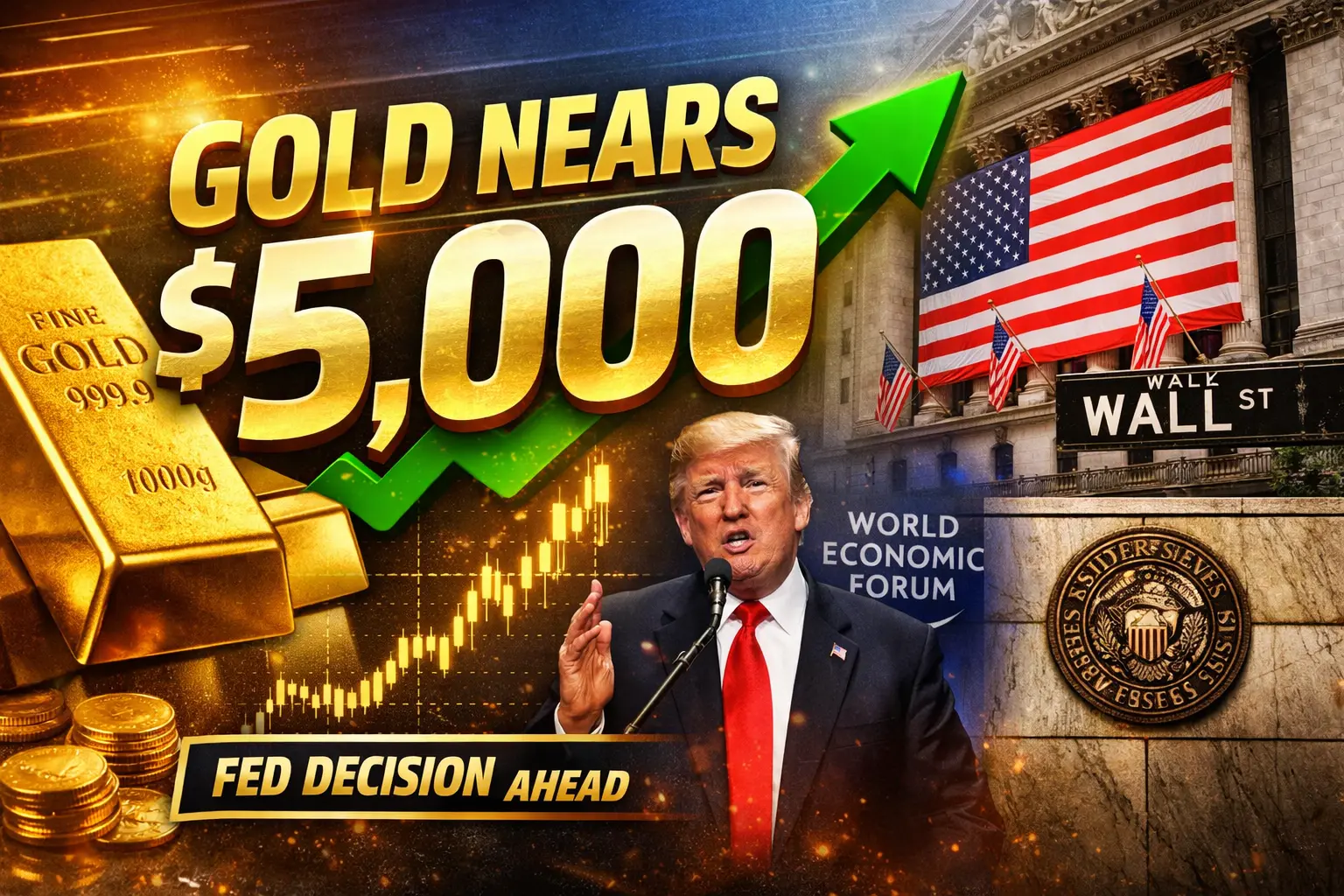
Gold markets have entered uncharted territory as prices surged to the doorstep of the psychologically powerful $5,000 per ounce level. A potent mix of geopolitical uncertainty, a weakening U.S. dollar, and growing scrutiny of central bank independence has pushed the yellow metal into a historic rally, reigniting enthusiasm on Wall Street even as retail investors grow more cautious.
The latest move highlights a widening divide between institutional sentiment and Main Street caution, with professional analysts overwhelmingly bullish while individual investors temper expectations after one of gold’s strongest weeks on record.
A week that rewrote the record books
Spot gold began the week near $4,654 per ounce, initially moving within a relatively tight range as U.S. markets remained closed for Martin Luther King Jr. Day. Early trading was calm, but that stability did not last long.
Momentum first emerged during Asian trading hours, when prices climbed decisively above $4,700 per ounce before extending gains through the European session. However, the real catalyst arrived with the return of North American traders. As U.S. markets reopened, gold pushed higher, reclaiming and then surpassing successive resistance levels with little hesitation.
By midweek, prices were already testing the upper $4,800 range. A new all-time high was set as buyers continued to absorb profit-taking with ease, confirming that demand remained robust across global sessions.
Geopolitics back in the driver’s seat
Much of the volatility surrounding gold this week can be traced to geopolitical anxieties linked to remarks by Donald Trump at the World Economic Forum in Davos. Markets were on edge ahead of his speech, particularly over concerns related to Greenland and broader strategic tensions between major global powers.
Although fears eased once it became clear that military escalation was not imminent, the brief relief rally in equities did little to derail gold’s advance. Instead, the precious metal demonstrated remarkable resilience, quickly rebounding after short-lived pullbacks.
This pattern reinforced a key theme dominating current markets: geopolitical flashpoints may come and go, but underlying global tensions remain unresolved. Issues ranging from Eastern Europe to the Middle East and long-standing friction between the United States and China continue to support safe-haven demand.
Approaching $5,000: psychological barrier or launchpad?
By Thursday, gold decisively broke above $4,900 per ounce, a level that had previously acted as stiff resistance. The breakout triggered another wave of buying, propelling prices to fresh records near $4,965 before consolidating briefly.
Friday’s session delivered the most dramatic move of the week, with gold surging to an intraday peak just shy of $5,000. While the market stopped short of a clean breakout, prices held firmly in the high $4,900s heading into the weekend—an extraordinary feat by historical standards.
Market technicians note that momentum indicators are stretched, suggesting the possibility of short-term consolidation or a pullback. However, the market’s ability to hold elevated levels after each dip continues to embolden bullish participants.
Wall Street turns decisively bullish
Professional sentiment has swung sharply in favor of gold. In the latest weekly survey, a strong majority of analysts expect prices to break above $5,000 in the near term. Their conviction is grounded in several reinforcing factors:
- Persistent geopolitical risk
- Concerns about equity market valuations
- Continued weakness in the U.S. dollar
- Rising participation from trend-following funds
Many strategists argue that even if gold pauses near $5,000, the broader trend remains firmly intact unless a significant macroeconomic shift occurs.
Main Street shows restraint
In contrast, retail investors appear more guarded. While most still expect higher prices, bullish participation has declined modestly following the sharp run-up. This caution reflects a familiar pattern: after rapid gains, individual investors often wait for confirmation before adding exposure.
This divergence between institutional confidence and retail hesitation is notable. Historically, such gaps can persist for extended periods, especially in momentum-driven markets.
The dollar’s quiet but powerful influence
One of the most consistent tailwinds for gold has been the prolonged weakening of the U.S. dollar. Over the past several months, the greenback has steadily lost ground, enhancing gold’s appeal as both a hedge and an alternative store of value.
As the dollar weakens, gold becomes cheaper for non-U.S. buyers, expanding global demand. Analysts emphasize that unless the dollar trend reverses meaningfully, this structural support for gold is unlikely to fade.
Eyes on the Federal Reserve
Attention now turns to the upcoming policy meeting of the Federal Reserve, the first decision of 2026. While no interest rate changes are expected, markets will scrutinize the central bank’s messaging closely.
Investors are particularly focused on:
- Economic assessments and forward guidance
- Any signs of dissent among policymakers
- Commentary on inflation, growth, and financial stability
- Signals regarding the Fed’s independence amid political pressure
Even without a rate move, subtle shifts in tone could influence both currency markets and gold prices.
Is a correction inevitable?
Despite the overwhelmingly bullish backdrop, some analysts caution that sharp rallies often invite equally sharp corrections. Historical comparisons suggest that gold’s recent pace of gains resembles prior episodes that eventually gave way to volatility.
However, others argue that today’s environment is fundamentally different. Unlike speculative blow-offs driven by leverage alone, the current rally is underpinned by strong physical demand, limited producer hedging, and broad participation from institutional investors.
As a result, pullbacks—if they occur—are widely expected to be shallow and short-lived, with buyers stepping in aggressively on dips.
A market at a crossroads
Gold’s surge toward $5,000 marks a defining moment for the precious metals market. While short-term consolidation would be healthy after such a rapid ascent, the structural forces supporting higher prices remain firmly in place.
Geopolitical uncertainty, a weakening dollar, and lingering questions around central bank policy continue to favor gold as a strategic asset. Whether $5,000 proves to be a temporary ceiling or a springboard to even higher levels, one thing is clear: gold has reclaimed its position at the center of the global financial conversation.