Gold and Silver Price Crash: What Really Happened and What Lies Ahead
The global commodity market witnessed dramatic turbulence on Friday as gold and silver prices plunged sharply, wiping out trillions of dollars in market value within days. Headlines screaming “trillions wiped out” captured the scale of the shock, but behind the numbers lies a deeper story about overheated markets, shifting monetary expectations, and investor psychology.
For months, precious metals had been on a historic rally. Gold and silver were touching new lifetime highs almost every few days, fuelled by inflation concerns, geopolitical uncertainty, and strong investor demand. The sudden reversal, both in speed and magnitude, caught even seasoned market participants off guard.
A Stunning Reversal After Record Highs
Just a day before the crash, gold prices in Delhi had soared to around ₹1,83,000 per 10 grams, while silver had touched approximately ₹4,04,500 per kilogram. These levels were unprecedented and reflected the extraordinary momentum built over recent months.
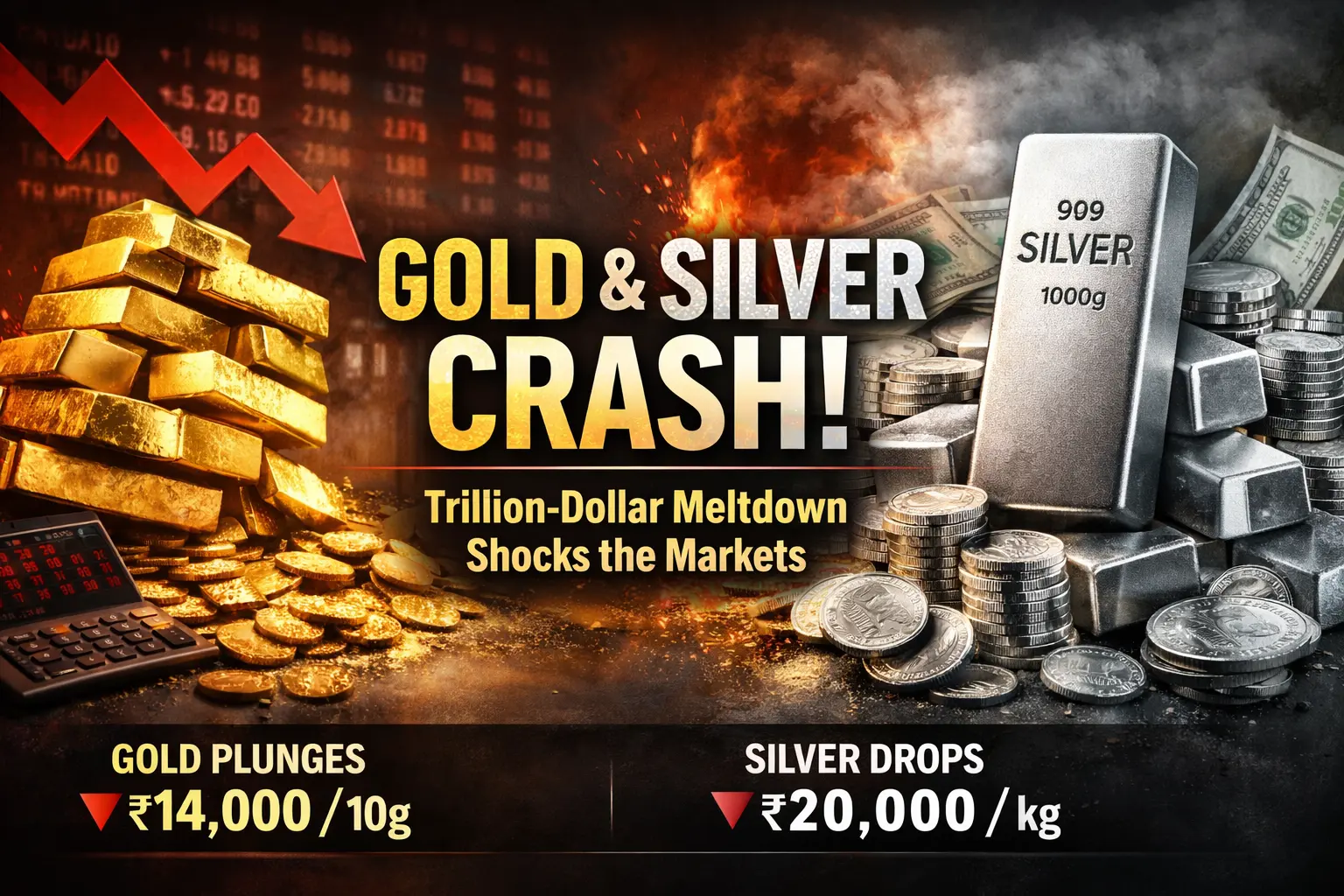
However, on Friday, sentiment flipped dramatically. Gold prices dropped by nearly ₹14,000 per 10 grams, and silver prices fell by about ₹20,000 per kilogram in the physical market. In futures trading, the fall was even more pronounced. Gold futures slipped to nearly ₹1.5 lakh per 10 grams, while silver futures crashed close to ₹3 lakh per kilogram—down more than ₹1 lakh from recent highs.
In percentage terms, gold corrected close to 10 percent from its peak, while silver plunged nearly 20 percent. Such sharp moves in traditionally “safe-haven” assets highlight just how volatile commodity markets can become when prices overshoot fundamentals.
Trillions Erased, Yet the Bigger Picture Remains Strong
The price correction had a massive impact on market capitalisation. In just two trading sessions, gold’s global market value declined by an estimated $3.5 trillion, while silver lost around $1.5 trillion. Together, that’s a staggering $5 trillion erosion in value over a very short period.
Yet, focusing only on the crash risks missing the broader trend. Despite this sharp pullback, gold’s market capitalisation is still higher by roughly $3 trillion since the beginning of the year. Silver, too, has added close to $2 trillion over the same period.
Zooming out further, the long-term gains are even more striking. Over the last two years, gold prices have surged by around 150 percent, while silver has skyrocketed by over 300 percent in international markets. From this perspective, the recent fall looks less like a collapse and more like a sharp correction after an extraordinary rally.
Why Did Gold and Silver Crash So Suddenly?
Several factors combined to trigger the abrupt sell-off in precious metals.
1. Overheated Prices and Profit Booking
The most immediate reason was simple: prices had risen too far, too fast. When assets rally aggressively without meaningful corrections, profit-taking becomes inevitable. Many investors chose to lock in gains, especially as prices reached psychologically significant levels.
2. Heavy Liquidation of Long Positions
Market data suggests that a large number of leveraged long positions were unwound in a short span. Once prices started falling, stop-losses were triggered, accelerating the decline and turning an orderly correction into a sharp sell-off.
3. Stronger US Dollar
A firm US dollar traditionally weighs on precious metals, which are priced in dollars globally. As the dollar strengthened, gold and silver became relatively more expensive for non-US investors, reducing demand and adding downward pressure on prices.
4. Shift in Interest Rate Expectations
Perhaps the most critical trigger came from the United States. Markets grew nervous following reports around a potential shift in leadership at the US Federal Reserve. The emergence of Kevin Warsh as a strong contender sent jitters through financial markets. Known as a monetary hawk, Warsh is associated with a tougher stance on inflation and less enthusiasm for rapid interest rate cuts.
Since gold and silver tend to perform best in low-interest-rate environments, any reduction in expectations of future rate cuts can hit prices hard. The mere possibility of a more hawkish policy outlook was enough to change market sentiment abruptly.
Why Silver Fell Harder Than Gold
While both metals declined sharply, silver’s fall was significantly steeper. This is not unusual. Silver is a hybrid asset—it functions both as a precious metal and an industrial commodity. When risk appetite weakens or economic uncertainty rises, silver often experiences exaggerated moves compared to gold.
Silver’s recent rally had also been more speculative, making it more vulnerable to rapid liquidation when sentiment turned negative.
Is This the End of the Bull Run?
Despite the dramatic headlines, many analysts believe this correction does not mark the end of the long-term uptrend in precious metals. Instead, it may represent a necessary reset after unsustainable gains.
Inflation concerns have not disappeared, global geopolitical risks remain elevated, and central banks around the world continue to hold significant gold reserves. These structural factors still support higher prices over the medium to long term.
Some experts expect gold and silver to stabilise in the near term before resuming their upward trajectory later in the year. Volatility, however, is likely to remain high, especially as markets continue to reassess interest rate expectations and global economic growth.
What Should Investors Learn From This Episode?
The sudden crash offers important lessons for investors:
- Even safe-haven assets are not risk-free: Gold and silver can be highly volatile, especially after sharp rallies.
- Corrections are healthy: Pullbacks help reset valuations and remove excessive speculation.
- Timing matters: Entering markets at record highs carries significant short-term risk.
- Long-term fundamentals still matter: Short-term price action does not always reflect long-term trends.
The gold and silver price crash was dramatic, unexpected, and costly in the short term, wiping out trillions in market value. Yet, when viewed in context, it appears more like a sharp correction than a fundamental breakdown. After months of relentless gains, the market needed a pause—and it arrived with force.
For investors, the key takeaway is balance: respect the power of long-term trends, but never underestimate the speed at which sentiment can change. In the world of commodities, volatility is not an exception—it is the rule.