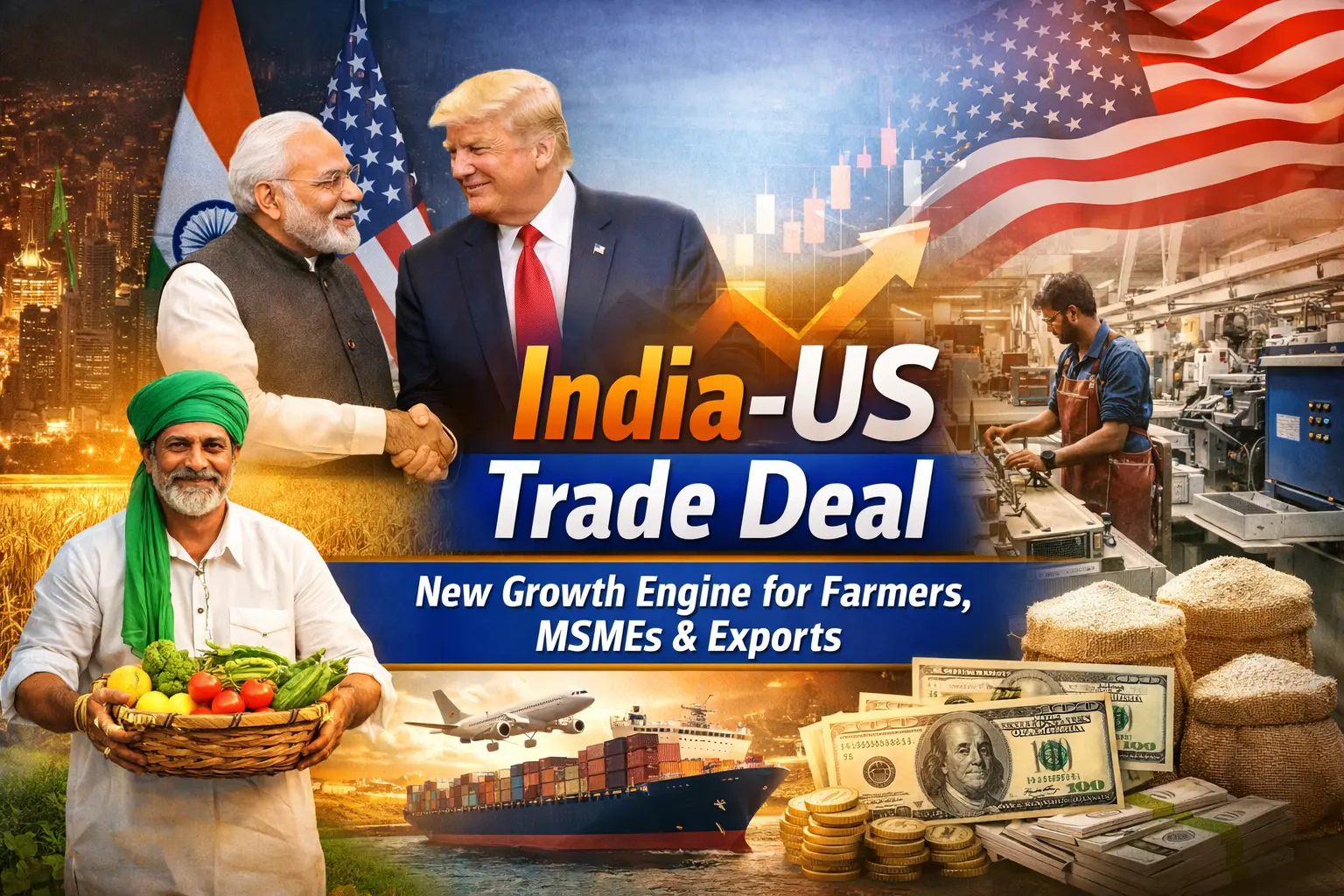
India-US Trade Deal Opens a New Chapter of Economic Opportunity
India’s evolving trade relationship with the United States has entered a decisive phase with the announcement of a landmark bilateral trade agreement. The deal, which reduces the US reciprocal tariff on Indian goods from 25% to 18%, is being widely seen as a turning point for Indian exports, especially for farmers, labour-intensive industries, MSMEs, and technology-driven enterprises.
Commerce and Industry Minister Piyush Goyal described the agreement as a catalyst for unlocking “unprecedented opportunities” across sectors, reinforcing India’s ambition to become a global manufacturing and innovation hub. The announcement followed discussions between US President Donald Trump and Indian Prime Minister Narendra Modi, underscoring the strategic depth of India-US economic ties.
Why the Tariff Reduction Matters
The reduction of reciprocal tariffs to 18% is significant because Indian exporters were struggling under steep duties—some as high as 50%—imposed by the US from August 27. These high tariffs had directly impacted India’s competitiveness in the American market, leading to delayed or cancelled orders, particularly in labour-intensive sectors.
With tariffs now lowered, Indian goods gain a price advantage over competing suppliers from other Asian economies. This is expected to revive export momentum, restore buyer confidence, and stabilize long-term sourcing commitments from US importers.
Big Boost for Indian Farmers and Agriculture Exports
For Indian farmers, the trade deal presents a rare opportunity to expand their footprint in the world’s largest consumer market. Products such as marine exports, processed food, spices, rice, and value-added agricultural goods are expected to benefit the most.
Lower tariffs make Indian agricultural produce more competitive, encouraging exporters to scale up procurement directly from farmers. Over time, this can translate into better price realization, reduced dependence on intermediaries, and greater income stability in rural areas.
In addition, improved access to US technology—especially in agri-processing, cold storage, and supply-chain logistics—can modernize India’s agricultural export ecosystem.
MSMEs and Labour-Intensive Sectors Stand to Gain
Micro, Small and Medium Enterprises (MSMEs) are among the biggest beneficiaries of the deal. Sectors such as textiles, apparel, leather, footwear, gems and jewellery, and marine products were under severe pressure due to elevated US tariffs.
According to exporters’ bodies, the tariff cut could trigger an immediate release of orders that had been put on hold. Federation of Indian Export Organisations President S C Ralhan called the agreement a “game-changer” that will enhance India’s export competitiveness vis-à-vis other Asian suppliers.
Given that global buyers typically finalize sourcing decisions months in advance, especially for summer seasons, the deal could help Indian manufacturers re-enter global supply chains at a critical moment.
Strengthening Make in India and Design in India
Beyond exports, the trade agreement aligns closely with India’s broader industrial strategy. Piyush Goyal emphasized that the deal supports the vision of “Make in India for the world, Design in India for the world, and Innovate in India for the world.”
With improved market access to the US, multinational companies may find it more attractive to set up manufacturing bases in India, using the country as an export hub. This could accelerate foreign direct investment, promote technology transfer, and generate large-scale employment.
The agreement also opens doors for collaboration in advanced manufacturing, clean energy, digital technologies, and artificial intelligence—areas where US expertise and Indian scale can complement each other.
Technology Access and Skilled Workforce Mobility
Another critical dimension of the deal is technology collaboration. Goyal noted that India will gain greater access to US technologies, which can strengthen domestic capabilities across sectors.
At the same time, the agreement is expected to create new opportunities for India’s skilled workforce, particularly in engineering, design, research, and high-end manufacturing. Enhanced cooperation between two “like-minded democracies” could lead to co-development of technologies and joint innovation platforms.
Trade Data Highlights the Urgency
Recent trade data underscores why the agreement is timely. India’s merchandise exports to the US declined by 1.83% to USD 6.88 billion in December 2025, largely due to high tariffs. Exports had also contracted in September and October, before rebounding sharply in November.
During April–December of the current fiscal year, India’s exports to the US rose 9.75% to USD 65.87 billion, while imports increased 12.85% to USD 39.43 billion. While the overall trend remains positive, sustained tariff barriers posed a clear risk to future growth—one that the new deal seeks to mitigate.
What Still Needs Clarity
Despite widespread optimism, trade experts and think tanks have cautioned that clarity is still required. The Global Trade Research Initiative (GTRI) has pointed out that details on product coverage, sector-specific concessions, and implementation timelines are crucial.
Exporters are particularly awaiting the US executive order that will formally outline the scope of the agreement. Only then will businesses be able to fully assess compliance requirements, pricing strategies, and long-term benefits.
Strategic Partnership Beyond Trade
Commerce Secretary Rajesh Agrawal described the pact as a “landmark trade deal” that unlocks shared prosperity, innovation, and growth for two natural democratic partners. Industry leaders have echoed this sentiment, calling the agreement a reinforcement of India’s rising global leadership.
More than just a tariff adjustment, the deal reflects a broader strategic alignment between India and the US—spanning trade, technology, security, and global supply-chain resilience.
A Defining Moment for Indian Exports
The India-US trade deal marks a defining moment for India’s economic engagement with the world’s largest economy. By lowering tariffs, restoring export competitiveness, and enabling deeper technology collaboration, the agreement lays the foundation for long-term growth across agriculture, manufacturing, and services.
For farmers, MSMEs, exporters, and skilled professionals, this is not just a policy announcement—it is an opportunity to integrate more deeply into global markets. If implemented effectively, the deal could accelerate India’s journey toward becoming a trusted global manufacturing and innovation powerhouse.