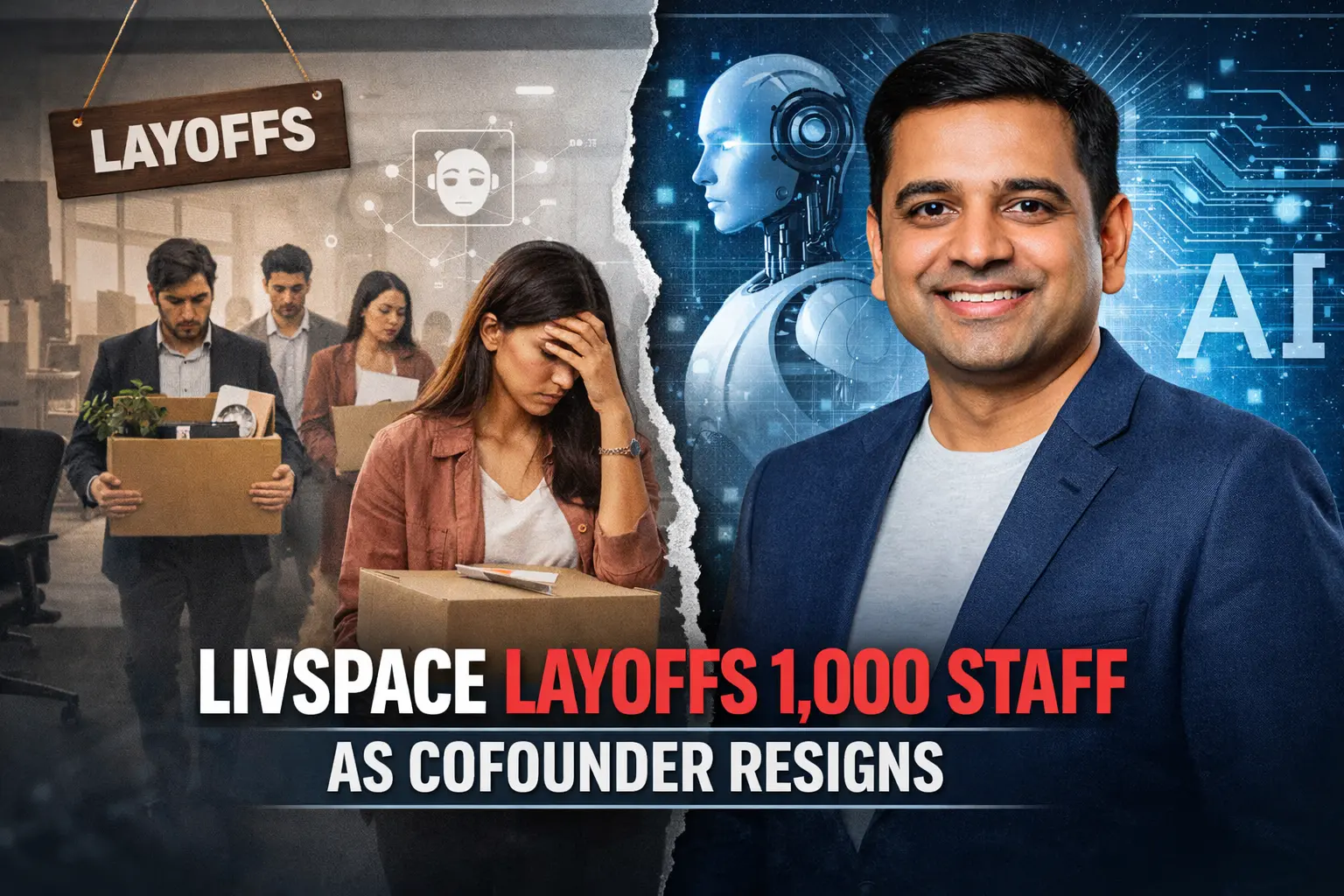
India’s home interiors unicorn Livspace has laid off around 1,000 employees—approximately 12% of its workforce—as it accelerates the integration of artificial intelligence across its core operations. The workforce reduction, which unfolded over the last six months, coincides with the company’s deeper push into AI-led automation spanning sales, design, marketing, and operations.
The development also comes alongside the resignation of cofounder and India CEO Saurabh Jain, who stepped down to pursue personal interests. Jain, according to the company, played a foundational role in shaping Livspace’s AI transformation strategy.
AI at the Core of Livspace’s Restructuring
In an official statement, Livspace clarified that the layoffs were not a reactive cost-cutting measure. Instead, the company described the move as a strategic realignment aimed at strengthening long-term capabilities through automation and AI deployment.
Over the past six months, the startup has tested and rolled out advanced AI agents across various functions. As manual processes were gradually phased out, AI-powered systems were implemented to ensure operational continuity and service quality.
The company emphasized that this phased approach allowed it to maintain performance standards while transitioning away from labor-intensive workflows. According to the spokesperson, Livspace is prioritizing technological investment to deliver higher precision, improved efficiency, and better customer outcomes.
This shift reflects a broader structural pivot: replacing legacy operational models with AI-augmented systems that reduce turnaround time, optimize resource allocation, and enhance scalability.
Leadership Exit Amid Strategic Change
The restructuring coincided with the exit of Saurabh Jain, who had been instrumental in Livspace’s India operations. In a LinkedIn post, Jain described his departure as the closing of a meaningful chapter, suggesting the company is entering a new phase of evolution.
Internally, he is credited with laying the groundwork for the company’s AI-driven avatar—an initiative that reportedly enabled large-scale automation and workforce restructuring.
While leadership changes during transformation phases are not uncommon, the timing of Jain’s resignation underscores the magnitude of Livspace’s pivot toward AI-first operations.
A Unicorn with Strong Financial Backing
Founded in 2014, Livspace operates an omnichannel home interiors and renovation marketplace, connecting homeowners with designers, contractors, and vendors. Over the years, it has emerged as one of India’s most recognized proptech-driven home décor brands.
The company has raised over $450 million in funding from marquee investors, including KKR, Ingka Group, TPG Growth, Goldman Sachs, Bessemer Venture Partners, and Jungle Ventures.
Such substantial backing has enabled Livspace to experiment with technology-led differentiation in a traditionally fragmented and offline-dominated sector. Its AI adoption strategy signals a shift toward building a tech-intensive platform rather than remaining purely a services marketplace.
AI and the Broader Layoff Wave
Livspace’s workforce reduction is part of a wider global trend where companies are restructuring operations amid rapid AI adoption. From multinational tech giants to domestic startups, automation has increasingly become a driver of organizational redesign.
Companies such as Amazon, Tata Consultancy Services, Microsoft, and Indian fintech startup ClearTax have all implemented job cuts in recent years, with automation frequently cited as a contributing factor.
The rationale is clear: AI systems can automate repetitive tasks, analyze large data sets, personalize customer experiences, and improve operational efficiency at scale. However, this efficiency gain often translates into reduced demand for certain manual or mid-level operational roles.
Economic Survey Flags Labour Displacement Risks
India’s Economic Survey 2025–26 highlighted the double-edged nature of AI adoption. While acknowledging that artificial intelligence promises productivity gains and long-term economic growth, it also warned of potential labor displacement—particularly in India’s service-oriented IT and BPO sectors.
For a country with a large workforce employed in process-driven roles, AI integration poses structural challenges. Automation of routine design support, sales coordination, customer onboarding, and backend operations—roles commonly found in startups like Livspace—can lead to workforce compression.
Thus, Livspace’s decision reflects not just an internal strategic choice but also a macroeconomic transition shaping India’s employment landscape.
“AI Washing” vs. Real Displacement
The debate over whether AI is genuinely responsible for job cuts or merely being used as a justification continues globally.
During the India AI Impact Summit 2026, Sam Altman, founder of OpenAI, acknowledged that while AI is indeed displacing certain roles, some companies may be overstating its impact.
He referred to a growing trend of “AI washing”—where organizations attribute layoffs to AI transformation even when cost rationalization or restructuring may have been planned regardless of technological shifts.
This distinction is critical. In some cases, automation directly replaces job functions. In others, AI becomes a strategic narrative to justify broader operational restructuring.
In Livspace’s case, the company maintains that automation genuinely replaced manual processes, and that its AI agents were fully deployed before workforce reduction occurred.
Reskilling: The Next Imperative
As AI integration deepens, the emphasis is shifting from job preservation to skill transformation. According to industry leaders, including Cornerstone Ventures’ managing partner Abhishek Prasad, upskilling the workforce in AI competencies is both necessary and complex.
Employers must rethink:
- Talent sourcing frameworks
- Project planning methodologies
- Performance appraisal systems
- Training programs
- Day-to-day workflow design
As AI increasingly becomes a “coworker” rather than just a tool, employees will need hybrid skill sets—combining domain expertise with AI literacy.
For startups like Livspace, this means fewer repetitive operational roles and greater demand for strategic, creative, analytical, and AI-supervisory positions.
Strategic Reallocation, Not Just Downsizing
Livspace insists that the layoffs represent strategic reallocation rather than contraction. By redirecting resources toward AI infrastructure and digital capabilities, the company aims to build a leaner yet more scalable organization.
From a business standpoint, this shift could enhance margins, improve customer personalization, and shorten project cycles. From a workforce perspective, however, it signals a structural transformation that prioritizes technological efficiency over labor intensity.
The Road Ahead
The Livspace episode underscores a broader inflection point for India’s startup ecosystem. AI is no longer experimental—it is becoming foundational.
Companies that fail to adapt risk obsolescence. Those that adapt aggressively may face short-term social and workforce disruption.
The key challenge lies in balancing innovation with inclusion. Policymakers, investors, employers, and employees must collectively navigate this transition—ensuring that technological advancement does not outpace workforce readiness.
Livspace’s decision to cut 1,000 jobs amid its AI push is not an isolated event. It is part of a structural shift redefining how Indian startups operate, scale, and compete in an AI-first economy.
As automation accelerates, the central question remains: will organizations simply replace roles—or will they redefine them?