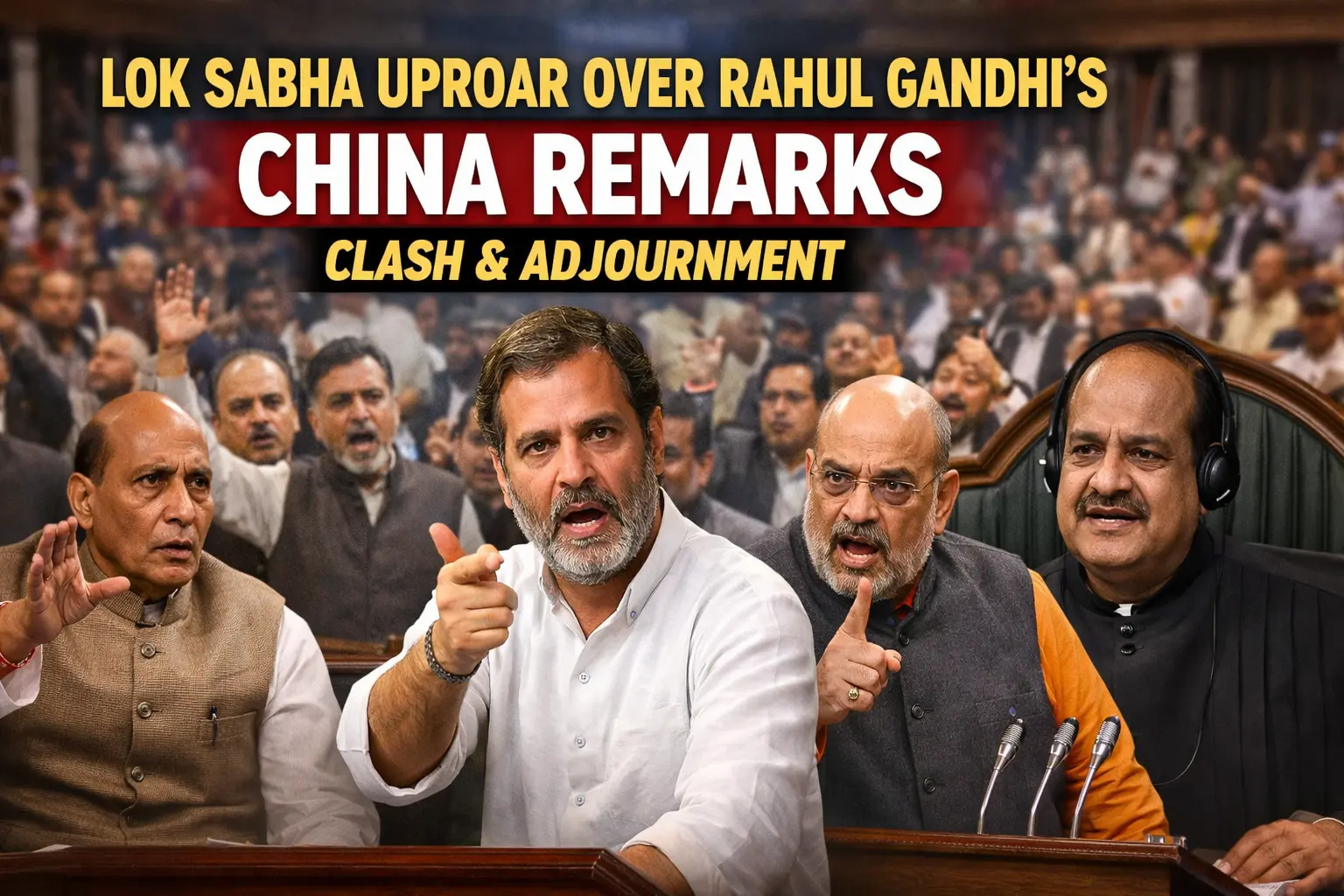
Lok Sabha Disrupted as India-China Debate Sparks Political Showdown
The Lok Sabha witnessed repeated disruptions and was ultimately adjourned for the day after sharp confrontations erupted between the Opposition and the Treasury benches. The flashpoint was Leader of Opposition Rahul Gandhi insisting on raising the issue of the India-China military confrontation of August 2020 during the debate on the motion of thanks to the President’s address. His remarks, based on excerpts from an unpublished book by former Army chief M M Naravane, triggered strong objections from the government side, plunging the House into chaos.
What began as a routine parliamentary debate soon escalated into a full-blown political standoff, underlining the deep divisions between the ruling alliance and the Opposition on matters of national security, parliamentary procedure, and freedom of debate.
The Trigger: Reference to an Unpublished Book
Rahul Gandhi’s intervention focused on the handling of the India-China standoff in eastern Ladakh in 2020, an issue that has remained politically sensitive for the government. Gandhi cited purported extracts from an as-yet unpublished memoir by former Army chief M M Naravane, claiming they shed light on critical aspects of the confrontation.
According to Gandhi, excerpts from the book had already appeared in Caravan magazine, making them part of the public domain. On this basis, he argued that the information was authentic and relevant to a debate on national policy and security, especially during a discussion responding to the President’s address.
However, the Treasury benches strongly contested this position, insisting that Parliament could not be used to quote from unverified or unpublished material.
Government Pushback and Rising Tempers
The first interruption came from Defence Minister Rajnath Singh, who objected to the citation of any source that had not been officially published or authenticated. He cautioned that quoting selectively from an unpublished book could mislead the House and undermine the dignity of parliamentary debate, particularly on sensitive defence matters.
As the exchanges grew sharper, Home Minister Amit Shah also intervened. Shah urged the Speaker to disallow references to unverified material and asked the Opposition leader to restrict himself to facts that could be formally placed on record.
The Opposition benches, meanwhile, accused the government of trying to stifle debate and avoid uncomfortable questions about national security and border management.
Speaker’s Ruling and Continued Deadlock
Speaker Om Birla attempted to restore order by issuing a ruling. He asked Rahul Gandhi not to refer to news articles or extracts from an unpublished book and to confine his speech to information that could be authenticated and officially submitted to the House.
Despite the ruling, the confrontation did not subside. Gandhi maintained that he had a right, as Leader of Opposition, to raise issues of national importance. He reiterated that the excerpts were already available publicly through a reputed magazine and therefore could not be dismissed as rumours or speculation.
The continued back-and-forth led to two adjournments during the day. When the disruptions resumed yet again, the Speaker adjourned the Lok Sabha for the remainder of the day.
Political Context: A Charged Atmosphere
The ruckus unfolded against an already charged backdrop. Just before Gandhi rose to speak, BJP MP Tejashwi Surya had criticised the previous UPA governments, recalling how presidential addresses during that period frequently referred to left-wing extremism, terror attacks, and economic slowdown. His remarks set a combative tone in the House.
For the Opposition, the India-China standoff represents a crucial accountability issue, particularly in light of repeated demands for transparency about territorial status and military engagement. For the government, however, such debates are tightly framed around national interest, confidentiality, and institutional discipline.
Larger Questions About Parliamentary Debate
Beyond the immediate clash, the episode raises broader questions about the functioning of Parliament. One key issue is the balance between freedom of speech for lawmakers and the need for procedural safeguards. Can MPs cite journalistic reports or leaked excerpts if they are already in the public domain? Or should parliamentary debate be restricted strictly to officially published and government-verified documents?
Another concern is the increasing frequency of disruptions. Repeated adjournments not only stall legislative business but also limit meaningful discussion on critical national issues. Both sides accused each other of deliberately provoking disorder—an allegation that has become all too familiar in recent parliamentary sessions.
Opposition’s Stand: Right to Question Power
From the Opposition’s perspective, Rahul Gandhi’s insistence on raising the India-China issue reflects a constitutional duty to hold the executive accountable. They argue that matters of national security cannot be shielded entirely from scrutiny, especially when public reports raise serious questions.
The Opposition also contends that silencing such references sets a dangerous precedent, narrowing the scope of parliamentary debate and weakening democratic oversight.
Government’s Position: Procedure and Responsibility
The government, on the other hand, maintains that parliamentary privilege comes with responsibility. Quoting from unpublished or selectively leaked material, it argues, risks misinterpretation and politicisation of sensitive defence issues. Ministers stressed that national security discussions must be based on verified facts and conducted within established rules.
A Symptom of Deeper Polarisation
The Lok Sabha adjournment over Rahul Gandhi’s China remarks is more than a procedural dispute—it is a reflection of deep political polarisation. With trust between the government and Opposition at a low ebb, even substantive issues like border security quickly descend into confrontation.
As Parliament reconvenes, the challenge will be to find a way for robust debate to coexist with order and procedure. Whether on national security or governance, democracy ultimately depends not just on the right to speak, but on the willingness of all sides to listen.