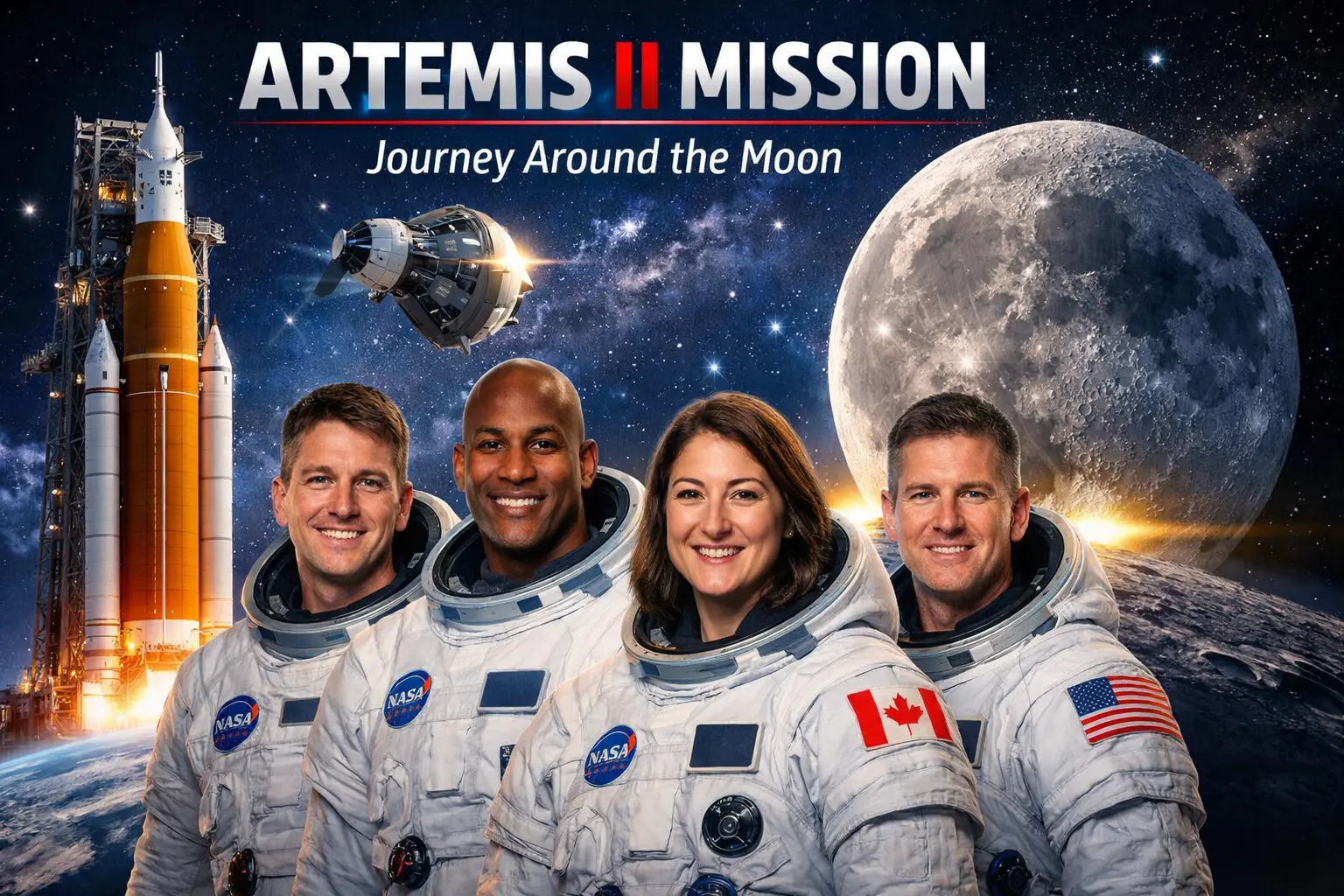
More than half a century after humans last journeyed beyond low-Earth orbit, NASA is preparing to send astronauts around the Moon once again. The agency is targeting early March for the launch of Artemis II, a landmark mission that will carry four astronauts on a 10-day voyage around the lunar far side and back to Earth. If successful, the mission will mark humanity’s most distant crewed spaceflight since the Apollo era and pave the way for a future lunar landing.
A New Era of Lunar Exploration
The Artemis II mission represents the next major step in NASA’s ambitious Artemis program, which aims to establish a sustained human presence on the Moon. The space agency has set March 6 as the earliest possible launch date (March 7 in the UK), following a successful “wet dress rehearsal” at Kennedy Space Center in Florida.
A wet dress rehearsal is one of the most critical pre-launch tests in any space mission. During this procedure, engineers fully fuel the rocket and conduct a simulated countdown to ensure all systems perform as expected. Earlier attempts in February were cut short due to a hydrogen leak at the launch pad. However, NASA engineers addressed the technical issues, including problems related to seals and filters, allowing the team to complete the rehearsal within the planned timeline.
According to NASA officials, the Space Launch System (SLS) rocket was fully tanked, and the entire launch countdown sequence was successfully demonstrated. This milestone has significantly boosted confidence that Artemis II is ready to proceed toward liftoff.
Meet the Artemis II Crew


The Artemis II crew consists of four highly experienced astronauts:
- Reid Wiseman (USA)
- Victor Glover (USA)
- Christina Koch (USA)
- Jeremy Hansen (Canada)
This international team reflects growing global collaboration in space exploration. Jeremy Hansen’s participation marks Canada’s first astronaut assigned to a lunar mission, underscoring the country’s role in supporting NASA’s deep-space ambitions.
The astronauts are expected to enter quarantine shortly before launch to minimize health risks. Following the successful rehearsal, morale among the crew is reportedly high, with anticipation building as they prepare for a mission unlike any undertaken in decades.
The Power Behind the Mission: SLS and Orion
Artemis II will launch aboard NASA’s towering 98-meter (322-foot) Space Launch System (SLS), the most powerful rocket ever built by the agency. The SLS has flown only once before during Artemis I in November 2022, an uncrewed test flight that successfully orbited the Moon and returned to Earth.
Atop the rocket sits the Orion spacecraft, the crew’s home for the 10-day mission. Roughly the size of a minibus inside, Orion is designed to support astronauts in deep space, far beyond Earth’s protective magnetic field. During the journey, the crew will live, work, eat, and sleep within this compact yet highly advanced capsule.
The 10-Day Journey Around the Moon
The mission profile is carefully planned. After liftoff from Florida, the astronauts will spend the first day in orbit around Earth while mission control verifies that all systems are functioning properly. If everything checks out, Orion will fire its engines to begin the four-day journey toward the Moon.
Once there, Artemis II will not land but instead perform a flyby of the Moon, traveling around its far side — the hemisphere permanently turned away from Earth. Humans have not visited this region since the Apollo missions, making it one of the most remote places ever explored by people.
The spacecraft will pass between 6,500 and 9,500 kilometers above the lunar surface. During this time, astronauts will conduct observations, collect imagery, and gather data to support future missions. The flyby will provide invaluable operational experience for NASA’s deep-space systems.
Following the lunar pass, Orion will begin its four-day return journey to Earth. The mission will conclude with a splashdown in the Pacific Ocean, where recovery teams will retrieve the crew and spacecraft.
Building Toward Artemis III
Artemis II is a crucial stepping stone toward Artemis III, the mission intended to return astronauts to the lunar surface. The last humans to walk on the Moon did so in 1972 during Apollo 17, marking the end of the Apollo era.
NASA aims to achieve a new lunar landing by 2028, though officials acknowledge that the timeline is ambitious. Artemis III will target the Moon’s south pole, a region believed to contain water ice deposits that could support long-term human exploration.
Commercial Partnerships and Competition
NASA is working with private aerospace companies to make Artemis III possible. SpaceX, founded by Elon Musk, has been contracted to develop the lunar lander system. The lander will be launched aboard the company’s massive Starship rocket.
However, delays in Starship development have raised concerns about schedule impacts. NASA has requested a streamlined plan from SpaceX to accelerate progress and ensure readiness for the lunar landing.
At the same time, Blue Origin, owned by Jeff Bezos, has also been asked to present an accelerated lunar architecture proposal. The involvement of multiple commercial partners reflects NASA’s strategy of fostering competition and innovation in the space industry.
A Global Race to the Lunar South Pole
The United States is not alone in its lunar ambitions. China has announced plans to land astronauts on the Moon by 2030 and has steadily advanced its lunar exploration program. Both nations are targeting the Moon’s south pole, where permanently shadowed craters may contain accessible water ice — a critical resource for future lunar bases.
The competition extends beyond symbolic achievements. Establishing infrastructure at the south pole could determine access to key scientific sites and resources. As a result, Artemis II is not just a scientific milestone but also part of a broader geopolitical strategy in space.
Why Artemis II Matters
Artemis II represents more than a return to lunar orbit. It demonstrates NASA’s renewed capacity for deep-space human exploration. The mission will validate life-support systems, navigation protocols, communication networks, and re-entry technologies under real operational conditions.
It also serves as an inspiration to a new generation. More than 50 years after Apollo 17 closed the chapter on lunar exploration, Artemis II signals that humanity’s next giant leap is within reach.
The journey around the Moon may last only 10 days, but its impact could define the next era of space exploration. If all goes according to plan, early March will mark the beginning of a bold new chapter — one that brings humans closer than ever to establishing a lasting presence beyond Earth.
As anticipation builds and the world watches the countdown, Artemis II stands poised to bridge the gap between the past achievements of Apollo and the future vision of sustainable exploration on the Moon.