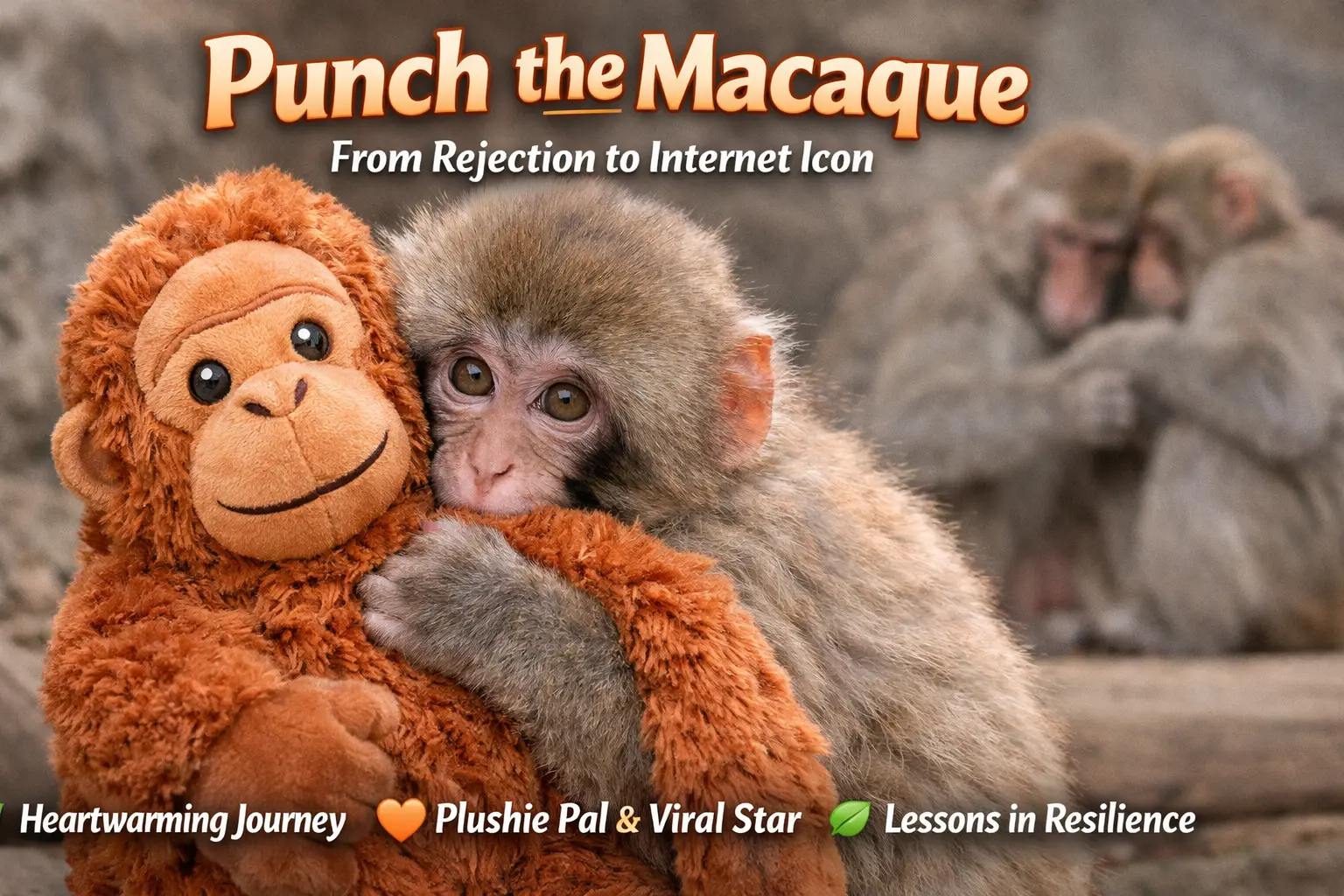
In a digital world saturated with fleeting trends and viral moments, it takes something truly special to capture collective attention. Recently, that “something” arrived in the form of a tiny, wide-eyed macaque named Punch.
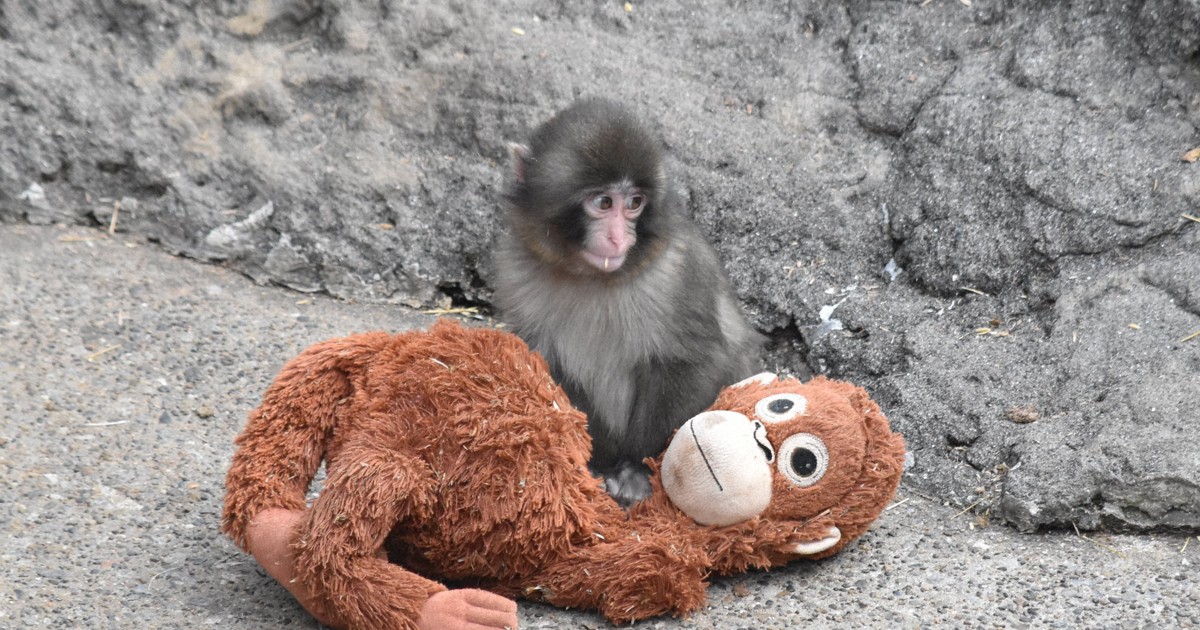
At just six months old, Punch — affectionately known as Punch-kun — has become one of the most adored animal personalities online. Residing at Ichikawa City Zoo near Tokyo, the young Japanese macaque has won millions of hearts with a simple yet powerful image: a small monkey carrying a slightly oversized orangutan plush toy everywhere he goes.
But behind the viral videos lies a story far deeper than cuteness. Punch’s journey is one of resilience, adaptation, and emotional survival.
A Difficult Beginning
Punch was born in July during an intense summer heatwave. Unfortunately, his entry into the world was not smooth. Shortly after birth, his biological mother rejected him — a behavior that can occur in primates due to stress, difficult labor, or environmental factors.
Without maternal care, Punch’s early months were spent primarily under the supervision of zoo staff. Human caretakers became his main source of nourishment and interaction. While this ensured his survival, it meant he missed out on a crucial element of macaque development: early social bonding within the troop.
For species like Japanese macaques, maternal presence is not merely nurturing — it is instructional. Young macaques learn social hierarchy, grooming etiquette, play signals, and group behavior through close observation of their mothers. Punch, however, had to grow without that guide.
The Challenge of Reintegration
By January, zoo staff determined that Punch was ready to be reintroduced to the troop on the zoo’s well-known “Monkey Mountain” enclosure. Reintegration is vital for long-term behavioral health, but it can also be socially demanding.
Japanese macaques operate within rigid dominance hierarchies. Every member has a place, and social positioning is learned gradually. Without a mother to advocate for him or model appropriate behavior, Punch entered a complex system alone.
Videos shared online show him cautiously approaching older monkeys, seeking interaction. In many clips, he is gently pushed away or ignored — not unusual in macaque society, but emotionally striking to human viewers. These moments sparked widespread empathy across social media platforms.
To many, it looked like bullying. To primatologists, it was a young macaque navigating the unavoidable realities of troop dynamics.
Enter the Plush Companion
Recognizing his vulnerability and need for comfort, zookeepers introduced an unexpected companion: a plush orangutan toy from IKEA — specifically, the Djungelskog model.
The toy served two practical purposes:
- Emotional reassurance during a stressful social transition.
- Physical engagement, as carrying and wrestling with the plush would strengthen Punch’s muscles.
What no one anticipated was how deeply Punch would bond with the stuffed animal.
He hugs it. Drags it across the enclosure. Sleeps beside it. Clings to it during uncertain moments. The plush orangutan has effectively become his surrogate comfort object — his silent, ever-present ally.
One widely circulated clip shows Punch attempting to maneuver the plush into a hugging position, almost as if urging it to reciprocate affection. The moment is equal parts heartbreaking and tender — a raw portrayal of longing for connection.
Viral Momentum
The internet responded immediately.
Short-form videos featuring Punch amassed tens of millions of views across TikTok and Instagram. Fan art began circulating on platforms like X and Reddit. Comment sections filled with emotional declarations, with users expressing protectiveness, admiration, and sometimes tears.
Even mainstream media took notice. Stephen Colbert referenced Punch during a monologue, humorously suggesting that perhaps everyone could use a plush companion during difficult times.
The effect extended beyond digital spaces. IKEA reported a noticeable surge in sales of its Djungelskog orangutan plush in Japan, the United States, and South Korea. In response, IKEA Japan embraced the phenomenon, incorporating imagery reminiscent of Punch into marketing materials and donating multiple plush toys to the zoo.
The tagline used in one campaign resonated deeply: “Sometimes family is who we find along the way.”
Addressing the “Bullying” Narrative
As videos of Punch being swatted away circulated, some viewers expressed concern, labeling the behavior as bullying. In response, Ichikawa City Zoo released a statement clarifying the situation.
According to zoo officials, Punch demonstrates strong resilience and recovers quickly after social corrections. The behaviors observed are part of natural macaque communication rather than cruelty. Reintegration requires persistence, and temporary rejection is common for juveniles learning social boundaries.
Rather than feeling sorry for Punch, the zoo encouraged supporters to view his journey as a testament to perseverance.
This distinction is important. Anthropomorphizing animal behavior can obscure biological context. While the interactions appear harsh through a human lens, they reflect standard primate socialization processes.
Signs of Acceptance
Encouragingly, more recent footage shows measurable progress.
Punch has been seen engaging in grooming sessions with peers — a critical social bonding behavior among macaques. Grooming is not merely hygienic; it reinforces alliances and signals acceptance within the hierarchy.
He has also begun playing with younger monkeys closer to his age, indicating increasing comfort and inclusion.
These developments suggest that his persistence is paying off.
For observers who have followed his journey from isolation to gradual acceptance, these clips feel triumphant. The narrative arc — rejection, struggle, endurance, belonging — mirrors themes that resonate universally.
Why Punch Resonates
Punch’s popularity cannot be explained by cuteness alone, though he undeniably possesses it.
His story intersects with several powerful emotional triggers:
- Underdog resilience — a small individual navigating a complex social world.
- Loneliness and adaptation — finding comfort when traditional support systems fail.
- Symbolic companionship — the plush toy as a metaphor for emotional anchors.
- Incremental progress — visible growth over time.
In an era marked by uncertainty and social fragmentation, Punch embodies persistence. He gets knocked back, holds onto his plush companion, and tries again.
The simplicity of that pattern speaks volumes.
Beyond Virality
What differentiates Punch from countless other viral animals is narrative continuity. His story evolves. Viewers are not just consuming isolated cute moments; they are witnessing a developmental trajectory.
There is also institutional transparency. Ichikawa City Zoo has addressed concerns directly, contextualizing behaviors within established primate ethology rather than exploiting sentimentality.
Meanwhile, IKEA’s involvement — through increased plush donations and brand acknowledgment — demonstrates how internet phenomena can influence real-world commerce and corporate storytelling.
A Small Monkey, A Big Lesson
Punch may never comprehend the scale of his online following. He remains a young macaque navigating troop hierarchy, clutching a stuffed orangutan for reassurance.
Yet symbolically, he represents something larger.
He shows that adaptation is rarely smooth. That rejection does not equal failure. That comfort can come from unexpected places. And that belonging often requires repeated effort.
In a sense, Punch has become more than a zoo resident. He is a reminder — quiet but powerful — that resilience is not loud or dramatic. Sometimes it looks like a tiny monkey carrying a plush toy up a rocky hill, trying once more to connect.
And for millions around the world watching him, that is more than enough.