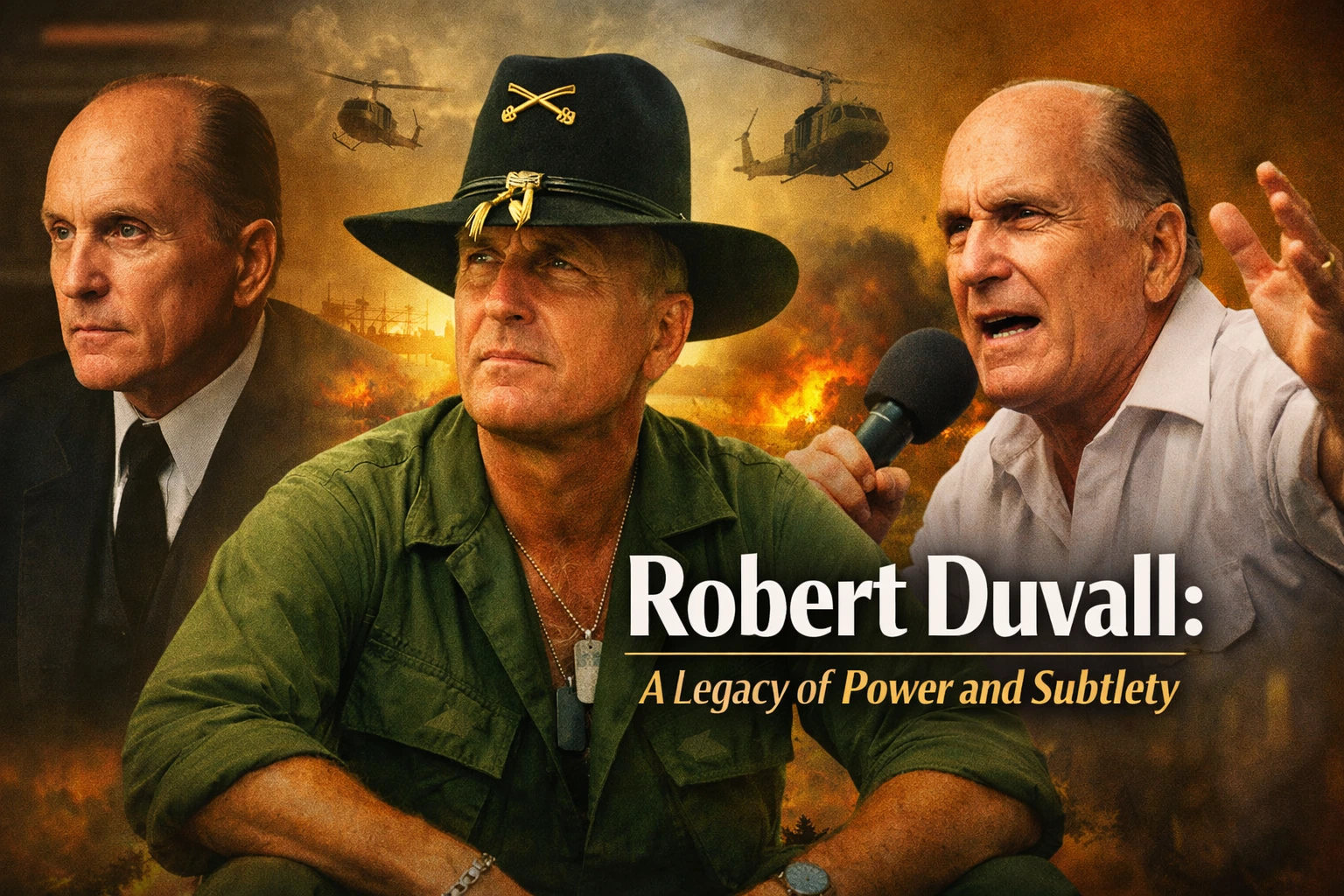
Robert Duvall: The Relentless Force of American Cinema
For more than six decades, Robert Duvall stood as one of the most formidable and quietly magnetic figures in American film. With his unmistakable foghorn voice, commanding screen presence, and restrained yet emotionally layered performances, Duvall embodied a rare blend of toughness and vulnerability. Whether portraying a calculating consigliere, a bombastic military officer, or a broken country singer seeking redemption, he approached each role with unwavering conviction. Simply seeing him on screen carried a certain assurance: the performance would be authentic, grounded, and unforgettable.
A Face Built for Authority
Duvall possessed a distinctive physicality. Bald for most of his adult life and bearing sharp, classical features, he often appeared ageless — perpetually in his forties, even as the decades passed. His look evoked authority: part Roman emperor, part seasoned Southern general. Yet beneath that imposing exterior lay a capacity for tenderness and emotional subtlety that defined many of his most memorable performances.
His early career was marked by strong supporting roles in films that have since become classics, including To Kill a Mockingbird, MASH*, The Conversation, and Network. However, it was his collaborations with director Francis Ford Coppola that would cement his place in cinematic history.
The Godfather: Quiet Steel as Tom Hagen
The Godfather (1972) introduced audiences to Duvall’s Tom Hagen, the adopted son and trusted consigliere of the Corleone crime family. Surrounded by fiery personalities — including Marlon Brando as Vito Corleone and Al Pacino as Michael — Duvall delivered a performance defined by restraint.
Hagen was not a soldier or a hotheaded strategist. He was an administrator, a negotiator, a corporate mind operating within organized crime. Calm and analytical, he absorbed insults from Sonny Corleone (played by James Caan), who famously dismissed him as unsuited for wartime decision-making. Yet beneath Hagen’s composure lay steely resolve.
One of the most infamous moments in the film — the gruesome horse’s head sequence — underscores Hagen’s quiet ruthlessness. Tasked with persuading a Hollywood producer to cast a singer favored by the Corleones, Hagen appears diplomatic and controlled. When persuasion fails, the next morning reveals the brutal message delivered overnight. Duvall plays Hagen’s aftermath with chilling understatement: when asked if he is tired after the trip, he casually replies that he “slept on the plane.” The calm is more disturbing than any overt threat.
Hagen’s emotional complexity deepens in later developments, particularly when Michael sidelines him. Duvall subtly conveys the character’s wounded pride and restrained hurt without melodrama. It remains one of the most nuanced portrayals in the entire Godfather saga.
Apocalypse Now: Controlled Madness as Kilgore
If Hagen was subdued calculation, Lieutenant Colonel Kilgore in Apocalypse Now (1979) was explosive theatricality. Again directed by Coppola, the Vietnam War epic presented Duvall in an entirely different register.
Kilgore, a surf-obsessed cavalry officer leading helicopter assaults, is a paradox — charismatic, reckless, oddly philosophical. In one of cinema’s most quoted scenes, he declares, “I love the smell of napalm in the morning,” delivering the line with eerie sincerity. The combination of bravado and wistfulness — “Someday this war’s gonna end” — suggests a man aware, perhaps dimly, of the absurdity around him.
Blasting Wagner’s “Ride of the Valkyries” during an aerial attack, Kilgore transforms warfare into spectacle. Duvall’s performance walks a fine line between satire and menace. He never plays the role as a joke; instead, he grounds Kilgore’s eccentricities in conviction. That seriousness makes the character unforgettable.
The Great Santini: Authority at Home
In The Great Santini (1979), Duvall portrayed Marine pilot “Bull” Meacham — a domineering father whose need for control extends into his family life. The character’s competitive one-on-one basketball games with his teenage son reveal a man incapable of surrendering authority, even in play.
The emotional brutality of the father-son relationship is difficult to watch. Duvall does not soften Meacham’s harshness. Instead, he exposes the insecurity beneath it — a man terrified of losing relevance and dominance. The role earned him an Academy Award nomination and demonstrated his ability to portray deeply flawed authority figures with psychological depth.
Tender Mercies: A Gentle Redemption
Duvall won the Academy Award for Best Actor for Tender Mercies (1983), directed by Bruce Beresford. In this intimate drama, he played Mac Sledge, a once-successful country singer whose life has unraveled due to alcoholism.
Unlike the bluster of Kilgore or the authority of Hagen, Mac Sledge is defined by quiet regret. The film traces his attempt to rebuild life and faith after personal loss. Duvall’s performance is understated, marked by pauses, glances, and emotional restraint. He even performed original songs for the film, revealing a surprisingly rich singing voice.
The role showcased another dimension of his artistry: vulnerability without self-pity. Mac Sledge is not a grand tragic figure but an ordinary man seeking modest redemption. That humility gave the film its emotional resonance.
The Apostle: A Personal Passion Project
Perhaps Duvall’s most personal achievement was The Apostle (1997), a film he wrote, produced, directed, and starred in. Playing preacher Euliss “Sonny” Dewey, Duvall crafted a story of spiritual collapse and rebirth set in the American South.
After committing a violent act in a drunken rage, Dewey flees and reinvents himself, founding a new church in Louisiana. The film avoids easy moral judgments. Instead, it portrays faith as messy, fervent, and deeply human.
Duvall’s preaching scenes are electrifying — energetic, rhythmic, almost musical. He brings both theatrical flourish and genuine spiritual conviction to the role. The performance earned him another Academy Award nomination and stands as one of the most compelling depictions of American evangelical culture on film.
A Career Defined by Conviction
Across genres — crime dramas, war epics, family dramas, spiritual journeys — Duvall maintained a singular quality: authenticity. He never appeared to be “acting” in a conventional sense. Instead, he inhabited roles fully, allowing gestures and silences to speak as powerfully as dialogue.
His collaborations with towering talents such as Coppola and fellow actors like Martin Sheen further amplified his impact, but Duvall never relied on spectacle or scene-stealing theatrics. Even when portraying outsized personalities, he grounded them in psychological realism.
Few actors have navigated such varied terrain while preserving a consistent sense of integrity. From mob consigliere to war-crazed colonel, from tyrannical father to penitent singer and fiery preacher, Duvall brought emotional truth to each performance.
The Enduring Presence
Robert Duvall represents a particular tradition in American cinema — masculine yet introspective, commanding yet restrained. His work reminds audiences that strength on screen does not require excess; sometimes the most powerful performances are those delivered with control and quiet confidence.
Even today, revisiting his films carries the same pleasure it always did: that unmistakable voice, that steady gaze, that sense of contained force. His legacy is not merely a collection of roles but a standard of commitment and craft that continues to inspire actors and filmmakers alike.
A little of that power may feel absent from modern screens, but it lives on in the films he left behind — enduring testaments to an actor who performed every role with heart, discipline, and unwavering conviction.