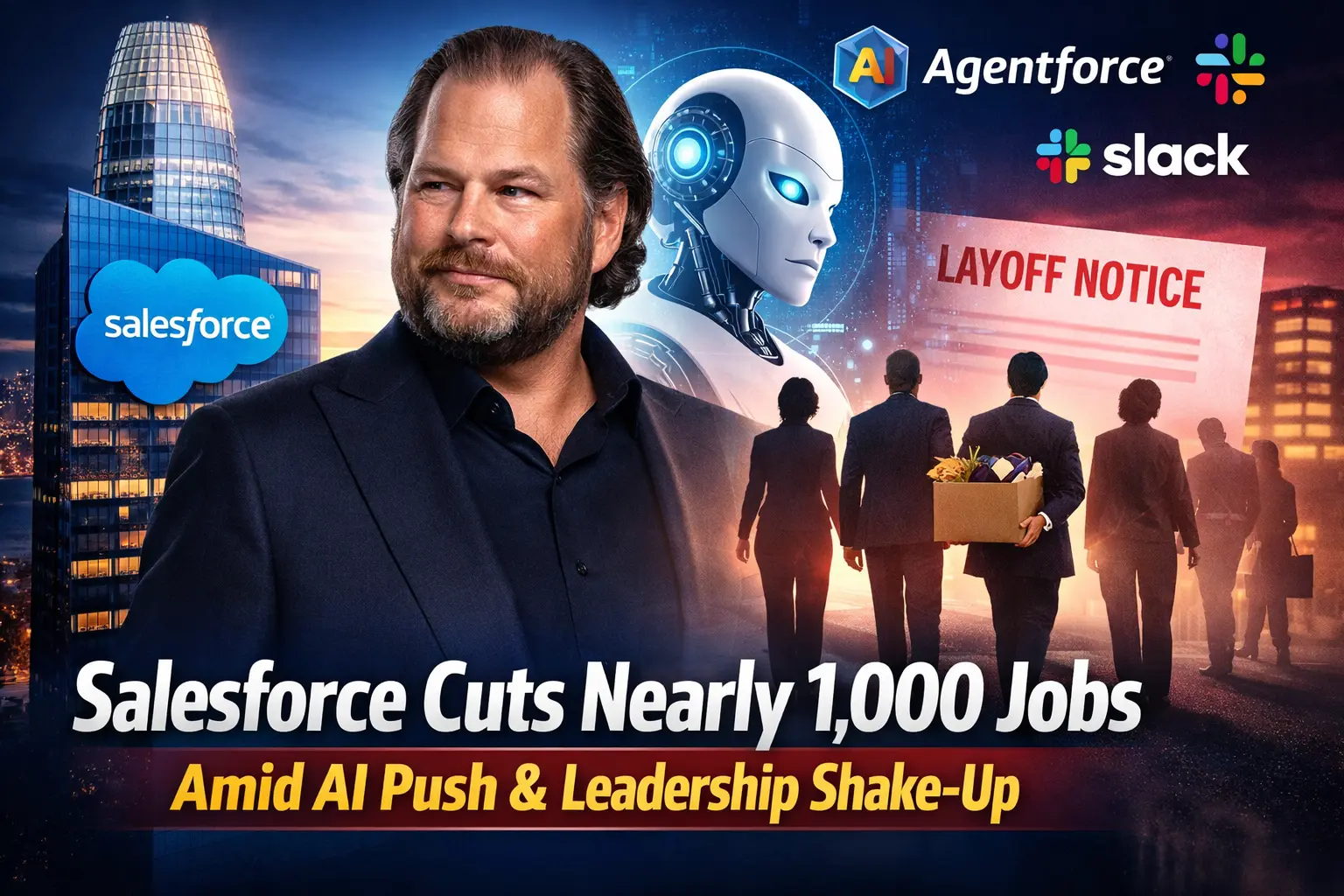
Salesforce’s Silent Layoffs Signal a Deeper Strategic Shift
Salesforce has quietly reduced its workforce by nearly 1,000 employees in another round of job cuts, reflecting the company’s accelerating pivot toward artificial intelligence and a rapidly evolving leadership structure. The layoffs, which occurred earlier this month, were not formally announced by the company but came to light through media reports and employee disclosures on social media platforms such as LinkedIn.
The affected roles reportedly span multiple teams, including marketing, product management, data analytics, and positions connected to Salesforce’s flagship AI platform, Agentforce. While Salesforce has declined to disclose the exact number of roles eliminated, sources familiar with the matter confirmed that fewer than 1,000 employees were impacted.
These cuts come at a pivotal moment for Salesforce, which is entering a new fiscal year while simultaneously reshaping its executive leadership and doubling down on AI-led growth.
AI Takes Centre Stage in Salesforce’s Strategy
Artificial intelligence has become the backbone of Salesforce’s long-term vision. CEO Marc Benioff has consistently framed AI not as an add-on, but as the foundation of every Salesforce product going forward. At the heart of this transformation is Agentforce, an autonomous AI agent platform designed to handle tasks traditionally performed by human teams.
Agentforce enables businesses to deploy AI-powered bots capable of customer engagement, data processing, workflow execution, and decision support. Salesforce positions the platform as a productivity multiplier—allowing organisations to scale operations without a proportional increase in headcount.
Benioff has openly acknowledged that Salesforce itself is using AI agents internally. In previous statements, he revealed that the company reduced its customer support workforce from roughly 9,000 employees to about 5,000 by leveraging AI-driven automation. While this shift has improved efficiency and margins, it has also raised concerns about the long-term implications for human roles within the organisation.
Launched in 2024, Agentforce has seen rapid adoption. By 2025, Salesforce reported “tens of thousands of deployments,” suggesting strong customer demand and growing confidence in autonomous AI systems. However, as AI adoption scales, the human cost of this transformation is becoming increasingly visible.
Executive Reshuffle Adds to Organisational Flux
Alongside workforce reductions, Salesforce is undergoing one of its most significant leadership transitions in recent years. Since December, five senior executives have exited the company, while six new leaders have been appointed or promoted to oversee critical areas of the business.
Key leadership changes include:
- Iain Mulholland, formerly of Google, joining Salesforce as Chief Security Officer, replacing Brad Arkin.
- Patrick Stokes, a long-serving Salesforce executive, stepping into the role of Chief Marketing Officer after Ariel Kelman’s departure to AMD.
- Dave Ward, previously CTO at Lumen Technologies, assuming the role of Chief Architect.
- Joe Inzerillo, now President of Enterprise and AI Technology, overseeing both Slack and Agentforce.
- Rob Seaman, promoted to Executive Vice President and General Manager for Slack.
- Madhav Thattai, promoted to Executive Vice President and General Manager for Agentforce.
Adding to the sense of transition, Adam Evans, the former head of Agentforce, recently announced his departure, marking another high-profile exit from the AI leadership team.
Salesforce has characterised these moves as part of long-term succession planning rather than reactive restructuring. According to a company spokesperson, the leadership reshuffle reflects a deliberate effort to institutionalise strategy rather than tie it to individual executives.
Employee Sentiment Reveals Growing Unease
Despite Salesforce’s public emphasis on innovation, stability, and growth, employee sentiment shared online paints a more complex picture. Posts on Reddit, LinkedIn, and other forums suggest increasing anxiety around job security, career progression, and organisational morale.
In one widely discussed Reddit thread, a senior finance professional considering a role at Salesforce expressed hesitation due to concerns about recurring layoffs, leadership churn, and performance pressure. The post attracted responses from current and former employees, many of whom echoed similar experiences.
Several employees described a workplace environment marked by frequent restructuring, limited promotion opportunities following organisational flattening, and an expectation of sustained high performance amid constant change. Some noted that layoffs have become almost predictable, often occurring twice a year, typically around February and September.
While compensation, benefits, flexible work arrangements, and generous parental leave continue to be viewed positively, many employees feel that internal competition has intensified. Career growth, according to some, now depends more on attrition above them than on merit alone.
At the same time, not all feedback has been negative. Some employees acknowledged that Salesforce remains a powerful brand and a valuable career platform, particularly for those who thrive in fast-paced, high-pressure environments and are comfortable adapting to ongoing transformation.
A Broader Recalibration Underway
The latest round of job cuts and leadership changes highlights a broader recalibration underway at Salesforce. As the company positions Agentforce and AI-driven automation as the core of its future, traditional roles are being reassessed, redefined, or eliminated altogether.
From a business perspective, the strategy is clear: improve efficiency, protect margins, and maintain competitiveness in an increasingly AI-driven enterprise software market. From a human perspective, however, the shift introduces uncertainty around long-term employment stability and workplace culture.
Salesforce’s new fiscal year began on February 1, and some leadership changes are still being formalised internally. As the company moves forward, the challenge will be balancing rapid technological advancement with employee trust, morale, and sustainable organisational growth.
The Salesforce story increasingly reflects a wider trend across the tech industry—where AI-led innovation promises growth and efficiency, but also forces difficult conversations about the future of work and the evolving relationship between technology and human talent.