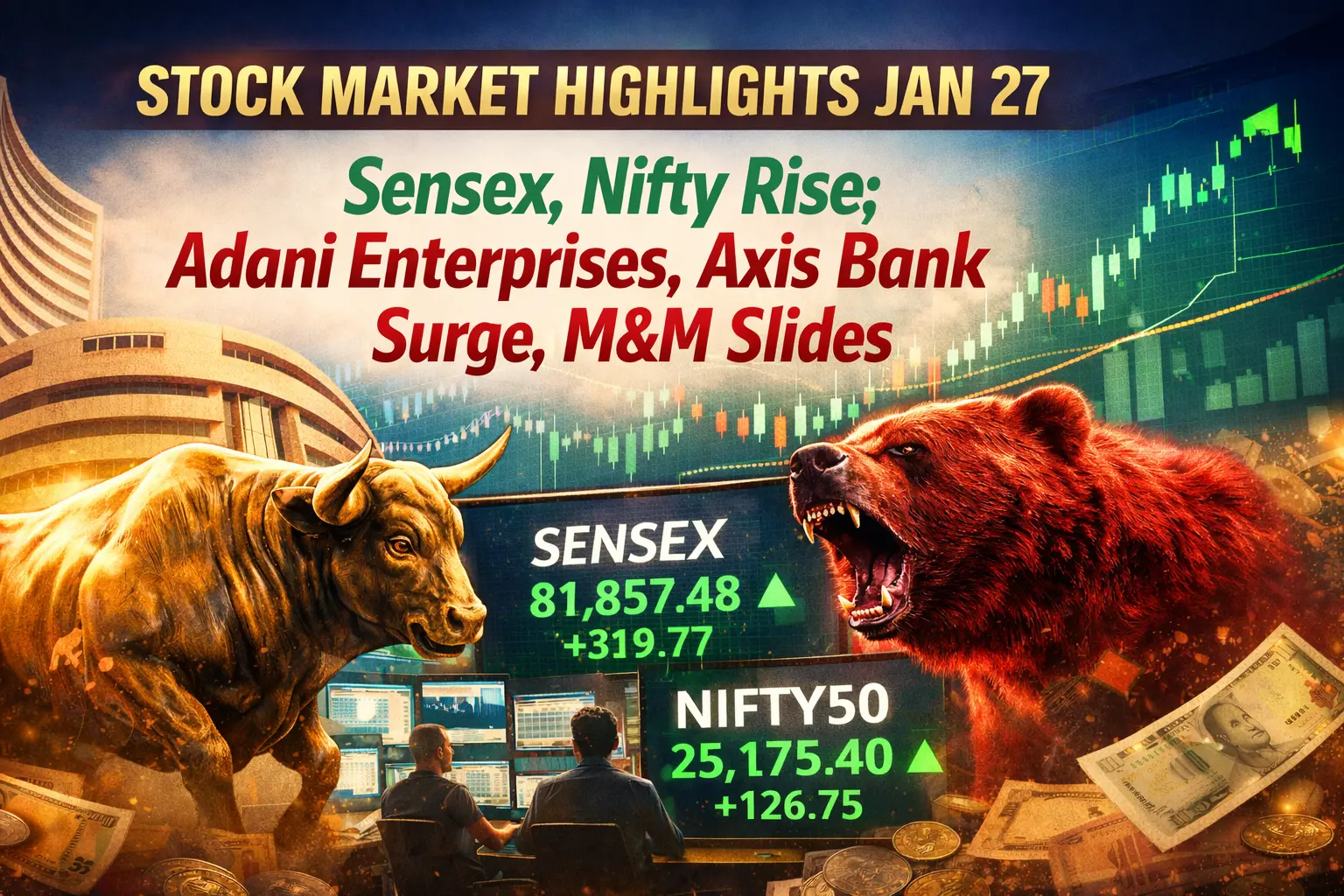
Indian equity markets ended Tuesday, January 27, in positive territory after a volatile trading session, supported by strong buying interest in metal and PSU bank stocks. Despite heavy selling pressure from foreign institutional investors (FIIs), domestic institutional investors (DIIs) provided crucial support, helping benchmark indices close firmly in the green.
Both SENSEX and NIFTY50 oscillated between gains and losses during the session, reflecting cautious investor sentiment amid earnings announcements and global cues. However, selective stock-specific buying, especially in metals, banking, and infrastructure-linked names, ultimately lifted market sentiment.
Market overview: Benchmarks finish higher amid volatility
The 30-share BSE Sensex advanced 319.77 points, or 0.39 percent, to close at 81,857.48. During the session, the index witnessed sharp intraday swings as investors reacted to corporate earnings, regulatory updates, and institutional flows.
Meanwhile, the Nifty 50 index climbed 126.75 points, or 0.51 percent, to settle at 25,175.40. Broader indices also ended in positive territory, indicating resilient domestic participation despite global uncertainty.
According to exchange data, FIIs sold equities worth ₹4,113.38 crore on Friday, while DIIs nearly matched the outflow by purchasing stocks worth ₹4,102.56 crore on a net basis. This strong domestic buying helped limit downside risks and stabilised the market.
NIFTY 50 top gainers and losers
The Nifty 50 index was led by Adani Enterprises, which surged 5.30 percent to close at ₹1,963. The stock rallied after the company clarified that there are no allegations against it and that it is not a party to the proceedings mentioned in recent media reports related to US regulators seeking legal summons for certain individuals. The clarification eased investor concerns and triggered strong buying interest.
Close behind was Axis Bank, which gained over 5 percent and touched a fresh 52-week high of ₹1,333.20 on the NSE. The rally followed the bank’s robust Q3FY26 performance, where it reported a 3 percent year-on-year rise in standalone net profit to ₹6,940 crore. Strong growth in net-interest income and a healthy net-interest margin of 3.6 percent further boosted investor confidence.
Metal stocks also dominated the gainers’ list. JSW Steel climbed 4.55 percent after posting a stellar 198 percent jump in consolidated net profit to ₹2,139 crore for the December quarter. Higher revenues and improved operational efficiency supported the stock’s sharp up move.
Other notable gainers included Adani Ports and Special Economic Zone and Grasim Industries, reflecting continued interest in infrastructure and commodity-linked stocks.
On the downside, Mahindra & Mahindra slipped 4.25 percent, emerging as the top loser on the Nifty 50. Auto stocks remained under pressure amid concerns over increased competition following reports related to the India–EU Free Trade Agreement, which could impact domestic manufacturers.
Shares of Asian Paints declined nearly 3 percent after the company reported a 4.56 percent year-on-year drop in consolidated net profit to ₹1,059.87 crore in Q3FY26. Weak demand conditions and margin pressures weighed on investor sentiment.
Other laggards in the index included Kotak Mahindra Bank, Max Healthcare Institute, and Maruti Suzuki India, which saw mild to moderate selling pressure.
NIFTY Midcap 100: Metals and defence stocks shine
The NIFTY Midcap 100 index closed 0.59 percent higher at 57,483.66, outperforming large caps during the session. The rally was driven by strong buying in metal, defence, and select industrial stocks.
Sona BLW Precision Forgings emerged as the top gainer, jumping over 7 percent on expectations of sustained demand from the auto and EV segments. Steel Authority of India and National Aluminium Company also posted solid gains, supported by rising metal prices and improved outlook for global demand.
Defence stocks remained in focus, with Bharat Dynamics gaining over 5 percent, reflecting continued optimism around government-led defence spending and indigenisation initiatives. Waaree Energies also advanced, extending its recent momentum amid strong investor interest in renewable energy plays.
However, the midcap space also witnessed selective selling. PB Fintech, Blue Star, Patanjali Foods, Bharti Hexacom, and Motilal Oswal Financial Services were among the top losers, weighed down by profit booking and stock-specific concerns.
NIFTY Smallcap 100: Selective buying continues
The NIFTY Smallcap 100 index ended 0.41 percent higher at 16,419.35, indicating cautious but steady participation from investors in smaller companies.
Karur Vysya Bank led the gainers with a sharp rise of nearly 10 percent, followed by Aegis Vopak Terminals and Garden Reach Shipbuilders & Engineers. Strong order inflows and sectoral tailwinds supported defence and logistics-related stocks.
Multi Commodity Exchange of India (MCX) rallied close to 7 percent after reporting a massive 151 percent year-on-year jump in consolidated net profit to ₹401.12 crore for the December FY26 quarter. Higher trading volumes and improved operational leverage significantly boosted earnings, attracting strong investor interest.
On the downside, Signatureglobal, Mahanagar Gas, CreditAccess Grameen, Nuvama Wealth Management, and Neuland Laboratories were among the top smallcap losers, declining up to 5 percent amid concerns over earnings visibility and valuations.
Market outlook
The January 27 trading session underscored the importance of stock-specific triggers and earnings momentum in the current market environment. While benchmark indices continue to show resilience, volatility is likely to persist due to global economic cues, institutional flows, and policy-related developments.
Sectors such as metals, defence, and banking remain in focus, while autos and select consumption stocks may face intermittent pressure. Investors are expected to remain cautious, with a preference for fundamentally strong companies backed by consistent earnings growth.
Disclaimer: This article is for informational purposes only and does not constitute investment advice. Investors should consult a certified financial advisor before making any investment decisions.