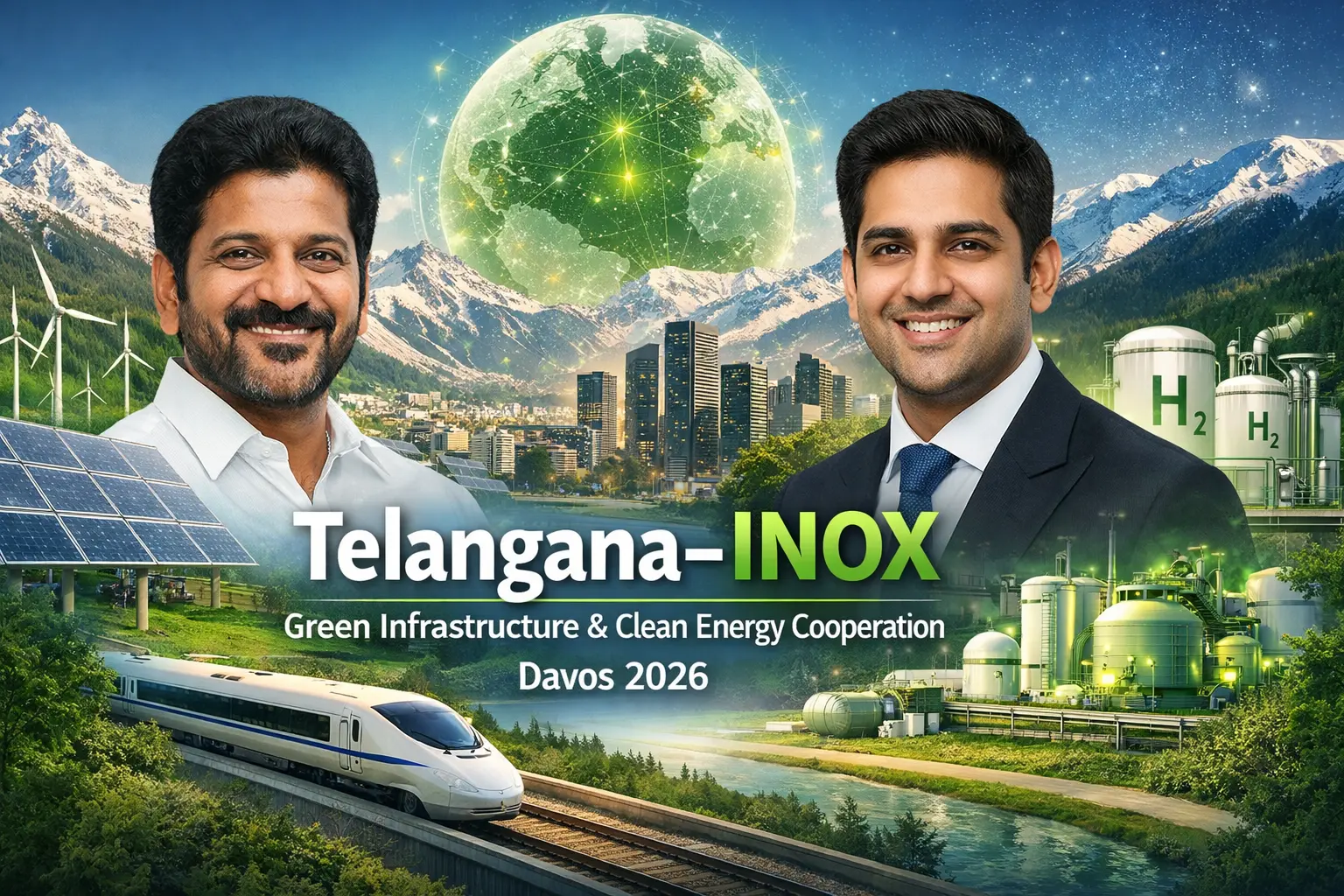
At the World Economic Forum (WEF) 2026 in Davos, the Telangana government reinforced its commitment to sustainable development by initiating high-level discussions with the INOX Group on green infrastructure and clean energy collaboration. The dialogue reflects Telangana’s long-term vision to position itself as a future-ready, low-carbon economic hub while supporting rapid urbanisation and digital growth.
Led by Chief Minister A. Revanth Reddy, the meeting focused on transforming Telangana’s urban landscape—particularly the Hyderabad metropolitan region—into a Net Zero zone. With data centres, IT parks, and advanced services expanding at unprecedented speed, the state is aligning its energy and infrastructure policies to ensure that growth remains environmentally responsible and globally competitive.
Telangana’s Net Zero Urban Vision
One of the central themes of the discussion was Telangana’s ambitious CURE (Core Urban Region Economy) model. Under this framework, the state proposes a structural transformation of the Hyderabad metropolitan area into a services-sector-dominated economy. The strategy involves relocating polluting and heavy industries away from the urban core, thereby reducing emissions, improving air quality, and enhancing overall livability.
By repositioning Hyderabad as a clean, sustainable services hub, the government aims to create an ecosystem that attracts global investment, skilled talent, and high-value enterprises. The long-term goal is not merely urban beautification, but the creation of a resilient metropolitan economy aligned with international climate commitments.
This urban transition requires large-scale access to clean and reliable energy—an area where the INOX Group is expected to play a strategic role.
Role of INOX Group in Clean Energy Transition
During the meeting, INOX Group Director Devansh Jain outlined the conglomerate’s interest in supporting Telangana’s green ambitions. The proposed collaboration spans multiple dimensions of the clean energy value chain, starting with renewable power generation and extending into advanced manufacturing and green infrastructure.
1. Large-Scale Renewable Energy Deployment
INOX Group plans to initially focus on the development of large-scale solar and wind power projects within Telangana. These projects are intended to supply clean electricity to urban infrastructure, data centres, and industrial clusters, helping the state reduce dependence on fossil fuels.
Given Telangana’s favourable solar irradiation and wind corridors, renewable capacity expansion is expected to be both technically viable and economically competitive.
2. Sustainable Manufacturing Ecosystem
Beyond power generation, INOX is exploring future investments in the manufacturing of solar modules and advanced energy components. Establishing such facilities locally would strengthen Telangana’s renewable energy supply chain, reduce import dependence, and create high-skilled employment opportunities.
This aligns closely with the state’s industrial policy, which prioritises value-added manufacturing linked to clean technologies.
3. Green Infrastructure and Hydrogen Economy
Another area of interest discussed was green hydrogen. As India moves toward hydrogen as a long-term clean fuel, Telangana aims to be an early mover by building enabling infrastructure and securing clean electricity for hydrogen production. INOX Group’s experience in industrial gases and energy positions it as a potential partner in this emerging sector.
Powering Telangana’s Data Centre Boom
A key driver behind Telangana’s aggressive clean energy push is the rapid expansion of data centres across the state. Minister for IT and Industries, D. Sridhar Babu, highlighted that Telangana is witnessing a “massive” influx of data centre investments due to its robust digital infrastructure, strategic location, and supportive policies.
Data centres are energy-intensive by nature, requiring uninterrupted and high-quality power. As global technology companies increasingly demand renewable energy sourcing, Telangana is proactively aligning its energy ecosystem to meet these expectations.
The state’s new energy policy offers preferential procurement advantages to locally based manufacturers. This incentive structure encourages companies like INOX to establish manufacturing and supply chain operations within Telangana, creating a virtuous cycle of local production, clean energy availability, and industrial growth.
Policy Continuity as a Competitive Advantage
Minister Sridhar Babu also underlined that Telangana’s industrial success is rooted in decades of policy continuity. Since the 1990s, successive governments have maintained a stable and investor-friendly policy environment, enabling long-term planning and infrastructure development.
This consistency has built strong investor confidence, making Telangana a preferred destination for high-end manufacturing, IT services, and emerging technology sectors. The current green energy and infrastructure push is a continuation of this legacy, rather than a short-term initiative.
Infrastructure Push: Beyond Energy
Clean energy is only one pillar of Telangana’s broader development strategy. The state is simultaneously investing in next-generation infrastructure, including greenfield expressways and proposed high-speed rail and bullet train corridors. These projects aim to improve regional connectivity, reduce logistics costs, and integrate industrial zones with urban centres efficiently.
By combining modern transport infrastructure with renewable energy and digital connectivity, Telangana seeks to position itself as a global alternative for advanced manufacturing and technology-driven industries.
Cross-Departmental Commitment to Sustainability
The presence of Minister for Revenue and Housing, Ponguleti Srinivasa Reddy, at the WEF meeting highlighted the cross-departmental priority accorded to the energy transition. Urban planning, housing, industrial development, and energy policy are being aligned to ensure that sustainability goals are embedded across governance structures.
This integrated approach is critical for achieving Net Zero ambitions, as energy transition alone cannot deliver results without coordinated land use planning, housing policy, and infrastructure development.
Telangana as a Green Growth Model
The Telangana–INOX dialogue at WEF 2026 signals more than a single investment discussion—it reflects a strategic shift in how the state envisions its future growth. By anchoring economic expansion in clean energy, sustainable manufacturing, and green infrastructure, Telangana aims to balance rapid urbanisation with environmental responsibility.
If successfully implemented, the CURE model and associated clean energy initiatives could position Telangana as a national and global benchmark for sustainable urban development. For investors, technology companies, and clean energy players, the message from Davos is clear: Telangana is open for business—and that business is green, future-focused, and policy-driven.
As global economies increasingly align growth strategies with climate action, Telangana’s approach offers a compelling blueprint for integrating sustainability into mainstream economic planning.