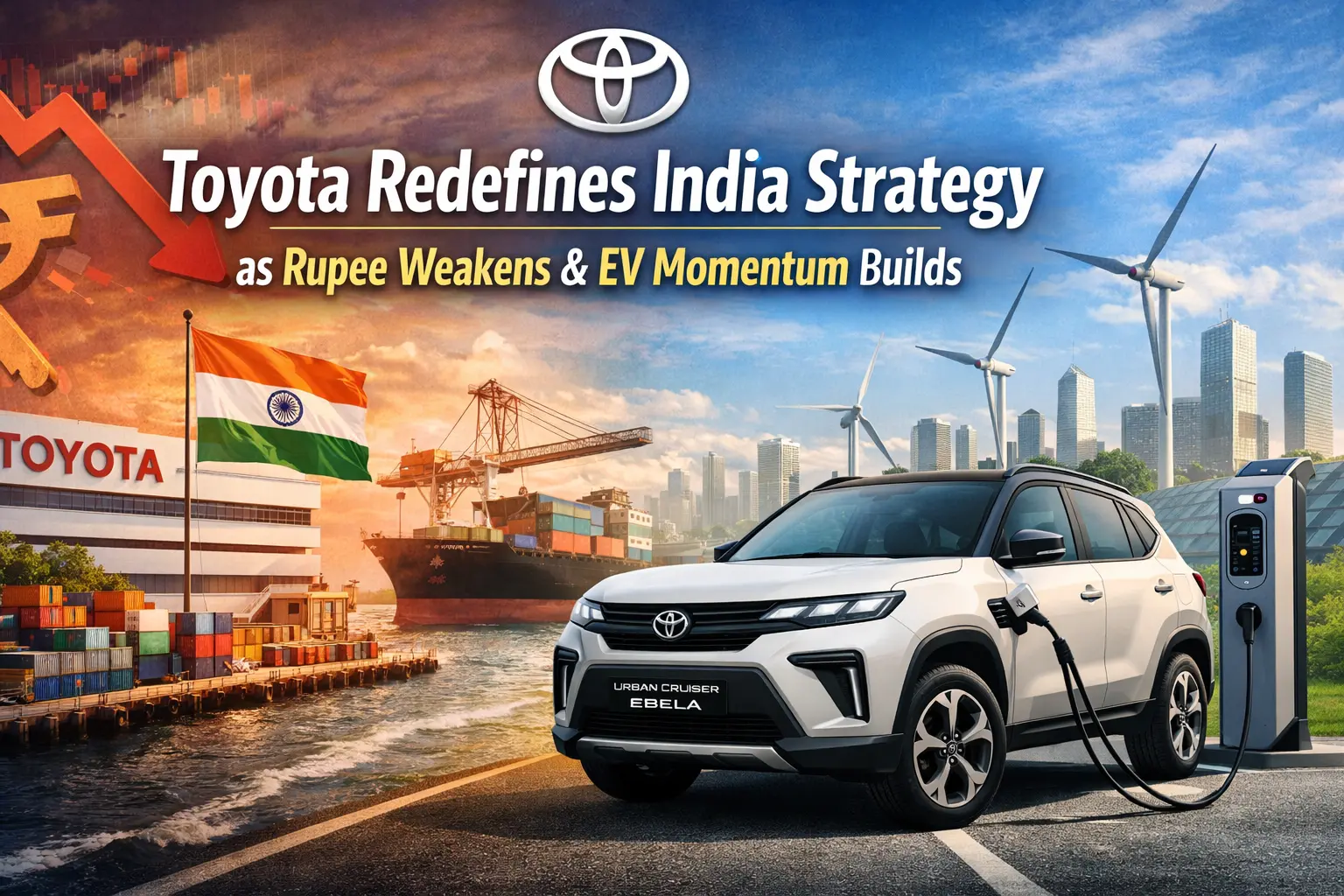
Toyota Motor Corporation is recalibrating its India strategy as a combination of currency pressures, global supply chain realignments, and growing confidence in electric vehicles (EVs) reshape the country’s automotive landscape. With the Indian rupee weakening, exports gaining traction, and EV adoption gradually accelerating, the Japanese automaker is doubling down on localisation while positioning India as a significant manufacturing and export hub—not merely an alternative to China, but a strategic market in its own right.
Weak Rupee: Challenge and Opportunity
The depreciation of the Indian rupee by nearly 5% in 2025 has intensified cost pressures for manufacturers dependent on imported components. For Toyota Kirloskar Motor (TKM), this currency movement has acted as a double-edged sword. On one hand, it increases the cost of imports; on the other, it makes exports from India more competitive in global markets.
According to Toyota’s leadership, the weaker rupee is accelerating the company’s push toward deeper localisation of components and supply chains. By sourcing more parts domestically, Toyota aims to reduce vulnerability to currency fluctuations while strengthening India’s automotive ecosystem. At the same time, the export economics are becoming more attractive, prompting Toyota to expand its overseas shipments from Indian plants.
This dual approach—localise more, export more—now sits at the heart of Toyota’s revised India roadmap.
Exports Outpace Domestic Growth
Toyota’s export performance from India has already begun to reflect this strategic shift. Passenger vehicle exports surged by over 40% in 2025, significantly outpacing the company’s domestic sales growth, which stood in the mid-teens. While Toyota sold more than 3.5 lakh vehicles in India during the year, exports crossed 37,000 units, underlining India’s rising importance as a global production base.
A key upcoming milestone in this journey is the planned export of the made-in-India Urban Cruiser Ebella to European markets. This move not only validates India’s manufacturing quality but also signals Toyota’s confidence in the country’s ability to meet stringent global regulatory and safety standards.
Strategic Alliances Power EV Entry
Toyota’s first electric vehicle for India marks another important pivot. Rather than developing an EV independently from scratch, the company is leveraging its long-standing global alliance with Maruti Suzuki. The Urban Cruiser Ebella is a rebadged version of Suzuki’s eVitara, sourced directly through this partnership.
This strategy reflects Toyota’s broader global approach—using collaborations to enter new segments quickly while keeping costs under control. In a price-sensitive and rapidly evolving EV market like India, partnerships offer speed, scale, and shared risk, all of which are critical for success.
By aligning with Maruti Suzuki, Toyota also gains access to an extensive supplier network and local manufacturing expertise, strengthening its localisation objectives even further.
India Is Not a ‘China Replacement
Globally, Japanese automakers such as Toyota, Honda, and Suzuki are rethinking their heavy reliance on China for manufacturing and sales. Geopolitical tensions, rising costs, and shifting consumer dynamics have prompted these companies to diversify operations across multiple regions.
However, Toyota’s leadership has been clear that India is not being positioned as a simple substitute for China. Instead, India has long been viewed as a core market with independent growth potential. The steady rise in both domestic sales and exports, according to Toyota executives, is a reflection of sustained investment and long-term commitment rather than a reactionary shift.
This distinction matters. It suggests that Toyota’s India strategy is structural, not tactical—designed to grow with the country’s economy rather than fill a temporary gap elsewhere.
Hybrid Legacy as a Bridge to EVs
One of Toyota’s strongest advantages in India lies in its deep experience with hybrid vehicles. For over a decade, the company has sold strong hybrid models in the country, building not just a customer base but also a robust service and support ecosystem.
Toyota believes this hybrid legacy will ease the transition to battery electric vehicles. High-voltage systems, power electronics, and energy management technologies used in hybrids share similarities with EV architectures. As a result, Toyota already has a network of trained technicians and service outlets capable of handling EV-related repairs and maintenance.
With over 500 service points prepared to work on high-voltage systems, the company sees customer trust and after-sales support as key differentiators in an EV market still grappling with range anxiety and reliability concerns.
Reducing Consumer Anxiety Around Batteries
Battery cost, longevity, and resale value remain major concerns for Indian EV buyers. Toyota is actively exploring innovative ownership models to address these issues, including assured buyback schemes and battery-as-a-service options.
Such models could significantly lower the perceived risk of EV ownership by separating the most expensive component—the battery—from the vehicle itself or by guaranteeing residual value. For first-time EV buyers, these assurances could make the difference between hesitation and adoption.
Toyota’s approach signals a shift from simply selling cars to offering mobility solutions tailored to evolving consumer mindsets.
EV Confidence Is Gradually Rising
While EV penetration in India remains modest compared to global leaders, confidence is clearly growing. Increased visibility of electric cars on Indian roads, improving charging infrastructure, and broader public discourse around clean mobility are changing perceptions.
Toyota believes the timing is right to enter the battery electric space, albeit cautiously. Rather than chasing volume aggressively, the company is focusing on reliability, customer care, and long-term trust—values closely associated with its brand globally.
This measured entry aligns with Toyota’s philosophy of introducing technology only when it meets its internal benchmarks for quality and durability.
Policy Environment: Mixed Signals
Government policy continues to play a crucial role in shaping India’s EV transition. Toyota has noted that recent changes in the GST framework have shifted the focus toward vehicle size rather than underlying technology. Unlike earlier policies that differentiated between powertrains, the current structure does not actively incentivise cleaner technologies based on emissions or efficiency.
That said, there is no clear indication of a policy rollback on EVs or hybrids. Toyota remains cautiously optimistic that future regulations will better align environmental goals with consumer incentives, creating a more technology-neutral yet sustainability-focused framework.
Toyota’s evolving strategy underscores a larger truth about India’s automotive future. As the rupee weakens, global supply chains diversify, and EV adoption gains momentum, India is emerging as both a major market and a competitive export base.
By deepening localisation, leveraging strategic partnerships, and building on its hybrid expertise, Toyota is positioning itself for steady, sustainable growth rather than short-term disruption. Its India roadmap reflects patience, pragmatism, and long-term conviction—qualities that may ultimately define success in one of the world’s most complex and promising auto markets.
In Toyota’s eyes, India is no longer just an opportunity—it is a cornerstone of its global mobility strategy.