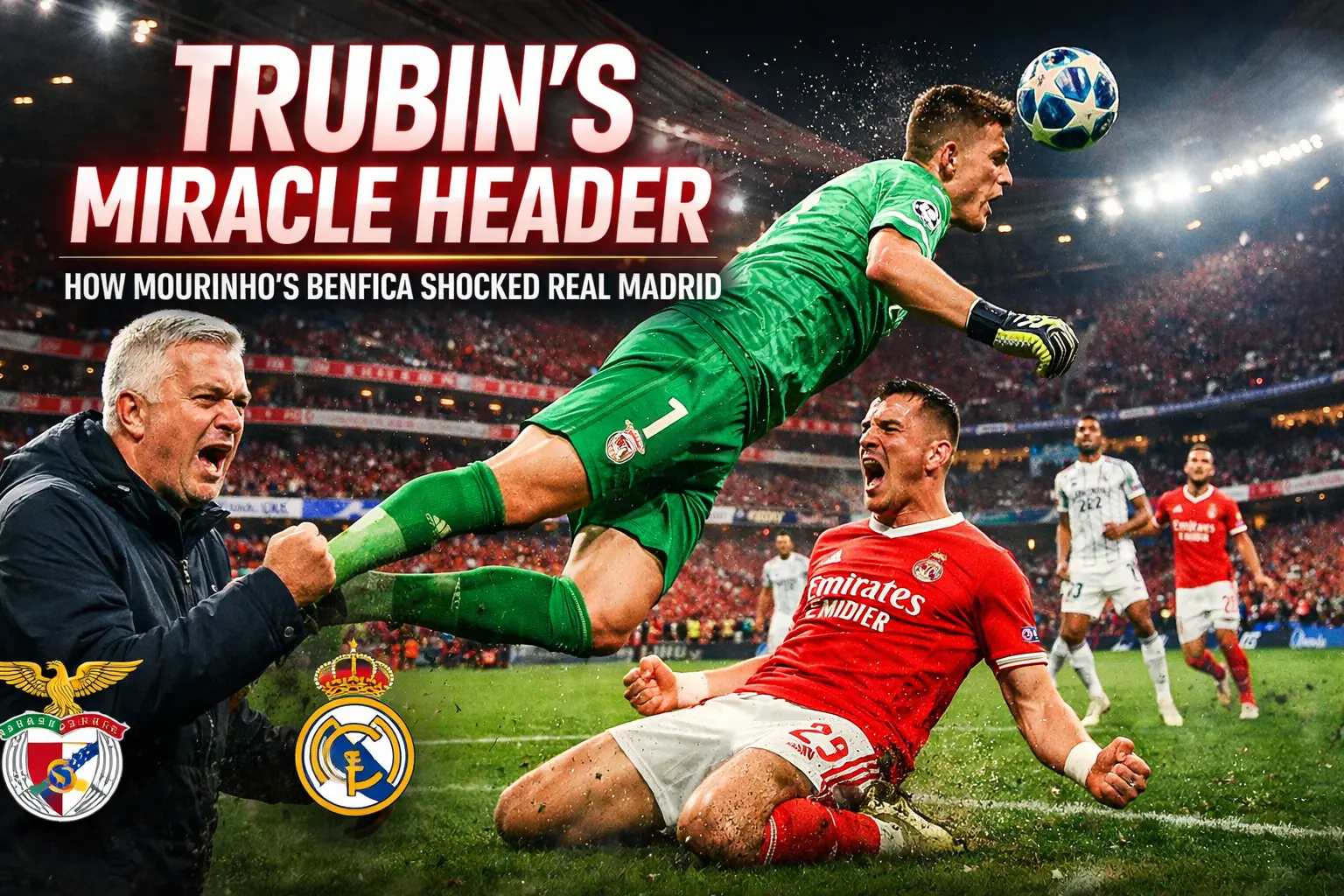
Football has always thrived on moments that defy logic, planning, and probability. On a dramatic Champions League night in Lisbon, one such moment unfolded when Anatoliy Trubin, a goalkeeper not known for scoring goals, became the unlikeliest hero in UEFA Champions League history. His last-gasp header sealed a stunning victory for Benfica over 15-time champions Real Madrid, keeping their European campaign alive and adding yet another unforgettable chapter to the storied career of José Mourinho.
A night that demanded more than victory
Simply beating Real Madrid was never going to be enough. The unique league-phase format meant 18 matches were being played simultaneously, and qualification margins were painfully tight. As the clock ticked deep into stoppage time at the Estádio da Luz, Benfica led 3–2. The stadium roared, but the truth was cruel: as things stood, they were still heading out of the competition on goal difference.
Players on the pitch seemed unsure. The bench was frantic. Calculations were being made in real time. Somewhere else in Europe, Marseille were clinging to a qualification spot — until Benfica decided to tear up the script.
The goalkeeper who didn’t know, but believed
A free-kick in the dying seconds offered Benfica one final opportunity. In an instinctive, almost cinematic decision, Mourinho gestured for Trubin to come forward. Even the goalkeeper himself admitted later that he did not fully grasp the qualification scenario. Minutes earlier, he had been trying to slow the game down, thinking survival depended on holding the 3–2 scoreline.
Then came the pointing, the shouting, the universal football signal: go up.
Trubin sprinted into the penalty area, timing his run perfectly. When the ball was delivered, he rose above everyone and powered a bullet header past the Madrid goalkeeper. Pandemonium followed. Players scattered in disbelief, fans erupted, and Trubin finished his euphoric run with a knee slide usually reserved for seasoned strikers.
For a 24-year-old goalkeeper scoring the first goal of his professional career, the moment bordered on the unreal.
Mourinho’s gamble pays off
For Mourinho, this was not blind faith. Weeks earlier, in a domestic cup match against FC Porto at the Dragão, Trubin had been sent forward for a last attack. He nearly scored then too, only to be denied by a desperate block. That rehearsal proved decisive.
“We knew he could do it,” Mourinho explained afterward. “He had already shown the timing and courage.”
The goal was more than just qualification insurance. It was symbolic — a reminder that Mourinho’s teams, regardless of form or league position, remain capable of producing moments of chaos and genius when the stakes are highest.
A turbulent Benfica chapter
Mourinho’s return to Benfica in September was met with scepticism. More than two decades after his first brief spell at the club, many wondered whether “The Special One” still had the magic. At 63, critics questioned whether his best days were long behind him.
Domestically, the doubts had some foundation. Benfica, though unbeaten in the league, sit third and trail leaders Porto by a daunting margin. A ninth league title for Mourinho looks unlikely. They were also eliminated from the Portuguese Cup in a quarter-final defeat — again by Porto — a club deeply woven into Mourinho’s personal history.
In Europe, the story was even bleaker at first. Benfica lost their opening four Champions League matches, and even victories against Ajax and Napoli felt insufficient after another setback in the penultimate round.
That is what made the Madrid night so powerful. From near-certain elimination to miraculous survival, all in one header.
The narrative Mourinho needed
Football narratives matter, and this one was irresistible. Mourinho beating Real Madrid — his former club — always carries extra weight. Adding further intrigue was Madrid coach Álvaro Arbeloa, a former player Mourinho has often described as being “like a son”.
European football analyst Julien Laurens summed it up perfectly: this was the moment Mourinho needed. After months of uneven results and public doubt, the dramatic nature of the victory shifted the conversation. Benfica were written off after heavy early losses, yet somehow, there was still life — and belief.
Guardiola watching from afar
The drama even rippled beyond Lisbon. Over in England, Pep Guardiola was keeping a close eye on events as his Manchester City side battled Galatasaray. City’s top-eight finish depended on Benfica holding on.
Guardiola later admitted confusion when Trubin charged forward. From the outside, it seemed reckless. From Mourinho’s perspective, it was necessity. One more goal was the only path to survival — and the risk was fully justified.
What comes next: Madrid or Milan
The reward for Benfica is no easy ride. Finishing 24th in the league phase, they face a daunting play-off. With Real Madrid ending ninth, there is a strong possibility of an immediate rematch. The alternative? Inter Milan, the side with whom Mourinho achieved legendary status by winning the Champions League as part of the 2010 treble.
Mourinho, unsurprisingly, expressed no preference. A return to the Bernabéu or the San Siro both appeal to his sense of history. Few managers relish hostile, high-pressure environments more than him.
A moment even Mourinho can’t top?
Mourinho’s career has been filled with iconic nights: Porto’s rise, Chelsea’s dominance, Inter’s treble, Madrid’s league-breaking points total. Yet even by his standards, a goalkeeper scoring in stoppage time to knock Real Madrid out of qualification positions is extraordinary.
Whether Benfica go further or not, Trubin’s header will live on — a snapshot of why football remains unpredictable and irresistible. For one night in Lisbon, tactics, statistics, and probability bowed to belief.
And even for a manager who has seen it all, Trubin’s miracle might be a story too perfect to ever truly repeat.