Introduction
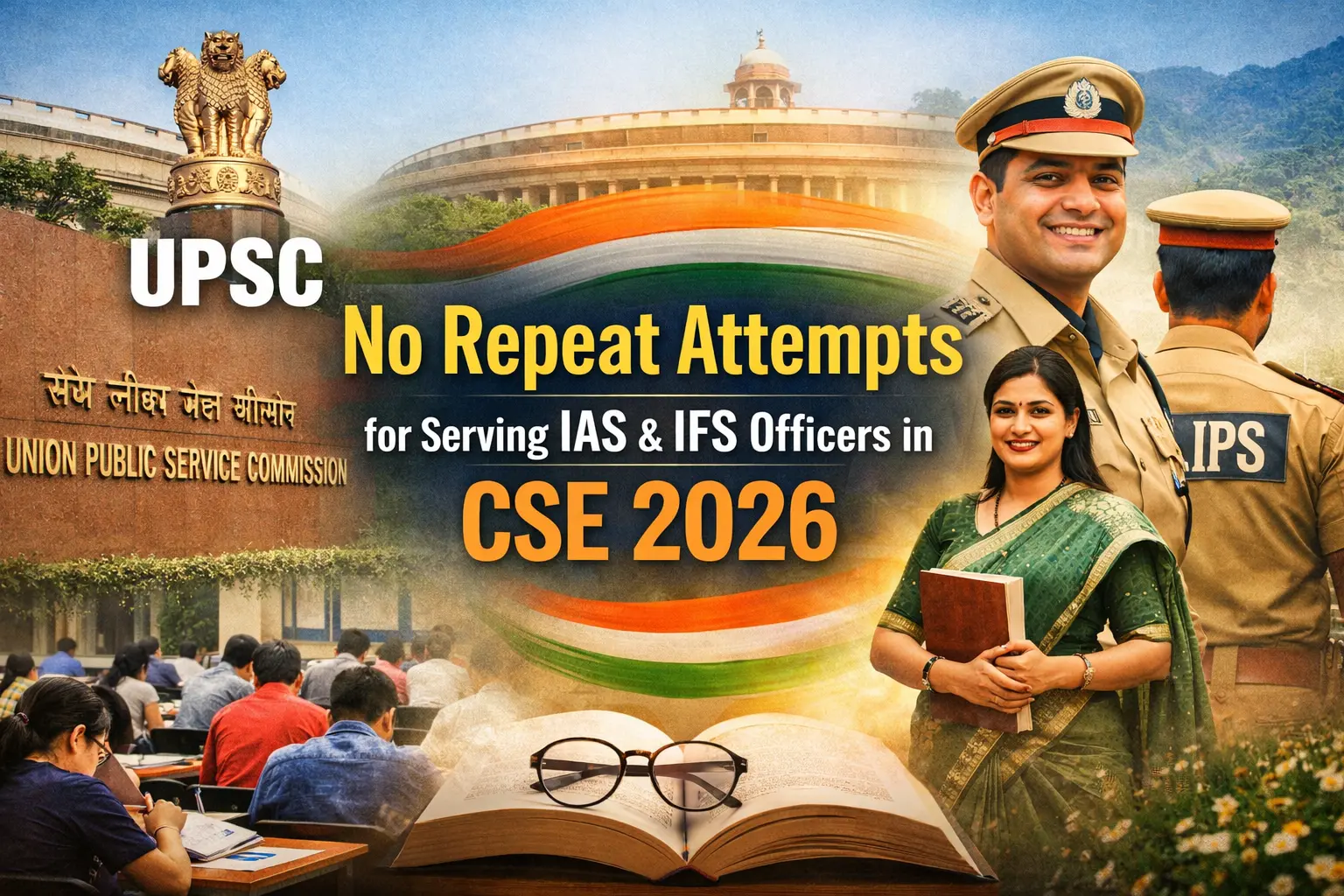
In a major reform aimed at strengthening the integrity and stability of the civil services, the Union Public Service Commission (UPSC) has announced significant changes to eligibility rules for the Civil Services Examination (CSE) beginning CSE 2026. The decision effectively ends the long-debated practice of successful candidates reappearing for the examination primarily to secure a “better” service or cadre posting after already joining the Indian Administrative Service (IAS) or the Indian Foreign Service (IFS).
The new rules were notified alongside the announcement of 933 vacancies for CSE 2026 and are expected to have far-reaching consequences for aspirants, serving officers, and the overall administration of the civil services.
What Has Changed for IAS and IFS Officers?
Under the revised framework, candidates already appointed as IAS or IFS officers through a previous CSE will not be eligible to appear for CSE 2026. This marks a clear departure from earlier years when such candidates could continue appearing within their remaining attempts.
UPSC has further clarified the cut-off stages at which ineligibility will apply:
- If a candidate clears CSE 2026 Preliminary Examination but is appointed as IAS or IFS before the Mains examination, they will not be allowed to write the Mains.
- If the candidate is appointed as IAS or IFS after the Mains but before the final results, the CSE 2026 result will not be considered for any service allocation.
This effectively ensures that once a candidate enters either of these top two services, the cycle of reattempts for upward movement within services comes to an end.
Why IAS and IFS Are Treated Differently
The UPSC’s rationale is rooted in the unique status of the Indian Administrative Service and the Indian Foreign Service. These are widely regarded as the most prestigious services in the civil services hierarchy, offering unmatched administrative authority, policy influence, and international representation.
Over the years, repeated attempts by serving IAS and IFS officers were seen as:
- Disrupting cadre stability
- Delaying training and field postings
- Blocking opportunities for fresh aspirants
The new rule aims to ensure administrative continuity while also improving fairness in competition.
IPS Officers Still Have Limited Flexibility
The restrictions are comparatively milder for the Indian Police Service (IPS).
Key points for IPS officers include:
- Candidates already selected or appointed to IPS through an earlier CSE may appear for CSE 2026.
- However, they cannot be allocated IPS again through CSE 2026.
- This means IPS officers can reattempt the examination only to secure IAS or IFS, not to improve their IPS rank or cadre.
This distinction reflects UPSC’s intent to discourage lateral movement within the same service while still allowing limited upward mobility.
One Additional Attempt for Group ‘A’ Services
UPSC has also addressed the long-standing ambiguity surrounding repeat attempts for candidates allocated to IPS or other Group ‘A’ services through CSE 2026.
Such candidates are permitted one additional attempt in CSE 2027, but only under strict conditions:
- One-time training exemption
- Candidates must obtain permission from the competent authority for a one-time exemption from training.
- This exemption is allowed only once.
- Mandatory joining of Foundation Course
- Even with exemption, candidates must mandatorily join the Foundation Course.
- Failure to either join training or secure exemption will result in cancellation of service allocation.
This framework ensures that candidates do not indefinitely delay training while chasing a higher service.
What Happens If a Candidate Clears CSE 2027 Again?
UPSC has laid out a clear and transparent choice mechanism:
- If selected again in CSE 2027, the candidate will be given the option to choose between:
- Service allotted through CSE 2026, or
- Service allotted through CSE 2027
- The service not chosen will be cancelled.
If the candidate fails to secure any service in CSE 2027, they may still join the service allotted through CSE 2026, provided all training requirements are fulfilled.
However, failure to join training for both examinations will lead to cancellation of both service allocations—a strong deterrent against speculative attempts.
Seniority Rules Clarified
Addressing concerns among aspirants and serving officers, UPSC has clarified that:
- Seniority will not be reduced due to reattempts.
- Seniority will depend solely on the date of actual joining of service, not on the examination year.
This ensures parity among officers and avoids administrative complications within cadres.
No More Attempts After Joining — Unless You Resign
Once a candidate joins a service through CSE 2026 or CSE 2027, they will not be permitted to appear for CSE 2028 or later examinations, unless they formally resign from the service.
Candidates who wish to retain their remaining attempts must:
- Refrain from joining any service allotted through CSE 2026 or CSE 2027
- In such cases, the service allocation will automatically stand cancelled
This rule introduces a decisive moment for aspirants—either commit to the service or continue the examination journey.
Special One-Time Relaxation for Existing Officers
For candidates already allocated a service through CSE 2025 or earlier, UPSC has granted a one-time relaxation:
- They may appear in either CSE 2026 or CSE 2027 without resigning from their existing service.
- However, to appear in CSE 2028 or any subsequent examination, resignation from the existing service will be mandatory.
This transitional provision balances fairness with reform, giving current officers time to adjust to the new regime.
Implications for Aspirants
The new UPSC rules fundamentally change exam strategy:
- Aspirants must now think long-term before joining any service.
- Repeated attempts purely for “better postings” are effectively discouraged.
- Fresh candidates may benefit from reduced seat blocking by serving officers.
- The civil services are likely to see greater stability and continuity in training and postings.
UPSC’s CSE 2026 reforms mark one of the most decisive shifts in civil services recruitment policy in recent years. By restricting repeat attempts for serving IAS and IFS officers, tightening conditions for Group ‘A’ services, and clearly defining post-selection choices, the Commission has emphasized commitment, efficiency, and fairness.
For aspirants, the message is clear: every attempt now carries greater weight, and the decision to join a service must be made with clarity and conviction.