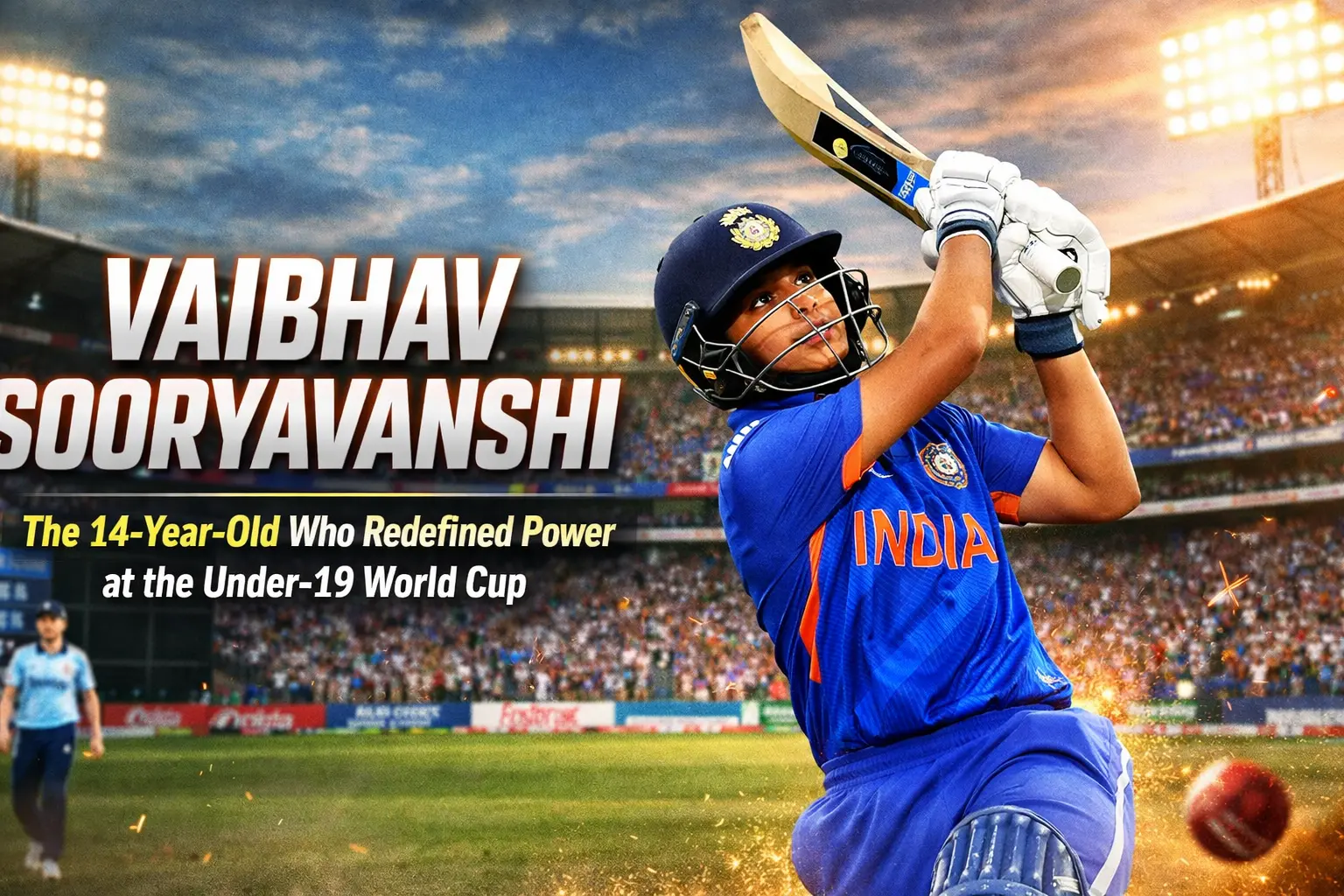
Cricket has a long tradition of prodigies, but once in a while, a player arrives who doesn’t merely promise greatness — he announces it. In the final of the Under-19 World Cup, that announcement came from Vaibhav Sooryavanshi, a 14-year-old left-hander whose bat spoke with the authority of a seasoned international.
Facing England in the summit clash at Harare Sports Club, Sooryavanshi produced an innings so commanding, so technically assured and so brutally effective that it felt less like youth cricket and more like a glimpse into the future of the game.
A tournament of quiet menace
For much of the World Cup, Sooryavanshi’s performances existed just below the noise threshold. His scores — 72, 40, 52, 30, 68 — were impactful but rarely headline-grabbing. The strike-rates were ferocious, the intent unmistakable, yet the viral moments that often define modern cricket stardom were missing.
That was nothing new for him.
Over the past year, his most astonishing feats had unfolded away from prime-time glare: a blistering 36-ball century in domestic youth cricket, a commanding 171 at the Under-19 Asia Cup, and a brutal assault on the UAE attack that left scorecards looking fictional. The numbers were eye-catching, but context mattered. Could they translate to the biggest stage?
The final answered that question decisively.
The scene: final pressure, fearless mind
Opening the batting for India Under-19 Cricket Team against England Under-19 Cricket Team, Sooryavanshi walked out with a helmet that seemed oversized for his youthful frame. His face still carried the softness of childhood, but his posture betrayed something else entirely — intent.
His bat lift was high, classical, almost reminiscent of his idol Brian Lara. At the point of release, his movements were minimal, balanced, boxer-like — coiled energy waiting to explode.
The first few overs were watchful. Fifteen runs from his first 17 balls. England’s bowlers tested him with pace and bounce on a lively surface. There were misses, edges of uncertainty. But there was no panic.
Then came the release.
Mechanics of destruction
When Alex Green strayed fractionally wide with a back-of-a-length delivery, Sooryavanshi unveiled the full extent of his method. Both heels lifted, his upper body leaned away, the bat face opened at the last instant — a complex chain of movements timed to perfection. The result was a soaring six over deep third, a shot that defied geometry.
England tried the obvious counter: cramp him for room.
Left-arm quick James Minto angled the ball into the stumps, a line designed to neutralize free arms. Instead, Sooryavanshi contorted with astonishing flexibility. His hips and shoulders opened fully, his feet realigned mid-shot, and without swinging across the line, he launched the ball high over wide long-on.
These were not slogger’s strokes. They were engineered.
Every adjustment — foot position, shoulder rotation, bat face — spoke of rare spatial awareness. Shots that come with risk warnings for most batters looked routine in his hands.
Bowling plans dissolve
Spin or pace, length or short ball, nothing stuck. Sooryavanshi’s half-century came off just 32 balls, and England’s bowlers were already searching for answers that didn’t exist.
The short ball, the last refuge, arrived from Manny Lumsden. It was chest-high, climbing, awkward. Sooryavanshi responded by hopping sideways, both feet airborne, realigning his body so late that the ball passed under his eyes. The bat opened, the timing pristine. Four runs split the field.
That moment summed up the innings: balance under chaos.
A hundred that broke context
Sooryavanshi’s hundred arrived in just 55 balls — nearly two runs per delivery — and still he accelerated. Overs from Ralphie Albert and Sebastian Morgan disappeared into the stands. The scoreboard blurred. From 100 to 151 took him just 16 balls.
Statistically, it became historic:
- 175 runs off 80 balls
- Highest individual score in an ICC tournament final
- Fifteen sixes — the most in a Youth ODI innings
- 150 runs in boundaries alone
But numbers alone failed to capture the essence of what unfolded.
More than a statistical outlier
Cricket fans have seen statistical earthquakes before. Chris Gayle’s 175 in 2013 felt like cricket from the future — power, scale and inevitability rolled into one. Sooryavanshi’s innings carried a similar aura.
He wasn’t just ahead in strength or reflexes. He was ahead in understanding.
Against bowlers executing reasonable plans, he manipulated angles, delayed contact, and redefined scoring areas. The gap between batter and bowler felt larger than the standard twenty-two yards — almost primal, as if the contest had tilted irrevocably in one direction.
The final image
When dismissal finally came — a faint glove brushing the keeper — the roar subsided. Sooryavanshi removed his helmet and walked back, and only then did the visual contrast strike again.
The face was unmistakably young. Almost fragile.
And yet, minutes earlier, that same teenager had dismantled a World Cup final with clinical brutality.
What this innings means
This was not just a great Under-19 knock. It was a statement about where cricket is heading. Power fused with technique. Fearlessness underpinned by clarity. Aggression without recklessness.
Vaibhav Sooryavanshi didn’t just dominate his peers — he towered over them, despite being younger than everyone else on the field.
A baby-faced bruiser, stepping into the ring without blinking, daring the world to catch up.