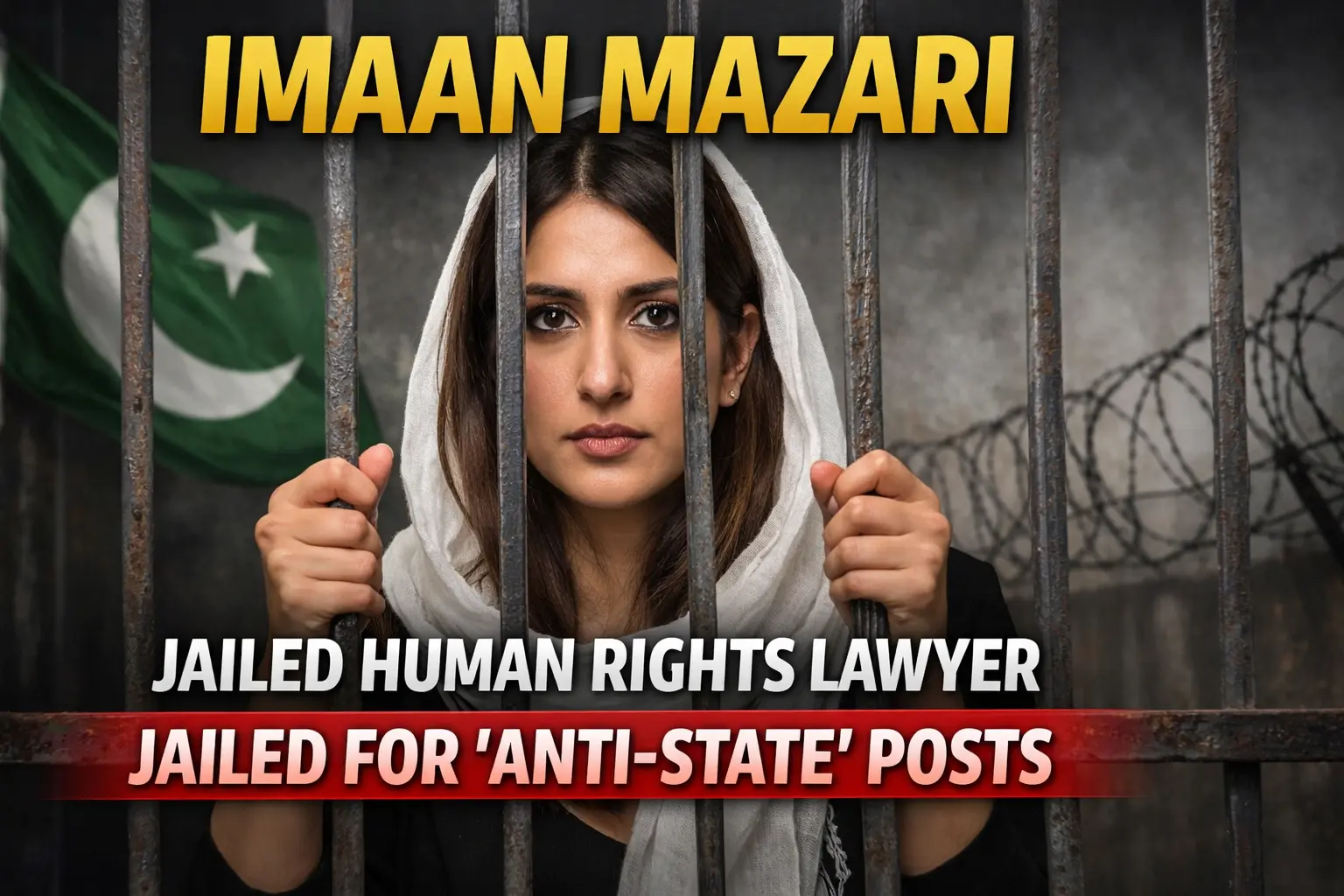
Who Is Imaan Mazari? A Voice of Dissent in Pakistan’s Legal Landscape
Imaan Mazari has emerged as one of Pakistan’s most prominent and outspoken human rights lawyers, known for her fearless advocacy in some of the country’s most sensitive and politically charged cases. At just 32 years old, Mazari has built a reputation that extends well beyond courtrooms—into the broader struggle for civil liberties, freedom of expression, and minority rights in Pakistan.
Her recent sentencing to a 10-year prison term for what authorities describe as “anti-state” social media posts has once again thrust her into the national and international spotlight, raising urgent questions about dissent, digital expression, and the shrinking space for human rights activism in the country.
Early Life and Influences
Imaan Mazari comes from a family deeply rooted in public service and human rights. She is the daughter of Shireen Mazari, Pakistan’s former federal minister for human rights, and her late father was widely regarded as one of the country’s leading paediatricians. Growing up in an environment where public debate, policy, and social justice were everyday conversations shaped her worldview early on.
Despite her privileged background, Mazari chose a path that placed her directly in confrontation with powerful state institutions. She pursued her legal education at the University of Edinburgh, where she honed her understanding of constitutional law, international human rights frameworks, and civil liberties—tools that would later define her professional life.
A Career Built on Controversial Cases
Mazari’s rise to prominence did not come through high-profile corporate cases or political patronage. Instead, she deliberately aligned herself with those on the margins of Pakistani society.
As a pro bono lawyer, she has represented:
- Ethnic minorities, particularly Baloch activists, in cases of enforced disappearances
- Journalists facing defamation, sedition, or cybercrime charges
- Individuals accused of blasphemy—one of the most dangerous and inflammatory allegations in Pakistan
- Afghan refugees and migrants targeted during state crackdowns
Among her most notable clients is Mahrang Baloch, a leading voice against enforced disappearances in Balochistan. By taking on such cases, Mazari positioned herself as what one journalist described as “a constant challenge for the state.”
Growing Friction with the State
As her legal activism expanded, so did the legal pressure against her. Over the years, Mazari has faced multiple cases, including allegations of “cyber terrorism,” “hate speech,” and violations under Pakistan’s cybercrime laws. Rights groups have repeatedly warned that such charges are often vaguely defined and selectively enforced against critics.
The tipping point came in January 2026, when she and her husband, fellow lawyer Hadi Ali Chattha, were arrested while heading to court to face charges related to social media posts critical of the military. An Islamabad court later sentenced the couple to 10 years in prison, ruling that Mazari had “disseminated highly offensive” and “anti-state” content online.
The verdict sparked outrage among civil society groups, journalists, and international observers, many of whom see the case as emblematic of Pakistan’s tightening control over dissent.
“We Will Not Back Down”
Mazari’s response to her sentencing has been consistent with her public persona—defiant, composed, and resolute.
“Truth seems overwhelmingly difficult in this country,” she told AFP in court. “But we knew that when we got into this work. We’re ready to face that. We will not back down.”
Her refusal to retreat has drawn comparisons to Asma Jahangir, Pakistan’s late and legendary human rights lawyer. Mazari has described such comparisons as “a huge honour and a privilege,” acknowledging the legacy she is often measured against.
International Recognition and Backlash
Despite domestic legal pressure, Mazari’s work has earned global recognition. In 2025, she received the Young Inspiration Award from the World Expression Forum for her “extraordinary courage, integrity, and impact in the struggle for the rule of law and justice.”
The same year, the United Nations special rapporteur on human rights defenders expressed concern that cases against her appeared to reflect “an arbitrary use of the legal system to harass and intimidate.”
However, criticism has not only come from courts. In January 2026, Pakistan’s military spokesperson, Ahmed Sharif Chaudhry, publicly cited one of her social media posts while accusing unnamed “hidden elements” of using human rights and democracy as a cover to promote terrorism—remarks widely interpreted as targeting Mazari.
Gender, Harassment, and Digital Attacks
Mazari’s activism has also exposed her to gender-based abuse. She has faced sexist remarks, doctored images, and sustained online harassment—a common reality for outspoken women in Pakistan, where female participation in public life remains limited.
Rather than silencing her, these attacks have reinforced her critique of both state power and societal norms that seek to marginalize women’s voices.
A Broader Crisis of Civil Liberties
Mazari’s imprisonment cannot be viewed in isolation. Legal experts and analysts argue that recent constitutional amendments and fast-tracked legislation have expanded state authority while eroding political and civil rights.
Journalist Asad Ali Toor, whom Mazari represented in several cases, has said her legal work threatens the state precisely because she represents “everybody who is directly or indirectly on the receiving end of the state.”
Resistance from Behind Bars
Despite incarceration, Mazari has made it clear that her commitment remains unchanged. Alongside her husband, she insists that unlawful detention will not deter their mission.
“We’re not the first people who will be unlawfully incarcerated in this country,” she said. “We will keep fighting.”
For supporters, Imaan Mazari represents more than an individual legal battle—she symbolizes the resilience of dissent in an increasingly constrained civic space. For critics, she remains an uncomfortable reminder that challenging authority, even through the law, carries heavy consequences in Pakistan today.
Whether behind bars or back in court, Imaan Mazari’s story continues to shape the debate over justice, free expression, and the future of human rights in Pakistan.