Modern passenger jets routinely cruise at altitudes above 30,000 feet, far higher than the human body can tolerate without assistance. At those heights, the air is simply too thin to provide enough oxygen, which is why aircraft cabins must be pressurized. For decades, the aviation industry settled on a compromise: instead of pressurizing cabins to sea-level conditions, most widebody aircraft were set to an equivalent altitude of around 8,000 feet. This balance reduced stress on the fuselage while keeping passengers reasonably comfortable.
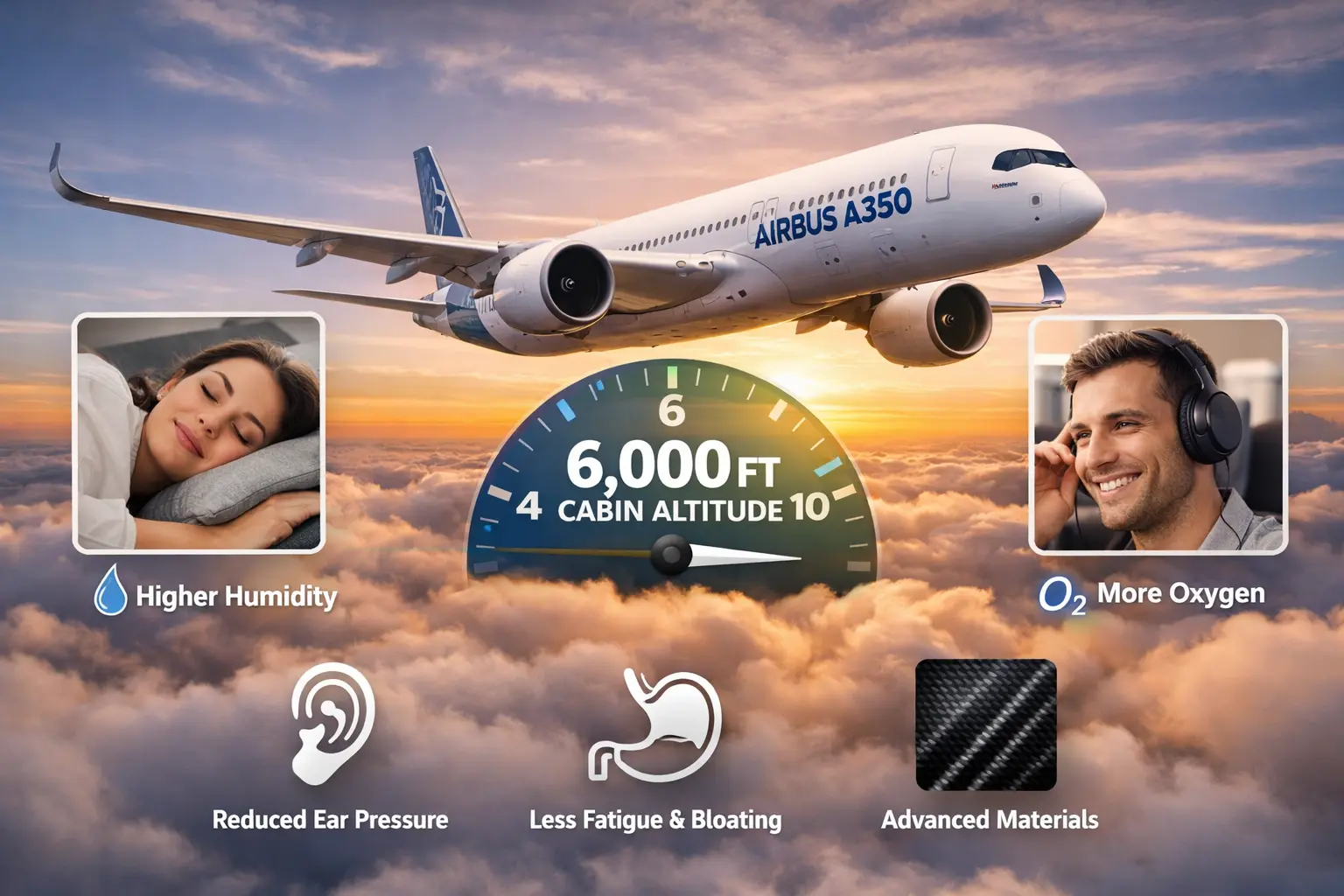
However, newer aircraft such as the Airbus A350 have changed the game. By using advanced materials and innovative engineering, the A350 maintains a significantly lower cabin altitude—around 6,000 feet—bringing noticeable benefits for passengers on long-haul flights.
Why Cabin Altitude Matters
To understand why a lower cabin altitude is important, it helps to think about how the human body reacts to pressure changes. An 8,000-foot cabin altitude is roughly equivalent to being in Aspen, Colorado. Most healthy people can tolerate this without serious issues, but it still represents a drop in oxygen levels compared to sea level.
At this altitude, passengers may experience increased fatigue, mild headaches, dehydration, or digestive discomfort. Jet lag, often blamed solely on time zone changes, can actually be worsened by reduced blood oxygen levels. Some people also experience bloating or flatulence due to pressure changes affecting gases in the digestive system. Others may feel ear discomfort during climb and descent, a condition known as ear barotrauma. In rare cases, trapped air in dental work or sinus cavities can even cause sharp pain.
Lowering the cabin altitude to 6,000 feet reduces these effects. Oxygen saturation in the blood improves, pressure changes are gentler, and the overall physical stress of flying is reduced—especially on flights lasting 10 hours or more.
The Airbus A350’s Cabin Pressure Advantage
The Airbus A350, which entered commercial service in 2015, was designed from the ground up as a next-generation widebody aircraft. One of its standout features is its higher cabin pressure, typically equivalent to about 6,000 feet, with some reports suggesting it can be as low as 5,500 feet.
This improvement directly addresses many of the discomforts associated with traditional 8,000-foot cabins. Passengers often report feeling less tired, experiencing fewer headaches, and noticing reduced ear pressure. Digestive discomfort is also less common, making the overall flight experience smoother and more pleasant.
The Role of Advanced Materials
The key enabler behind the A350’s lower cabin altitude is its extensive use of advanced materials. Around 53% of the aircraft’s structural weight is made up of carbon-fiber reinforced plastic (CFRP), with another 14% coming from titanium. In total, about 70% of the A350’s structure uses advanced materials.
Traditional aluminum fuselages are more susceptible to fatigue caused by repeated pressurization cycles. Over time, this limits how much pressure differential they can safely handle. Composite materials like carbon fiber are far more resistant to fatigue and corrosion, allowing the fuselage to withstand higher internal pressures without compromising structural integrity.
For airlines, this means lower maintenance costs and longer service life. For passengers, it translates directly into a more comfortable cabin environment.
Higher Humidity for Long-Haul Comfort
Cabin pressure isn’t the only area where the A350 improves passenger comfort. Another major upgrade is cabin humidity. On older aircraft, cabin humidity can drop as low as 5%, far drier than most deserts. This dryness can cause irritated eyes, dry skin, sore throats, and dehydration, all of which contribute to fatigue.
The Airbus A350 uses an inflight humidification system that raises cabin humidity levels to around 20–23%. While still lower than typical indoor environments on the ground, this is a substantial improvement over older designs. Higher humidity helps passengers stay hydrated, reduces dryness-related discomfort, and can even improve the perception of taste and smell during the flight.
Composite materials again play a role here. Unlike aluminum, they are far less prone to corrosion, making it safer to operate cabins with higher humidity over long periods.
Incremental Improvements Over Time
Airbus continues to refine the A350 platform. In recent years, updates have included weight reductions, improved takeoff performance, and a higher maximum takeoff weight. These changes benefit airlines operationally while also allowing for cabin enhancements.
Cabin refinements include slightly increased interior width, more flexible seating layouts, and optional third-generation electro-dimmable windows. These windows can block nearly all visible and infrared light, helping keep cabin temperatures comfortable and giving passengers better control over their environment.
Even small changes—such as a few extra inches of cabin width—can make a noticeable difference, allowing airlines to install industry-standard seat widths without sacrificing layout efficiency.
How the A350 Compares to Other Widebodies
The Boeing 787 Dreamliner was the first commercial aircraft to introduce a 6,000-foot cabin altitude, setting a new benchmark in passenger comfort. The upcoming Boeing 777X is expected to follow the same standard, combining lower cabin altitude with improved humidity and reduced noise.
In contrast, the Airbus A330neo, while modern and efficient, is based on an older design and typically operates with a cabin altitude between 7,000 and 8,000 feet. This highlights how clean-sheet designs like the A350 and 787 have greater flexibility to push comfort boundaries.
A New Standard for Passenger Experience
Higher cabin pressure and increased humidity are quickly becoming the norm for long-haul travel. As fleets modernize and older aircraft are retired, more passengers will experience the benefits of these advancements without even realizing it. They’ll simply arrive feeling less exhausted, less dehydrated, and more ready to adapt to their destination.
The Airbus A350 exemplifies this shift. By combining advanced materials, thoughtful engineering, and a focus on passenger well-being, it delivers one of the most comfortable flying experiences available today. While future aircraft may push these limits even further, the A350 has already set a high bar—one that reflects how far commercial aviation has come in balancing efficiency with human comfort.