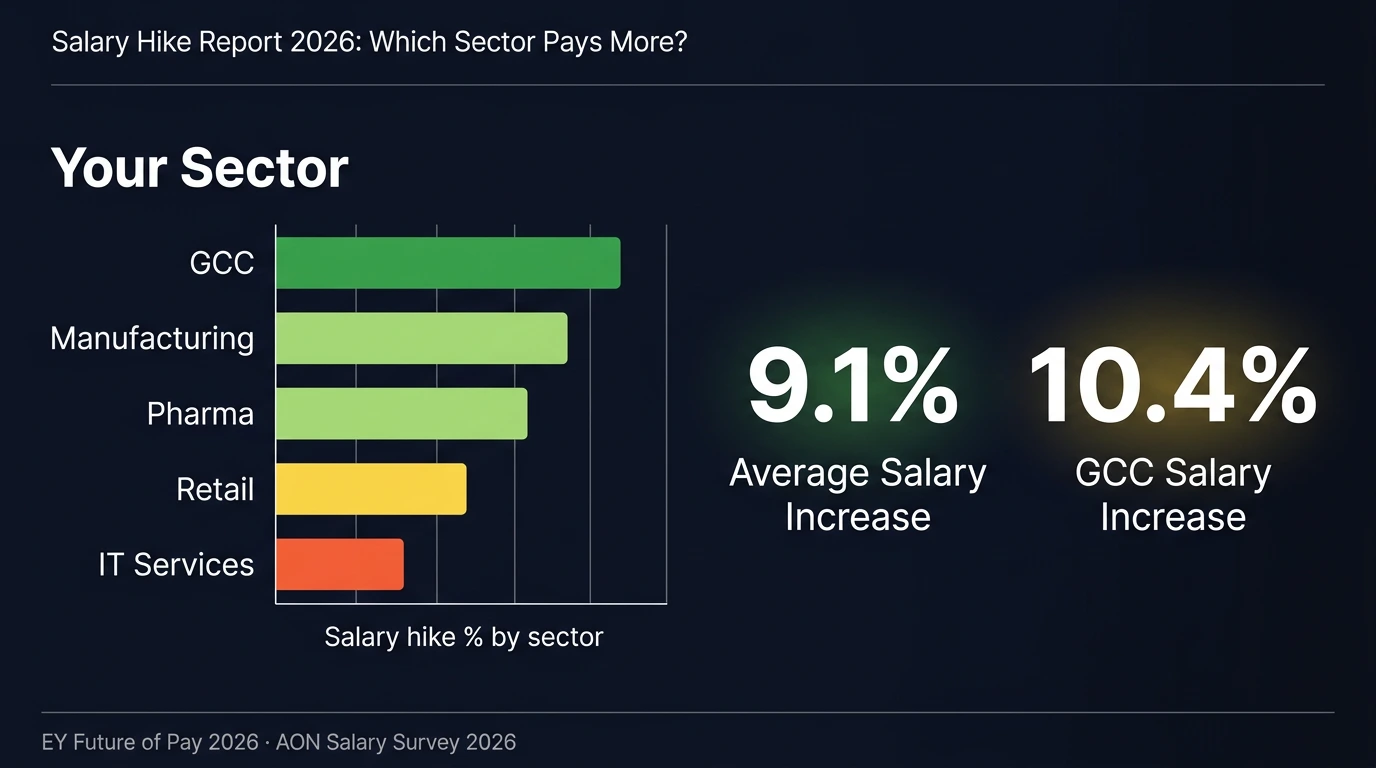
India’s average salary hike in 2026 is 9.1%, according to EY and AON reports. But that number hides a wide gap. GCC professionals are getting 10.4%. IT services employees are seeing as low as 7%. And professionals with AI, cloud, or cybersecurity skills are walking away with 30–40% more than their peers.
Appraisal Season Is Here — And the Gap Has Never Been Wider
It is April. Performance reviews are happening across India. Managers are scheduling one-on-ones. Increment letters are being prepared.
But here is what most people do not know going into this cycle: the 9.1% average India is talking about is almost meaningless for individuals.
Two people at the same company, same level, and same years of experience can walk away with completely different numbers this year. One gets 12%. The other gets 6%. The difference is not seniority. It is not loyalty. It is skills and sectors.
Here is the full picture, by sector, by skill, by profile.
The Sector-by-Sector Breakdown
The most important thing to understand first: which industry you work in matters more than which company you work for.
According to EY’s Future of Pay 2026 report based on data from hundreds of Indian organizations, here is how sectors stack up:
| Sector | Projected Hike 2026 |
|---|---|
| Global Capability Centres (GCCs) | 10.4% |
| Financial Services | ~10% |
| E-Commerce | 9.9% |
| Life Sciences & Pharma | 9.7% |
| Real Estate & Infrastructure | 10.2% (AON data) |
| NBFCs | 10.1% (AON data) |
| Engineering & Manufacturing | 9–9.5% |
| Automotive | 8.9% |
| IT Services | ~7% |
The spread between the highest and lowest sectors is now over 3.5 percentage points, the widest divergence India has seen in recent years, per AON’s longitudinal analysis.
If you are in IT services, 2026 is a weak appraisal year. If you are in GCC, financial services, or e-commerce, you are in one of the best sectors for increment growth right now.
Why GCCs Are Paying More Than Everyone Else
GCCs, Global Capability Centres set up by multinational companies in India, are consistently outpaying traditional IT firms, and the gap is widening.
The reason is simple: GCCs are competing for the same talent that product companies and startups want. They cannot afford to be stingy.
GCCs also reported the lowest attrition in India at 14.1%, compared to 24% in financial services and 20.5% in IT. This is not a coincidence. Higher hikes lead to people staying. People staying leads to knowledge retention and better outcomes. Companies that understand this cycle are investing in it.
If you have 3–8 years of experience and are sitting in a traditional IT services company, the data strongly suggests your earning potential is higher in a GCC role even in the same city, same function.
The Skill Premium Nobody Is Talking About Loudly Enough
Here is the shift that changes everything in 2026: pay is no longer just about your role. It is about your skills.
According to EY, nearly 45–50% of Indian organisations are now moving to skill-based pay frameworks. And the premium for the right skills is not marginal, it is substantial.
AI, GenAI, machine learning, cybersecurity, and cloud skills now command 30–40% salary premiums above base increments. That means while your colleague with a similar title gets 9%, you get 12–13% simply because you have demonstrated AI proficiency.
One Bengaluru-based AI firm replaced traditional increment bands with “skill tokens.” Employees who certified in new AI tools received on-the-spot mid-year increments of up to 8%. Attrition at the firm dropped from 24% to 11% in a single year.
This is not an outlier. It is the direction the market is moving.
Top Performer vs. Average Performer: The Gap Is Now 2x
The era of “everyone gets roughly the same hike” is ending fast.
According to EY’s 2026 report, outstanding performers in India are now receiving 1.5 to 1.6 times the increment of those who simply meet expectations.
In practice: if the company’s average hike is 9%, a top performer may get 13–14%. An average performer may get 6–7%. At the same company. In the same quarter.
Variable pay is also climbing. It now accounts for 16.1% of fixed compensation, up from 14.8% last year. Top performers earned 120–150% of their target variable payout. Average performers earned just 60–80%.
This matters more than the base percentage. If you are going into your appraisal conversation thinking “I’ll get the standard hike,” you may be leaving money on the table.
What Most Professionals Are Getting Wrong This Appraisal
The biggest mistake people make is walking into appraisals without data.
Your manager has data. HR has salary benchmarks. If you walk in with “I feel I deserve more,” you will get the standard number.
The professionals who negotiate effectively in 2026 come prepared with three things:
- Quantified impact: not what you did, but what it resulted in. Revenue influenced. Cost saved. Time reduced. Companies reward productivity multipliers.
- Market benchmark data: what your role pays in your sector and city right now. AON and EY publish this. Use it.
- Skill evidence: a certification, a project, a deployed tool. AI and cloud skills are specifically rewarded right now. If you have them and have not mentioned them, you are leaving a 30–40% premium on the table.
Quick Checklist: Before Your Appraisal Meeting
- Know your sector’s benchmark hike (use the table above as a reference)
- List 3 outcomes from your work this year with numbers, not just activities
- Check if you have any AI, cloud, or automation skills you have not formally highlighted
- Review your variable pay target and whether you have documented evidence of exceeding it
- Research what GCCs or competing firms pay for your role, this is your negotiating floor
- If your sector hike is trending below 9%, start exploring GCC and fintech openings in parallel
FAQ
Is 9.1% a good hike in 2026?
On paper, yes, it is above inflation, which is projected at around 2% for FY26. But in practice, it depends on your sector. IT services professionals at 7% are effectively getting one of the lowest real hikes in years. GCC professionals at 10.4% are doing significantly better.
Which sector gives the best hike in India in 2026?
GCCs lead at 10.4% per EY, followed by real estate and infrastructure at 10.2% per AON, and financial services at around 10%. E-commerce at 9.9% and life sciences at 9.7% are also strong.
Does having AI skills really change your hike?
Yes, and significantly. EY’s report confirms a 30–40% skill premium for AI, GenAI, ML, cybersecurity, and cloud capabilities. This is not a future prediction. Companies are already deploying it in the current appraisal cycle.
What if my hike is lower than the sector average?
It is a direct signal. Either your performance documentation is weak, or your skills are not aligned with what the company is currently rewarding. Both are fixable, but not in hindsight after the letter is issued.
Is this a good time to switch jobs for a higher salary?
Attrition has declined to 16.4% in 2025, suggesting a more cautious job market. But GCCs and fintech are still hiring aggressively and offering 15–22% premiums over IT services. A lateral move with the right skill positioning can give you more than any appraisal cycle.
Conclusion: The Appraisal Map Has Been Redrawn
The 9.1% average tells you very little about what you will actually receive in 2026.
The real story is the growing gap between sectors, between skill levels, and between top and average performers. India’s compensation landscape is no longer designed for everyone to move forward together. It is designed to accelerate some and hold others still.
By 2027, skill-based pay frameworks will be the norm, not the exception. The professionals who start building evidence of AI, cloud, and data capabilities now, before the next cycle, will be on the right side of that divide.
The appraisal season happening right now is the first real test of that new reality.