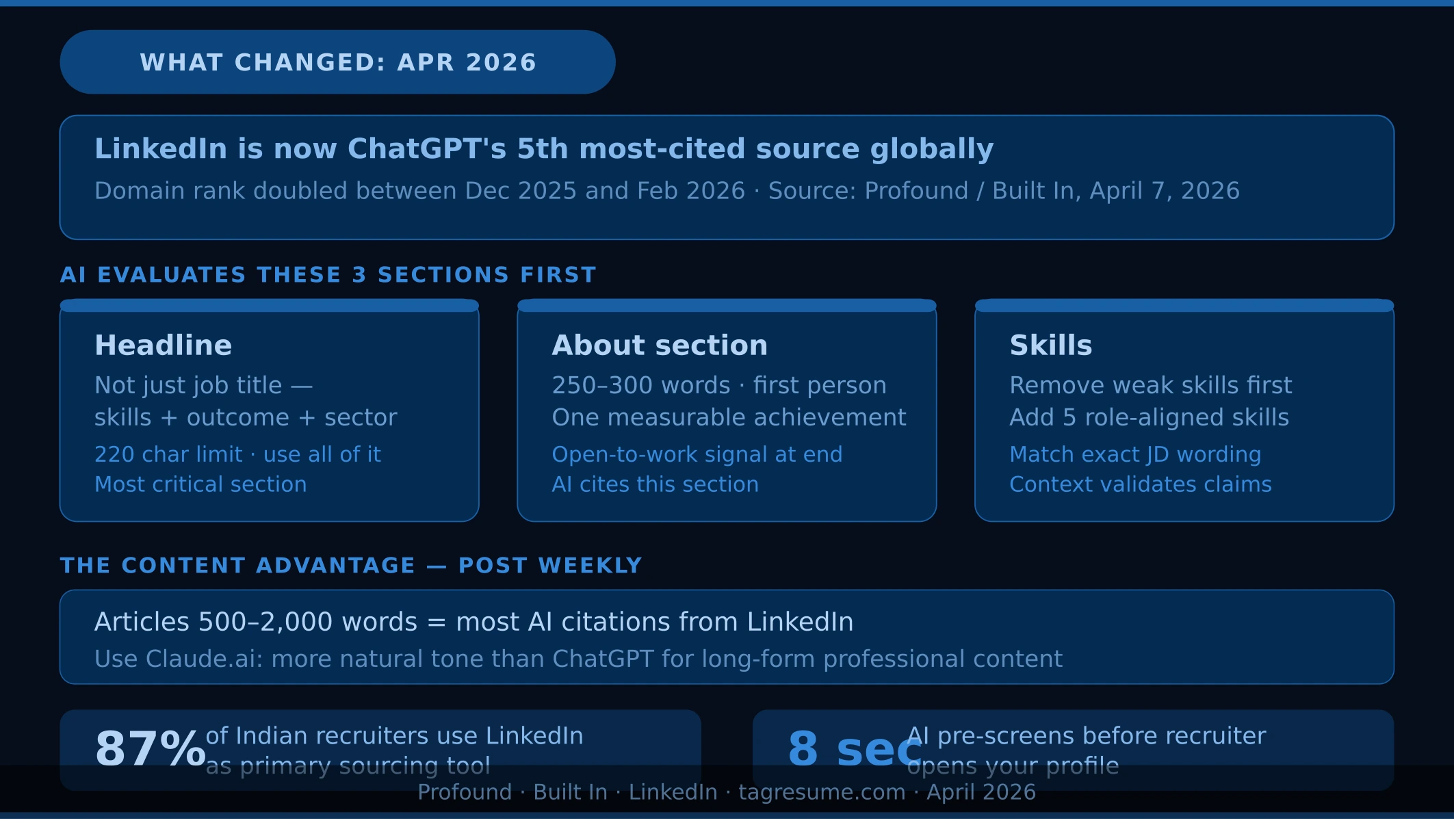
As of April 2026, LinkedIn has become the most cited professional source across AI tools, including ChatGPT and Google’s AI Overviews. Indian recruiters now pre-screen candidates using AI before opening a single profile. If your LinkedIn does not signal value to a machine first, a human recruiter may never see it.
AI Is Reading Your LinkedIn Before Recruiters Are
Something shifted on LinkedIn between December 2025 and February 2026 that most Indian professionals have not noticed yet.
LinkedIn more than doubled its domain rank on ChatGPT during this period, becoming the chatbot’s fifth-most-cited source globally. For professional-related queries, LinkedIn is now the most-cited domain across all AI search platforms, including Google’s AI Overviews.
What this means in practice: when a recruiter at a Bengaluru GCC, a Mumbai BFSI firm, or a Hyderabad startup asks ChatGPT or LinkedIn’s own AI hiring tools to find candidates for a role, your profile’s content determines whether you appear at all.
AI tools now pre-screen candidates before a human recruiter even sees your profile. LinkedIn’s algorithm prioritises skill matches over job titles.
How LinkedIn’s AI Actually Evaluates Your Profile in 2026
The old LinkedIn worked like a search engine, it matched keywords. Type “product manager” and profiles with “product manager” appeared.
The 2026 version is fundamentally different. LinkedIn’s knowledge graph now maps what it calls semantic relevance, understanding the relationships between skills, titles, and industries. If your profile says “Python” but has no surrounding context like “data pipelines,” “pandas,” or “ML models,” the algorithm treats the claim as shallow and deprioritizes your profile.
Simply listing “Python” on your profile is worth almost zero in 2026. LinkedIn now looks for what it calls “Entity Associations”, if you claim Python skills, the AI looks for posts you’ve written about Python, endorsements from people with higher Python scores, and projects in your experience that mention it.
The implication: a vague but complete profile scores lower than a specific but shorter one.
The Three Sections That Matter Most
Recruiters and LinkedIn’s own AI evaluate profiles differently, but they align on three sections that carry the most weight:
1. The Headline
Your first two lines must explain what you solve, not your title. A headline that says “Senior Software Engineer at TCS” tells the algorithm your employer. It says nothing about your value.
A headline that works in 2026: “Senior Software Engineer | React, Node.js, AWS | Building scalable SaaS for BFSI | Open to Product Company Roles.”
Use Claude.ai or ChatGPT to generate headline options with this prompt:
“Write 5 LinkedIn headline options for a [your title] with [X years] experience specialising in [2–3 skills]. Each must be under 220 characters. Include specific tools and one outcome or sector. Avoid these words: passionate, dynamic, results-driven.”
2. The About Section
LinkedIn posts and long-form articles between 500 and 2,000 words make up the majority of AI citations. Content that shares practical, relevant advice is cited most by AI search tools.
Your About section should follow the same principle. Aim for 250–300 words written in first person. Open with the problem you solve. Include one measurable achievement. End with what you are open to. Include role-specific keywords naturally, not as a list at the bottom.
Claude.ai prompt for the About section:
“Write a LinkedIn About section for a mid-career [your role] in India with [X years] experience. Specialisations: [list]. Key achievement: [one specific result with a metric]. Tone: confident, direct, first person. Length: 270 words. Avoid any AI clichés. End with what roles or opportunities I am open to.”
3. Skills quality over quantity
Remove 5 weak skills today. Add 5 role-aligned skills pulled from 3 job descriptions you are actually targeting. This single action meaningfully improves your AI match score.
Most Indian professionals on LinkedIn have 30–50 skills listed. The algorithm interprets a long, unfocused skills list as a diluted signal, not evidence of breadth.
The Content Advantage Most Professionals Ignore
Users who post on LinkedIn are also able to influence how a given topic is explained by AI, which can be a powerful tool for building your professional brand and getting noticed in your industry.
This is the sharpest edge available to Indian mid-career professionals right now. Posting one specific, insight-led article per week about your domain, BFSI fraud detection, cloud migration for Indian enterprises, GCC talent strategy, signals to both LinkedIn’s algorithm and AI tools that you are an active practitioner, not a passive profile.
Use Claude.ai for this with a specific prompt:
“Write a 600-word LinkedIn article about [specific industry trend in your domain] from the perspective of a practitioner with [X years] experience in India. Include one data point, one real example, and one practical takeaway. Tone: professional but conversational. No motivational language.”
Claude.ai consistently produces more natural, narrative-driven writing than ChatGPT for this type of content, useful because AI-sounding posts on LinkedIn have started to lose reach as the platform’s own detection improves.
Quick Checklist: LinkedIn Optimization for AI Visibility
- Rewrite your headline to include skills and outcome, not just job title
- Update your About section to 250–300 words in first person with a measurable achievement
- Remove unfocused skills, keep only role-relevant ones matching actual job descriptions
- Use “Open to Work” set to Recruiters Only, not the public green banner
- Post one insight-led article per week in your domain area (500+ words)
- Add context around every technical skill claim, tools, projects, outcomes
- Verify your LinkedIn URL is customized to your name, not the default numeric string
FAQ
How is LinkedIn profile optimization different in 2026 compared to 2023?
The algorithm shifted from keyword matching to semantic relevance. Having a keyword in your profile is no longer enough, the algorithm now checks whether your broader profile validates that claim through related skills, posts, and endorsements.
Should I use ChatGPT or Claude.ai for LinkedIn optimization?
Both work well. Claude.ai handles longer text inputs more reliably, useful when pasting a full profile alongside a job description. For headline generation and short summary writing, ChatGPT is equally effective. Many professionals use both in sequence.
Does posting on LinkedIn actually help recruiter visibility?
Yes, and the data from April 2026 makes this concrete. LinkedIn is now the most-cited professional source across AI tools. Profiles with active posting histories receive higher algorithmic weight in recruiter search results, independent of follower count.
How often should I update my LinkedIn profile?
Review your profile monthly and make updates quarterly at minimum. Add new skills, update your headline to reflect current goals, and refresh your about section when your focus changes. Recruiters notice profiles that show recent activity and current information.
Conclusion
The shift that happened between December 2025 and April 2026 is structural, not temporary. LinkedIn is now a source that AI systems actively read, cite, and use to answer professional queries. Your profile is no longer just for recruiters scrolling on a Tuesday afternoon.
It is being read by machines making candidate recommendations right now.
The Indian professionals who understand this are updating their profiles for semantic clarity, not keyword density. They are posting domain insights, not motivational quotes. And they are using Claude.ai and ChatGPT to sharpen their language, not replace it.
By 2027, optimizing for AI visibility on LinkedIn will be as standard as having a clean resume. The professionals who start now will have 12 months of algorithmic authority that cannot be replicated quickly.