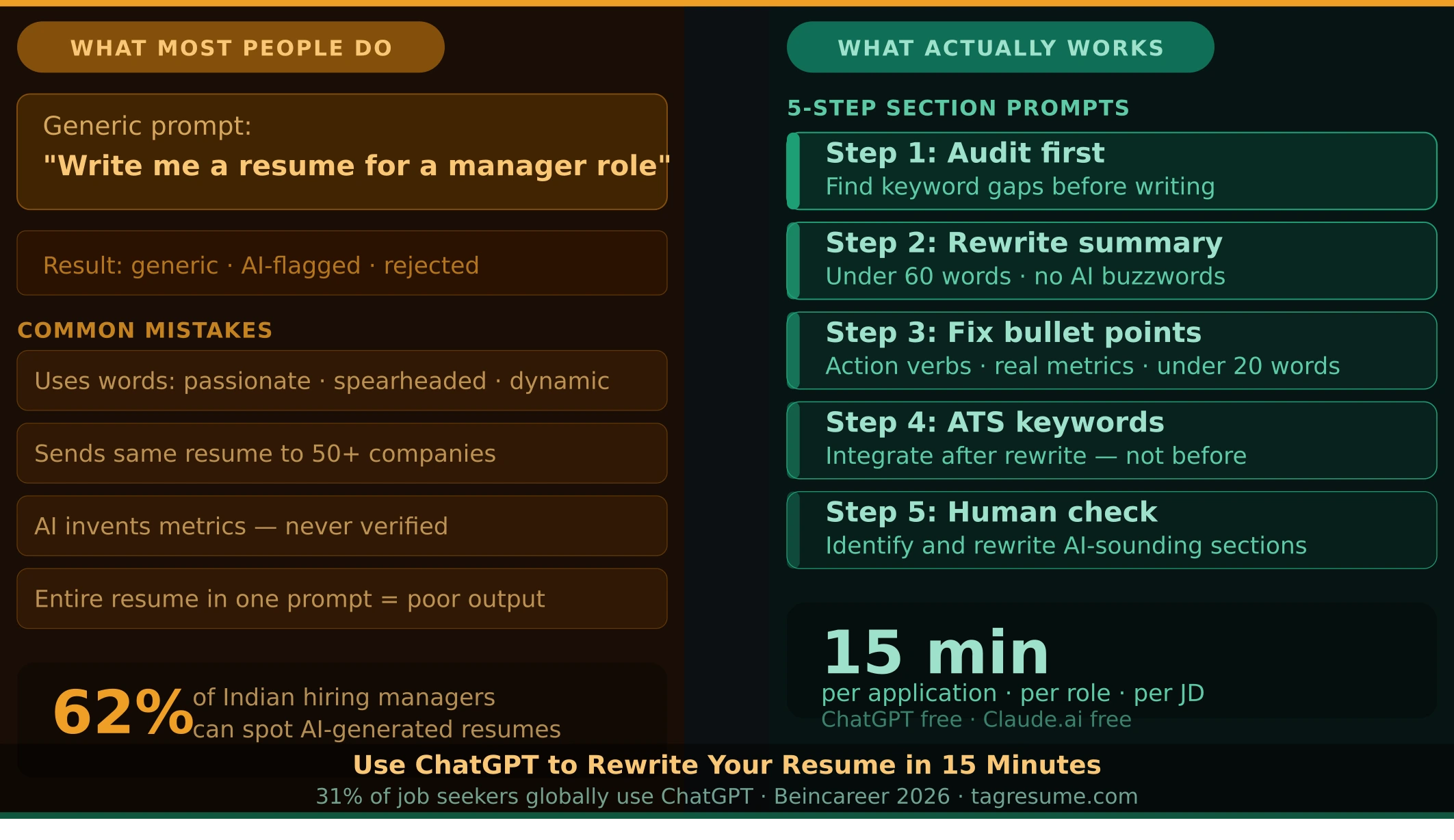
ChatGPT can rewrite your resume in under 15 minutes, but only if you use specific prompts. Generic requests produce generic output recruiters instantly recognize. These prompts are built for Indian mid-career professionals targeting IT, BFSI, and GCC roles, with ATS optimization built into each one.
By early 2026, 31% of job seekers globally use ChatGPT in their job search, up 7% from last year. Indian professionals who use AI strategically are landing interviews faster. Those who use it badly are generating resumes that recruiters flag immediately.
The difference is not which AI tool you use. It is what you ask it to do.
Why Most People Use ChatGPT Wrong for Resumes
Typing “write me a resume” into ChatGPT is the single biggest mistake mid-career professionals make. It produces generic output that reads like every other AI-generated document in the recruiter’s inbox.
The word “passionate” appearing in the first line. “Spearheaded” in every bullet. “Transformative” somewhere in the summary. Experienced Indian recruiters, especially at TCS Digital, Infosys BPO, GCC hiring desks, and BFSI firms, have seen this pattern so many times they now reject it on sight.
The fix is simple: treat ChatGPT as a writing collaborator, not a ghostwriter. Give it your actual data. Ask it to work on one section at a time. Then verify everything it produces.
The Section-by-Section Prompt System
Research from Upplai.com confirms that complex, multi-section prompts reduce ChatGPT’s output quality significantly. One section per prompt produces far better results. Here is the exact workflow for mid-career Indian professionals:
Prompt 1: Audit your resume first
Paste your resume and the job description, then use this:
“You are an ATS specialist for the Indian job market. Evaluate my resume against this job description. List the top keywords from the JD that are missing from my resume. Rate my overall job fit: High / Medium / Low. Do not suggest adding anything I have not actually done.”
This gives you a gap list before you write a single word. It also prevents the most common mistake, adding skills you do not have.
Prompt 2: Rewrite your professional summary
“Rewrite my professional summary for a mid-career [your role] applying for [specific role name]. I have [X years] of experience in [2–3 key skills]. My biggest achievement is [one specific metric-backed result]. Keep it under 60 words. Make it sound like a confident professional wrote it, not an AI. Remove any of these words if they appear: passionate, dynamic, driven, spearheaded, transformative, synergy.”
The instruction to remove specific words is not optional. Claude.ai and ChatGPT both default to these phrases. The instruction forces them out.
Prompt 3: Convert job duties into achievements
This is where most Indian resumes lose ground. Bullet points that say “responsible for managing team” or “handled client escalations” communicate nothing to an ATS or a recruiter.
“Rewrite these resume bullets using strong action verbs and measurable outcomes. Each bullet must be under 20 words. Where I have not provided a metric, suggest a realistic range I can verify and fill in — do not invent specific numbers. Target role: [paste role title]. My bullets: [paste your current bullets].”
The instruction to suggest ranges rather than invent numbers is critical. ChatGPT will hallucinate metrics if you do not constrain it. A fabricated “increased revenue by 47%” that the recruiter challenges in the interview ends the conversation immediately.
Prompt 4: ATS keyword integration
“Integrate these keywords naturally into my resume without changing factual content. Each keyword must appear at least once in the experience or skills section. Keywords: [paste the list from Prompt 1]. Resume: [paste current draft].”
Run this after Prompt 3. Do not run it first ATS optimization on weak bullet points produces keyword-stuffed text that still reads poorly.
Prompt 5: The human check
“Read this resume and identify any section that sounds like it was written by AI. Rewrite those sections to sound like a senior professional having a direct conversation, not a formal document. Keep all facts identical. Resume: [paste].”
This is the final filter. Sixty-two percent of Indian hiring managers say they can identify AI-generated resume content. This prompt addresses that gap.
What ChatGPT Cannot Do
Claude.ai handles longer inputs better than ChatGPT’s free tier, if your resume exceeds 2,000 words or you are pasting a long job description alongside it, Claude.ai processes the full context more reliably. For this reason, many mid-career professionals use ChatGPT for the rewrite and Claude.ai for the full document verification pass.
Neither tool should generate your metrics for you. If you increased process efficiency, you need to know by how much. ChatGPT can help you phrase it, it cannot invent it.
Quick Checklist: ChatGPT Resume Workflow
- Run Prompt 1 first audit before rewriting
- Provide your actual data in every prompt, never let AI guess
- Rewrite one section at a time, not the entire resume in one go
- Explicitly ban AI buzzwords in your prompt instruction
- Ask for metric ranges, not specific invented numbers
- Run the human-check prompt before saving the final version
- Check the final resume with a free ATS tool before applying
FAQ
Can ChatGPT write my entire resume from scratch?
Technically yes, but it should not. Resumes generated entirely by AI lack the specific context, real metrics, and authentic voice that Indian recruiters now screen for. Use ChatGPT to improve what you have, not replace your input entirely.
Is ChatGPT free for resume writing?
Yes. GPT-3.5 on ChatGPT’s free tier handles resume rewriting effectively. GPT-4o on the free plan also works for shorter documents. Claude.ai’s free tier handles longer context better, useful for pasting a full resume alongside a job description.
Will Indian recruiters know my resume was written with AI?
They may. The pattern of over-used phrases, perfectly uniform bullet lengths, and certain sentence structures are recognizable. Using the “human check” prompt (Prompt 5 above) significantly reduces this risk. Tailoring each application to the specific JD also differentiates AI-assisted resumes from generic AI output.
How long does this workflow take?
With the prompts above, a full resume audit and rewrite takes 15–20 minutes per application. The time investment is per role, one resume does not work for TCS Digital and a Goldman Sachs GCC simultaneously.
Conclusion
ChatGPT does not write better resumes. It helps you write your resume better, if you know how to direct it.
The professionals getting callbacks in 2026 are applying to fewer roles with sharper, more targeted resumes. They are spending 15 minutes with the right prompts rather than sending the same document to 50 companies.
By 2027, AI-assisted resume writing will be the norm, not the advantage. The window to differentiate through smart AI use is now, before everyone applies the same workflow and the output becomes indistinguishable again.